Category Archives: Info

Physics WA: Physics Performance Task: The “Physics Explained” Challenge

1. Task Overview

Total Marks: 30
Target Audience: Lower Secondary Students (Sec 1 & 2)
Group Size: 3 pax
Format: 90-second video

The Challenge
Your team must create an educational demonstration video to illustrate a Physics concept from a topic in the Sec 3 or Sec 4 syllabus. You must make the concept easy to understand, engaging,
and visually clear for a lower secondary student.

Submission Requirements

  • Each group must submit a 90 s video.
  • Originality: The video must be entirely your own work. Do not reuse videos from the internet or experiments already shown by your teacher in class.
  • Group introduction: At the start of the video, all members must appear on screen to introduce themselves.
  • Demonstration: You must use a real-life apparatus and setup.
    • Note: Animations/drawings are allowed for explanation only, not for the primary
      demonstration.
  • Captions: All speech must be captioned in the video.
  • Balanced participation: Every member must speak in the video, and speaking time should be roughly equal, no single member should dominate the presentation.
  • At the end of video, references and sources should be acknowledged.
  • Project brief to be submitted by the group leader by 9 Mar 2026 (Term 1 Week 10, Monday) for teachers’ approval.

401 Group / Topic Selection Form

409 Group / Topic Selection Form

  • The video should be submitted by the group leader via Google classroom to your Physics teacher by 13 April 2026 (Term 2 Week 4, Monday)

Links to be updated here nearer to submission due date

  • Peer assessment form must also be completed and submitted by each member by 13 April 2026. Link to the form will be provided by your subject teacher in due course.
    • Individual scores are subject to moderation based on peer assessment of contribution.


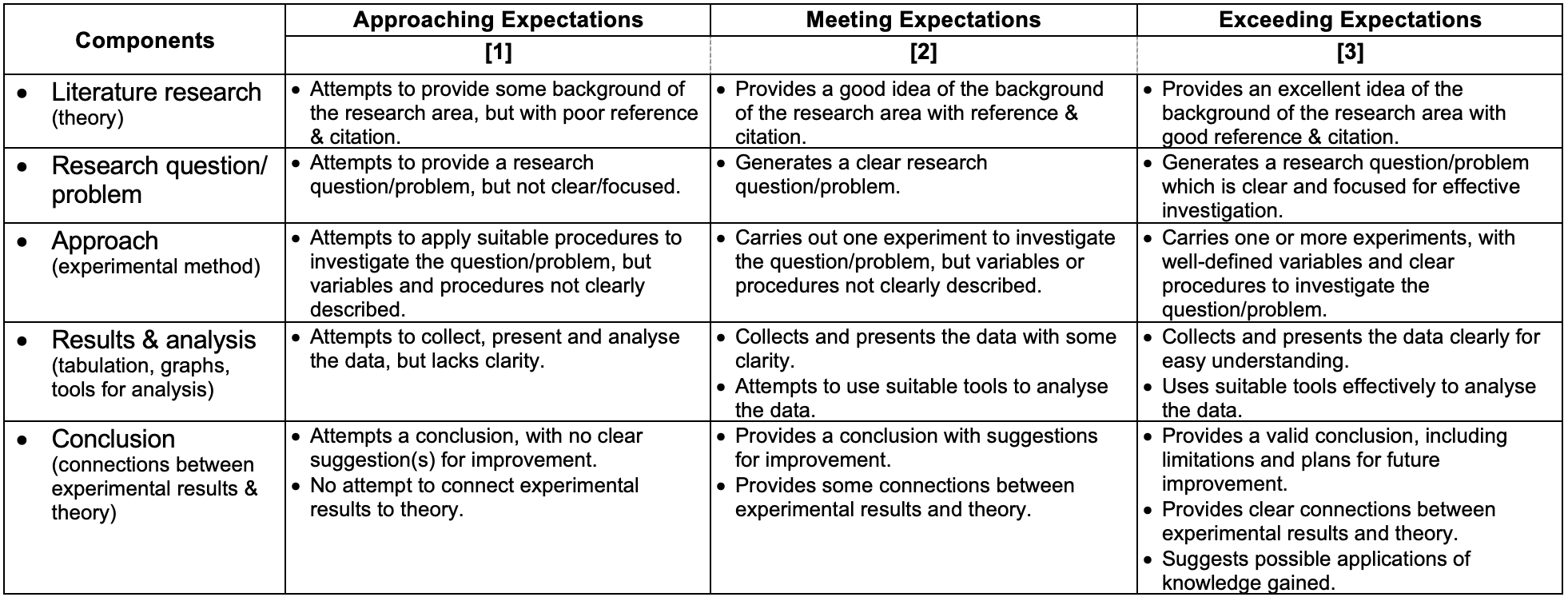
2. Assessment Rubrics (30 Marks)
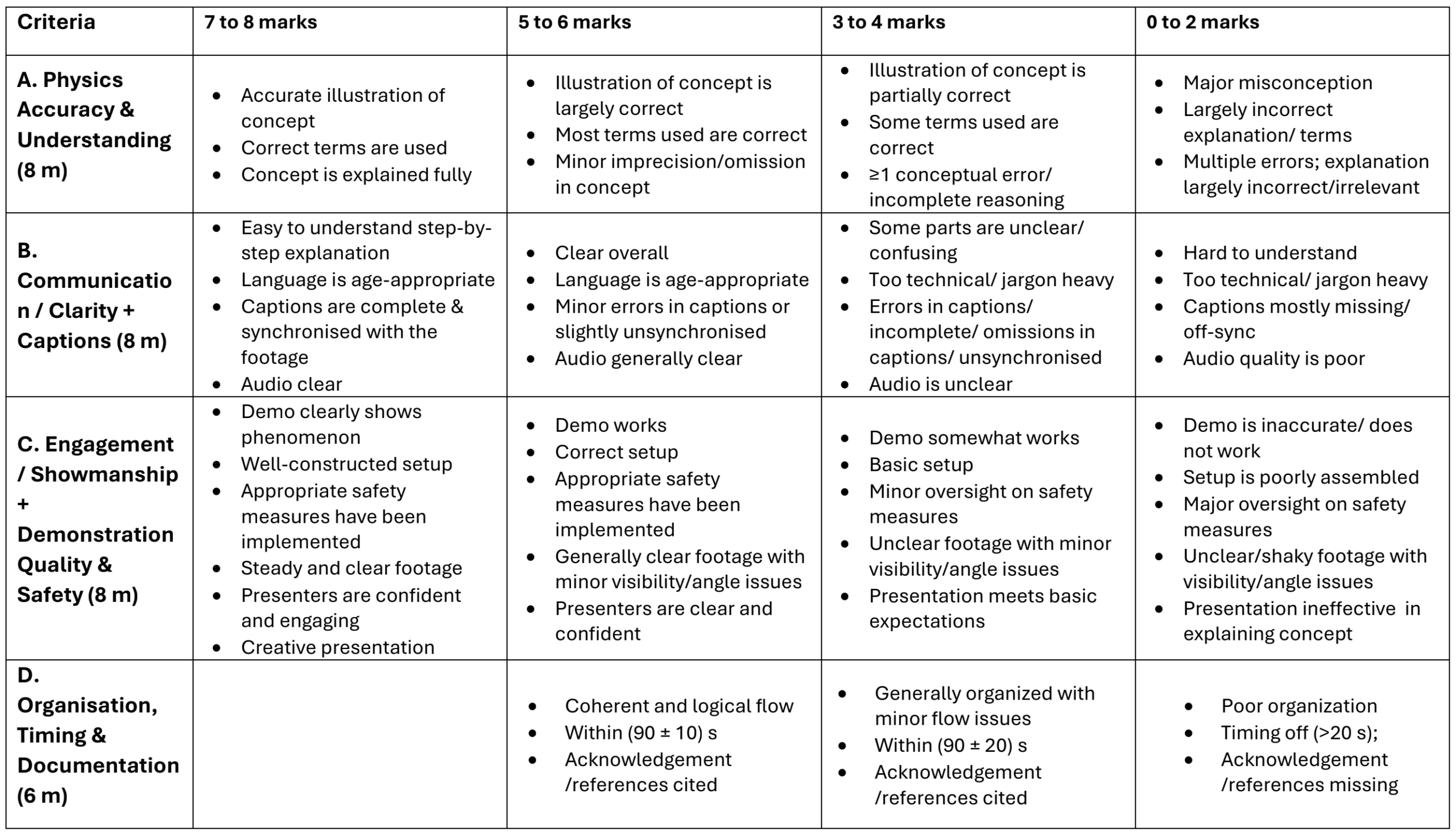
 

3. Student FAQ

  • Can I use AI to help me?
    You may use AI to brainstorm ideas or simplify your script. However, the final script must be your own work, and you cannot use AI-generated voiceovers.
  • Do we all need to be on camera?
    Only for the introduction at the start. After that, you may choose who demonstrates and who narrates.
  • Can I use a drawing for the experiment?
    No. The demonstration must be a real, physical setup. You can use drawings only to help explain the “non-visible” physics concepts (like force arrows or light rays).
  • What is the time limit?
    90 seconds. You have a 10 second buffer. Going significantly over or under will result in mark deductions.
  • Can we borrow equipment from the lab?
    No. Please source for your own equipment.


4. Checklist

  • All members introduced themselves on camera at the start.
  • The video is approximately 90 seconds long.
  • Every word spoken has a clear caption on screen.
  • The physics phenomenon is demonstrated with real objects.
  • The language is simple enough for a lower secondary student.
  • We have all submitted the peer review form.

PDF Version of this information

409 TASK: Electromagnetic Waves

In your assigned groups create a mini presentation on your assigned em wave to share during tomorrow’s lesson.

Group 1: Radio Waves & Microwaves

Group 2: Infrared (IR)

Group 3: Visible light

Group 4: Ultra-violet (UV)

Group 5: X-rays & Gamma Rays


Some questions to consider:

  1. How are the waves made/ created? (in nature and man-made)
  2. How are they detected?
  3. What are the typical wavelength and frequency of these waves.
  4. What are some typical uses /applications of these waves?
  5. Are there any dangers from exposure to these waves? How can risk be reduced?

Each group should create a presentation to share during tomorrow’s lesson:

    • Use diagrams/ photos/ images

    • Include real-life examples

    • Explain dangers clearly

    • Keep slides clear (not too wordy)

    • Speak clearly for 2–3 minutes


Sec 3 Advanced Physics Lessons on Thursday, 5 February

As mentioned earlier, Mr Shone will not be in school on Thursday, 5 February.

For Physics lesson that day, please move to the library (you are not allowed to remain in any labs unsupervised) and complete the following:

Assignment AS02_1 Optics (Reflection)

Assignment AS02_2 Optics (Refraction & TIR) (You should be able to at least answer Q1-3 at this point)

Application for DSO National Laboratories Research@YDSP Projects

Dear Sec 4 students

If you are a Singaporean and interested in undertaking a research project related to defence science, you are invited to apply for a research opportunity at DSO National Laboratories.

Research@YDSP (DSO) projects are nine-month project attachments which offer hands-on opportunities to work on defence-related projects, under the mentorship of top defence engineers, software developers, cybersecurity experts and research scientists from DSO.

The project details are listed in the microsite and as summarised below. The prerequisites for the projects are stated in the individual posting.

Project Title Project Details
Improving LIDAR using Quantum Illumination Link
Length-Preserving Encryption and its Applications to Full-Disk Encryption Link
Modernized Analysis of Attacks Against Triple-Encryption Link
Naval Platform Protection with the NEAT Algorithm Link
Passive Magnetic Measurements, Signal Processing And Motion Compensation Link
Wideband Monopole Antenna and Methods to Enhance its Performance Link

Read the following carefully:

  1. Applications must be Singapore Citizens & Sec 4 students.
  2. All applicants are to directly apply for the project(s) that they are interested in via the posting(s) at the microsite.
  3. If you wish to form your own teams, you may include your team members’ names in the application form. However, each student should submit their individual application. They will be assessed individually.
  4. Each student can apply for no more than 2 projects.

You may visit this link to have a glimpse of what a day in the life of a DSO student researcher is like.

Deadline for application is 20 February 2026.

The Science Department would like to support you in your application by providing advice on your write-up before you submit. Please reply to me by 6 February 2026, Friday to indicate your interest to apply. I will then share with you a google doc link to draft your application.

Regards

Mr Shone

(***Copy of email sent out to all Sec 4 students on 18 January***)

Training for Singapore Junior Physics Olympiad (SJPO)

Dear Sec 3 Advanced Physics Students,

The school is planning Training Sessions for those interested in participating in the Singapore Junior Physics Olympiad (SJPO) this year.

We would recommend the training sessions to those with very strong foundations in Physics and Maths and a strong passion to study Physics. The material is higher level than Secondary School Physics lessons. Much of the material would be found in an A level Course.

You should only sign up if you are able to fully commit to the schedule (see FAQ) and attend all of the training sessions. Please make sure the dates do not clash with your other commitments such as other Olympiad trainings, 3rd Language lessons, AEP lessons, or CCA, etc.

Interested students should complete the following form: https://forms.gle/UoNySezAGDvdRr2R6  (by Monday, January 26) so that we can get an indication of the numbers.

Regards,

Your Physics Teachers

Commonly asked FAQs

1. What is SJPO?

SJPO is an annual Physics Competition organised by the Institute of Physics Singapore. More details can be found at https://ipssingapore.org/events/SJPO.html.

2. What material will be covered in the Training Sessions?

The syllabus for SJPO can be found here: https://ipssingapore.org/events/SJPO.html. The training sessions will cover Physics and Maths topics to help prepare for the SJPO.

3. What are the training times / dates?

The sessions will be conducted on Monday afternoons, 3:30 pm – 5:00 pm in Physics Lab 4. The proposed dates for training being:


Date Session Time
2-Feb session 1 3.30pm to 5pm
9-Feb session 2 3.30pm to 5pm
16-Feb ELD
23-Feb session 3 3.30pm to 5pm
2-Mar session 4 3.30pm to 5pm
9-Mar session 5 3.30pm to 5pm
16-Mar Mar holidays
23-Mar  Hari Raya holiday
30-Mar session 6 3.30pm to 5pm
6-Apr session 7 3.30pm to 5pm
13-Apr session 8 3.30pm to 5pm
20-Apr session 9 3.30pm to 5pm
27-Apr session 10 3.30pm to 5pm
4-May session 11 3.30pm to 5pm
11-May session 12 3.30pm to 5pm

*these may change due to unforeseen circumstances.

4. What is the cost?

The cost of the training sessions will be borne by the school. However, you will be expected to participate in SJPO and will be required to pay for entry to that competition.

5. Do I have to attend these Training Sessions to be able to participate in the Singapore Junior physics Olympiad (SJPO) competition?

No. A separate email will be sent out for registration to SJPO as soon as we have details.

6. How many places are available in the training sessions?

Numbers have not been fixed yet. If there is a larger number of students interested in the Training Sessions than places available then we will ask for recommendations from your Physics teachers.

Young Defence Scientists Programme (YDSP) World of Science (WOS) module for Sec 3

Dear Sec 3 Advanced Physics students,

Our school is invited to nominate Singaporean students for the Young Defence Scientists Programme (YDSP) World of Science (WOS) modules.

WOS is a series of hands-on STEM-related enrichment modules that allow students to discover advanced topics in Physical Sciences to Information Technologies critical to Singapore’s defence. There are a total of 8 exciting WOS enrichment modules this year:

But Only ONE Module is open to Sec 3 Students 

  • Cryptography

To help you better understand the modules, please refer to the microsite for more details. You may also refer to the LinkedIn video link here for the key highlights of past runs of WOS.

A Certificate of Participation will be given to students who achieve 100% attendance for the modules. You may select up to three modules according to your preference. If selected, you will only attend ONE module. Successful allocation is subject to the enrolment demand of each module as well as the suitability of students based on the quiz attempted (for selected modules).

Kindly indicate your interest for nomination by completing this form no later than Tuesday, 3 February 2026. Please ensure that you select only modules you can commit to attending for their entire duration (check your parents do not intend to take you on holiday during the dates of the module). Note that once enrolled, withdrawals from modules will not be allowed. I encourage you to carefully consider your availability before submitting your interest.

Regards,

Mr Shone

(Modified from an email I sent out on 15 January to Sec 4 Students)

Young Defence Scientists Programme (YDSP) World of Science (WOS) Modules

Dear Sec 4 students,

Our school is invited to nominate Singaporean students for the Young Defence Scientists Programme (YDSP) World of Science (WOS) modules.

WOS is a series of hands-on STEM-related enrichment modules that allow students to discover advanced topics in Physical Sciences to Information Technologies critical to Singapore’s defence. There are a total of 8 exciting WOS enrichment modules this year:

  • Remote Sensing Technologies
  • Robotics
  • Quantum Technologies
  • EM Waves Unleashed: Electromagnetics and the Science Behind Wireless Communications
  • Cryptography
  • Computer Security
  • Artificial Intelligence
  • Aerodynamics

To help you better understand the modules, please refer to the microsite for more details. You may also refer to the LinkedIn video link here for the key highlights of past runs of WOS.

A Certificate of Participation will be given to students who achieve 100% attendance for the modules. You may select up to three modules according to your preference. If selected, you will only attend ONE module. Successful allocation is subject to the enrolment demand of each module as well as the suitability of students based on the quiz attempted (for selected modules).

Kindly indicate your interest for nomination by completing this form no later than Tuesday, 3 February 2026. Please ensure that you select only modules you can commit to attending for their entire duration (check your parents do not intend to take you on holiday during the dates of the module). Note that once enrolled, withdrawals from modules will not be allowed. I encourage you to carefully consider your availability before submitting your interest.

Regards,

Mr Shone

(***Copy of email I sent out on 15 January***)

Welcome to Sec4 2026 Physics

Mr Shone uses this website as a central point for accessing course information, notes and links. Please make sure you bookmark the site.

Soft-copies of course materials can be found in the Google Classroom for the cohort. The Google Classroom is the same as used in 2025, thus you should already be enrolled.

Welcome to Sec4 2026 Physics

Mr Shone uses this website as a central point for accessing course information, notes and links. Please make sure you bookmark the site.

Soft-copies of course materials can be found in the Google Classroom for the cohort. The Google Classroom is the same as the one used in 2025, thus you should be already enrolled.

Google Classroom: 5vir2hj


Advanced Physics Paper (Paper 3)

The advanced Physics EOY Written Paper will be held on the same day as Paper 1 and Paper 2, i.e. Friday, 17 October.

Duration: 50 mins

Time: 1345 – 1435

Format: 30 marks of structured questions.

Topics: (All Sec 3 & Sec 4 Advanced Physics Topics which came with notes)

    • Projectile Motion
    • Circular Motion
    • Gravitational Fields
    • Linear Momentum
    • Superposition of Waves
    • Electric Fields
    • Magnetic Fields
    • Advanced Nuclear Physics

The following list of equations and formulae will be included:

Practical Notes:


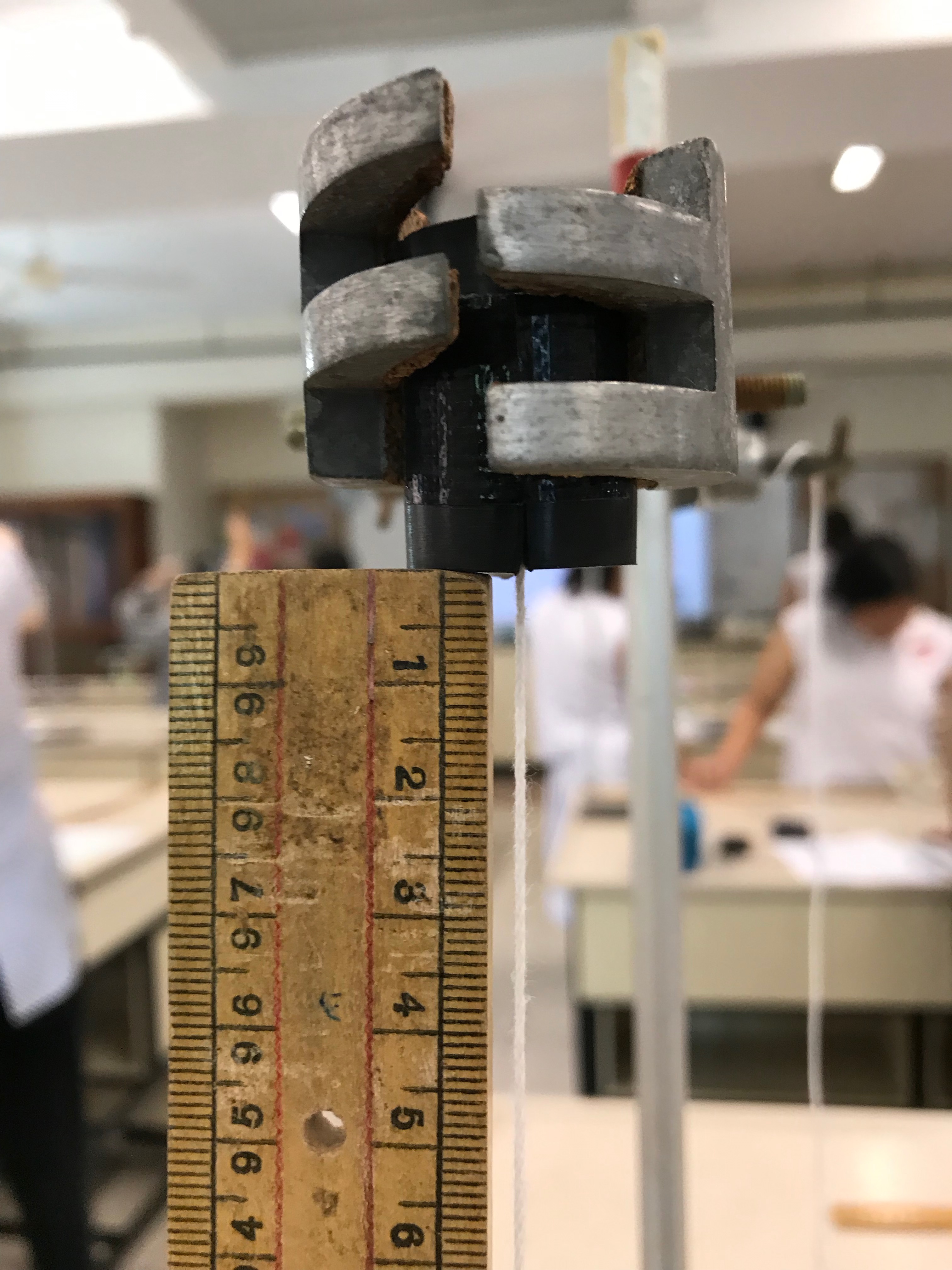
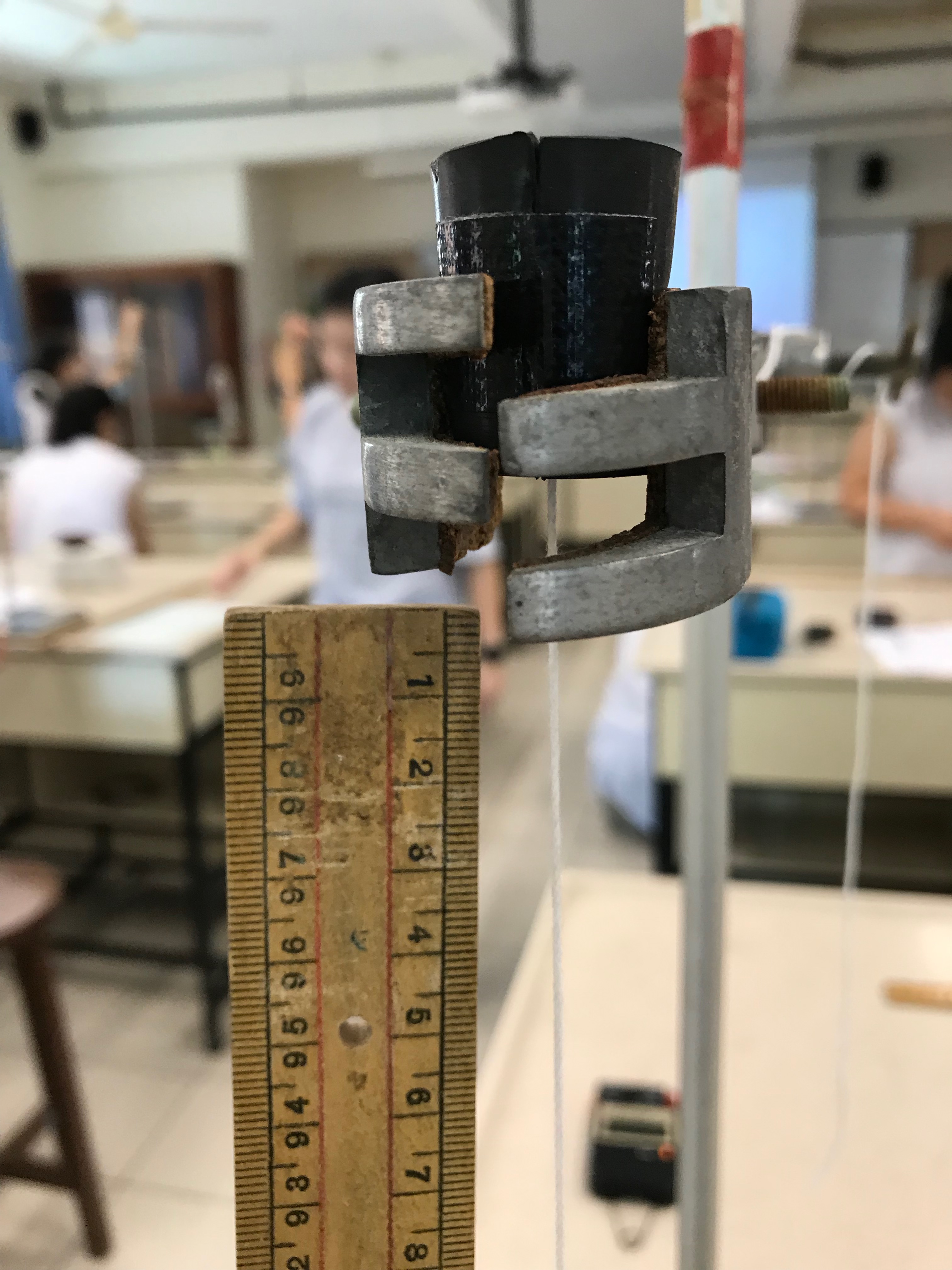
This diagram shows the correct use of a clamp to hold a split cork (or split rubber bung in this case). Note how the ruler can be placed against it to measure the length of the string.


As can be seen from this image, if the split cork is clamped higher up it is difficult or impossible to measure the length of the pendulum accurately.


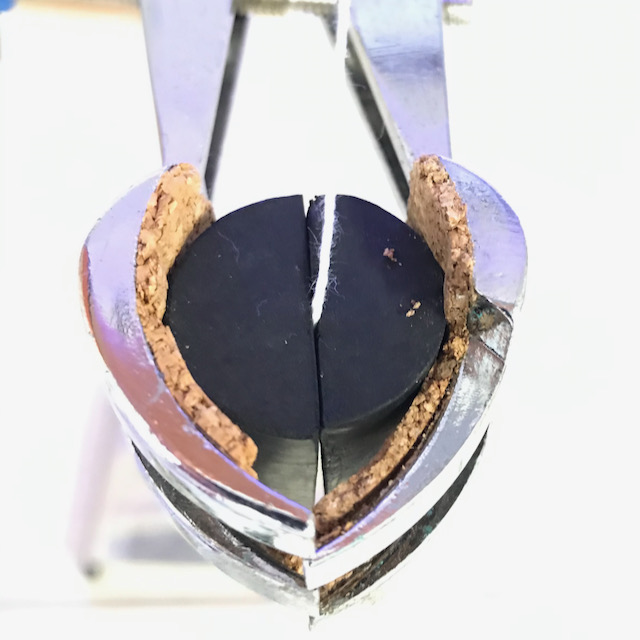
This diagram shows the correct way to clamp the split cork. When the jaws of the clap compress they will hold the string firmly between the two halves.


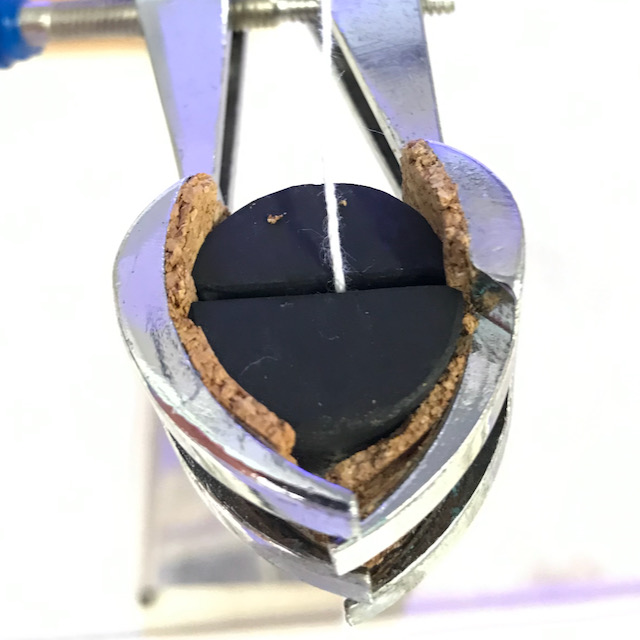
Incorrect alignment of the cork. Here tightening the clamp will not result in the sting being held more firmly.


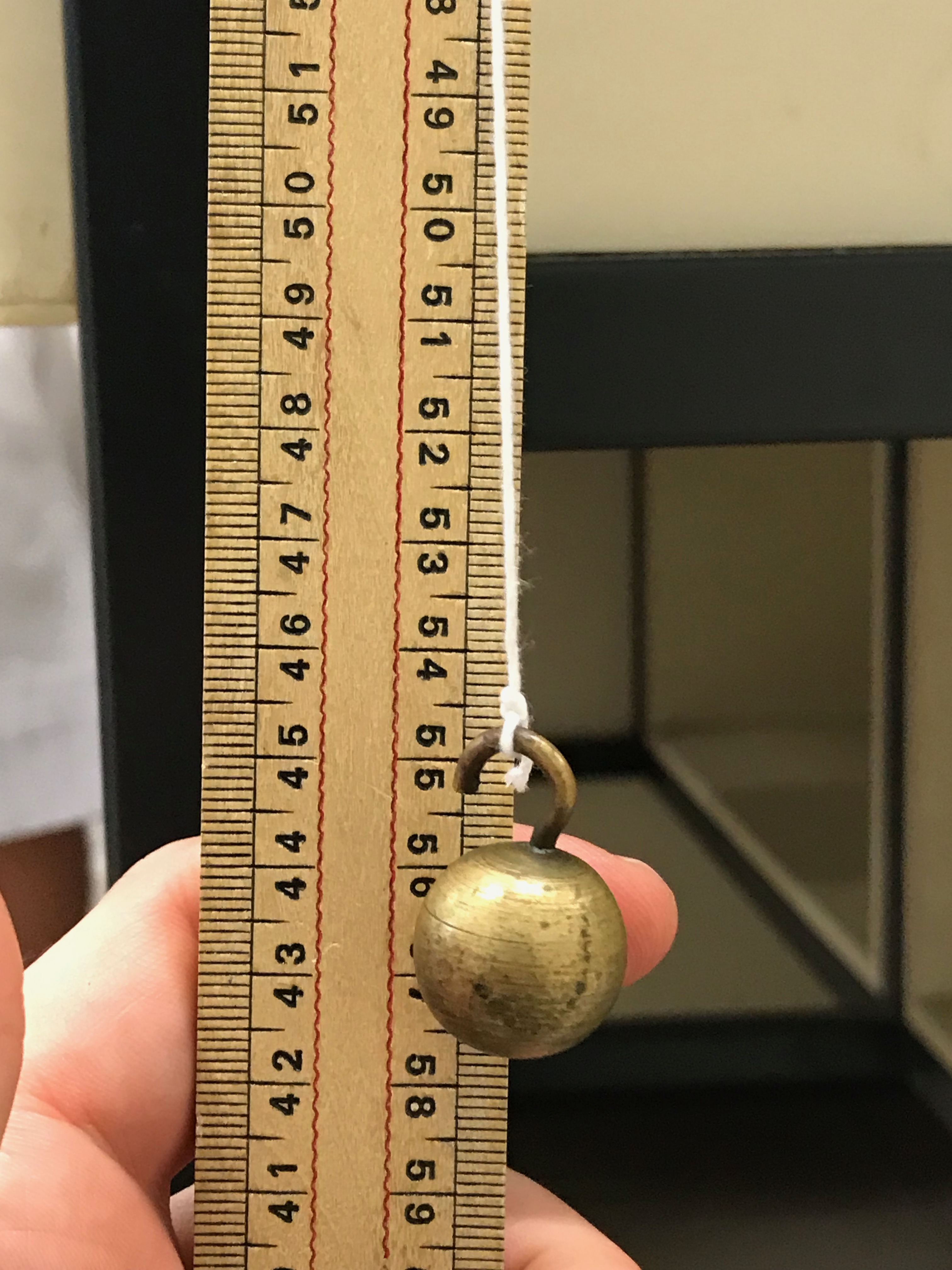
When measuring the length of the pendulum we must measure to the centre of the pendulum bob. In this case it would be recorded as 56.7 cm (half way between 55.7 cm and 57.7 cm)

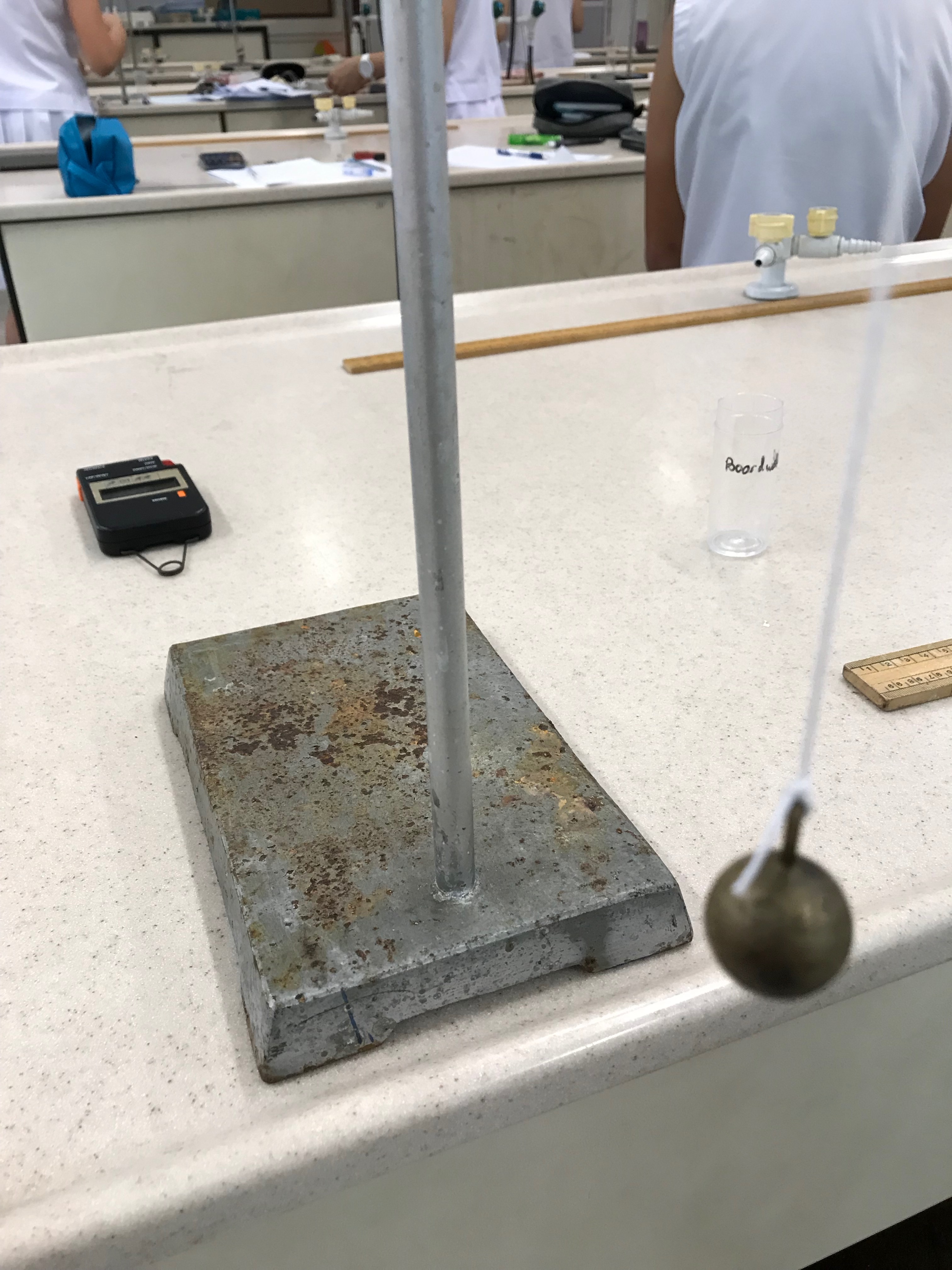
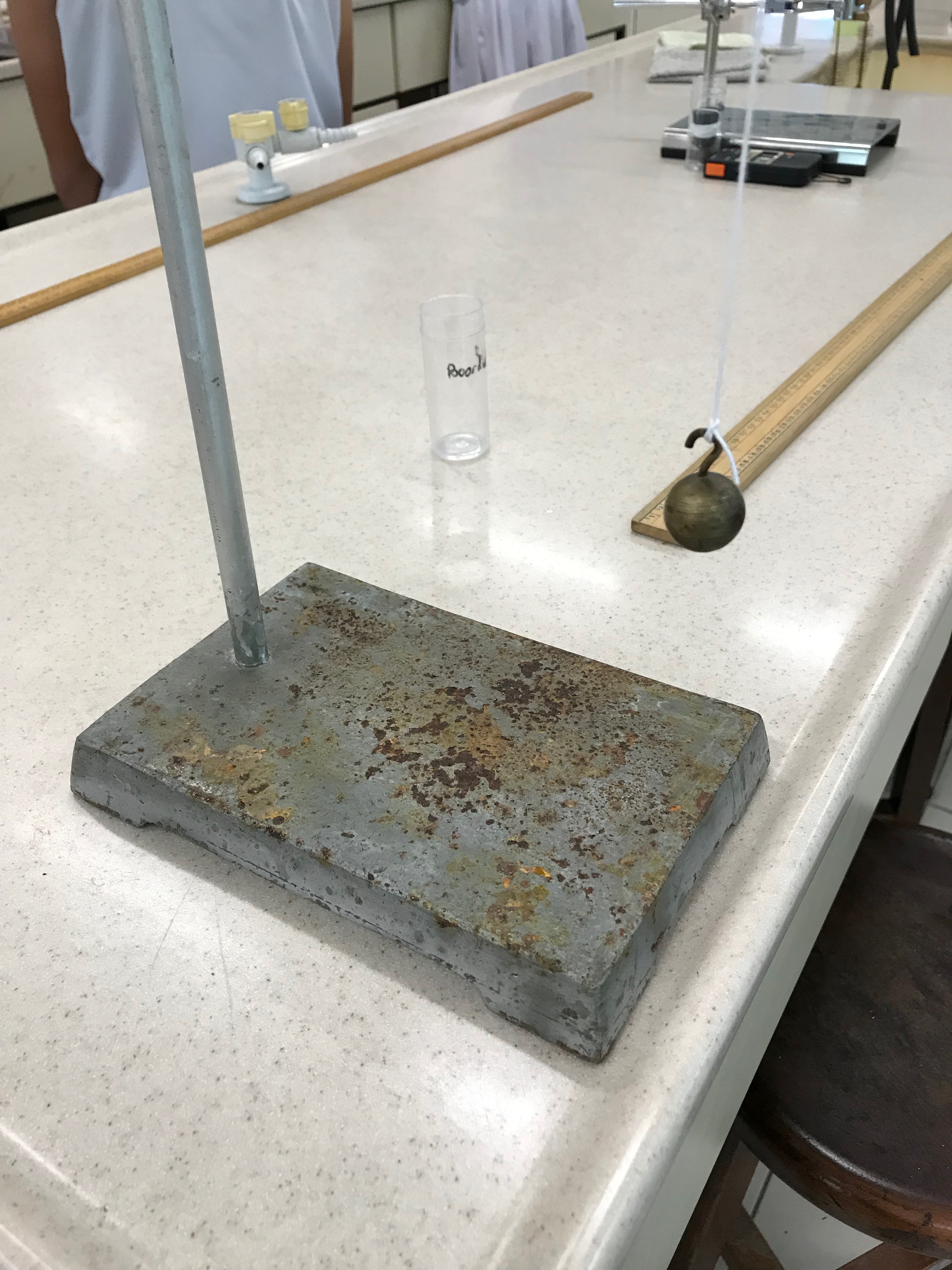
The top picture shows the stand being used correctly. In the lower diagram the bob will not be able to extend beyond the edge of the table.


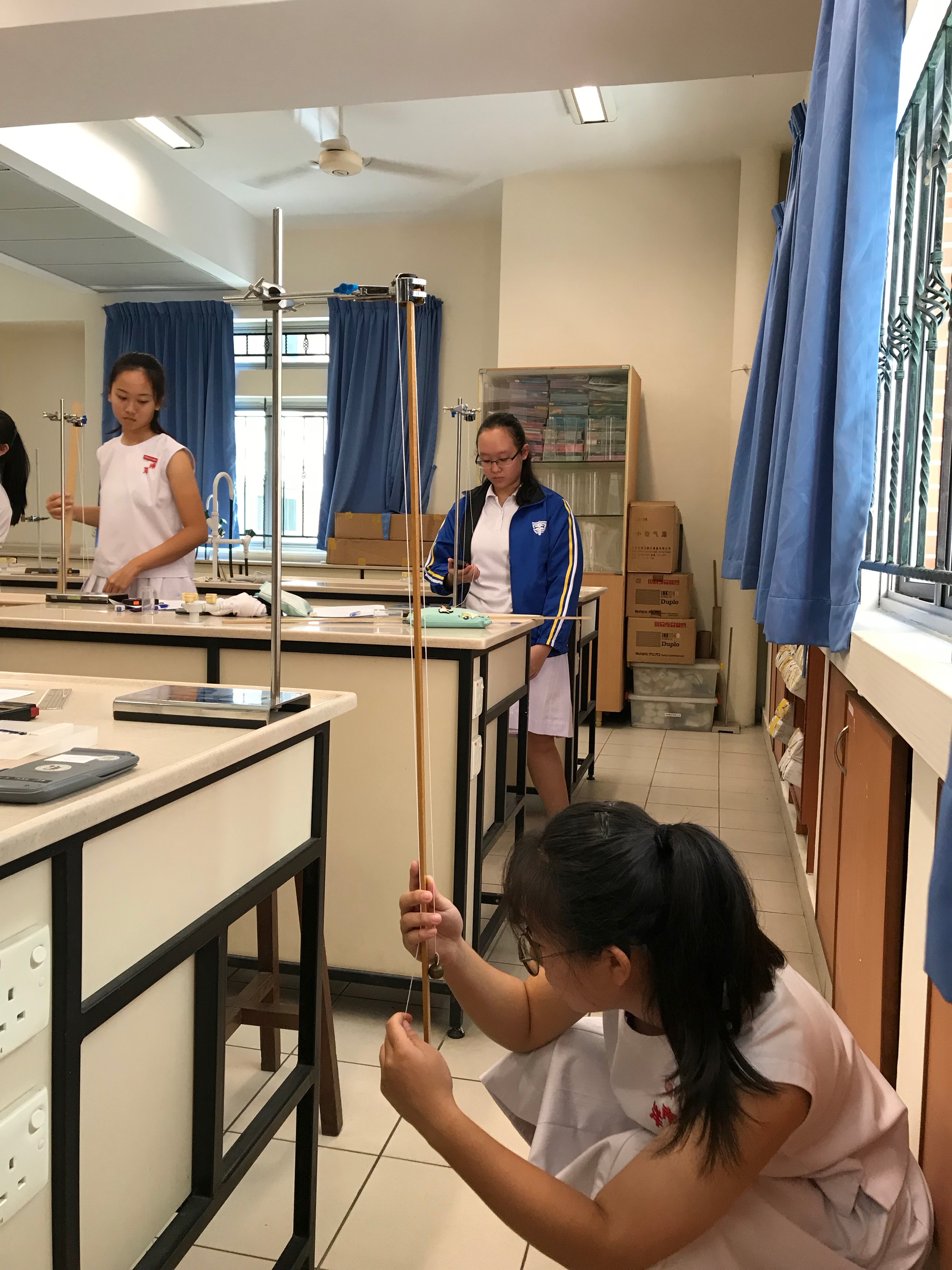
Correct position to read the length of the pendulum – placing the eye at the level of the bob to avoid parallax error.

pendulum swinging


ANSWERS TO PHYSICS ASSIGNMENTS (2025)

Suggested answers to Physics Assignments:

09: Pressure

10: Thermal Properties

12A: General Wave Properties

12B: Sound

12Adv: EX1 Superposition of Waves

13: Static Electricity

13Adv: EX2A Electric Fields

14: Current of Electricity

15A: DC Circuits

15B: Thermistor & LDR

16: Practical Electricity

17: Magnetism

17Adv: EX2B Magnetic Fields

18: Electromagnetism

19A: Electromagnetic Induction

19B: Electromagnetic Induction – Transformers

20: Radioactivity


These answers are frequently brief answers and should not be assumed to be perfect model answers. If you are not sure, please check in with Mr Shone.

ANSWERS TO PHYSICS NOTES (2025)

Suggested answers to Physics Notes:

09: Pressure

10: Thermal Physics

11: EM Spectrum

12: General Properties of Waves

12Adv: AP1 Superposition of Waves

13: Static Electricity

14: Current of Electricity

15: DC Circuits

16: Practical Electricity

17: Magnetism

18: Electromagnetism

19: Electromagnetism

20: Radioactivity


These answers are frequently brief answers and should not be assumed to be perfect model answers. If you are not sure, please check in with Mr Shone.

Advanced Physics Team-based Investigative Project (TIP)

TIP will make up 50% of your Advanced Physics Grade. The remainder will come from the EOY Advanced Physics written paper.


The TIP will be conducted in Groups of 2 or done individually. (No, I will not make a special allowance for you to be a group of 3!)

The project can be experimental or research based on a physics phenomena.

Both options will require submission of a report (PowerPoint Slides) and a presentation (T3, Week 9).

Complete the following form with details of your project:

https://docs.google.com/spreadsheets/d/1G6BygDq8LhAhzEdcyNDYPIZOiio0TxkdVlFCMYaCAz4/edit?usp=sharing

The Task

Option 1: Experimental Practical

Design and conduct two (related) small experiments to investigate any suitable physics phenomena of your choice.

You will need to plan an experiment and let Mr Shone know what physics equipment you wish to borrow from the lab – a form will be sent out for this later.


Option 2: Research

Choose a topic of suitable difficulty  and suitable depth to investigate on your own.

The topic must not be something we have already looked at (or will be looking at) as part of the Physics / Advanced Physics syllabus.

Some Projects that girls undertook in previous years:

Experimental:

      • Oscillation of Connected Springs
      • Archimedes Principle
      • Circular Motion

Research Based Project:

      • Special Relativity
      • Photoelectric Effect
      • Physics of Flight
      • Physics of  Maglev Trains
      • Doppler Effect & Red-Shift
      • Ionising Radiation
      • Kepler’s Laws of Motion
      • Superconductivity
      • Physics of Black Holes
      • Physics of Star Wars
      • Physics of Rocket Propulsion
      • Orbital Resonance of Astronomic Objects
      • Doppler Shift
      • Wave-Particle Duality


The Presentation

The presentation must be between 10 – 15 mins and everyone in the group must present.

The Slides are likely to include the following to be covered within the stipulated time:

For Practical Projects

      • Brief literature review (theory)
      • Experimental setup and brief procedures
      • Results
      • Analysis
      • Conclusion
      • Brief reflections and key takeaways

For Theory Projects

      • Detailed literature review (of the topic). You will not be expected to talk on every slide as there is unlikely enough time within the presentation period. Thus summary slides might be useful at points.
      • History of the discovery
      • Background information on the key scientists involved

All presentation will end with a short Q&A session.


Rubrics

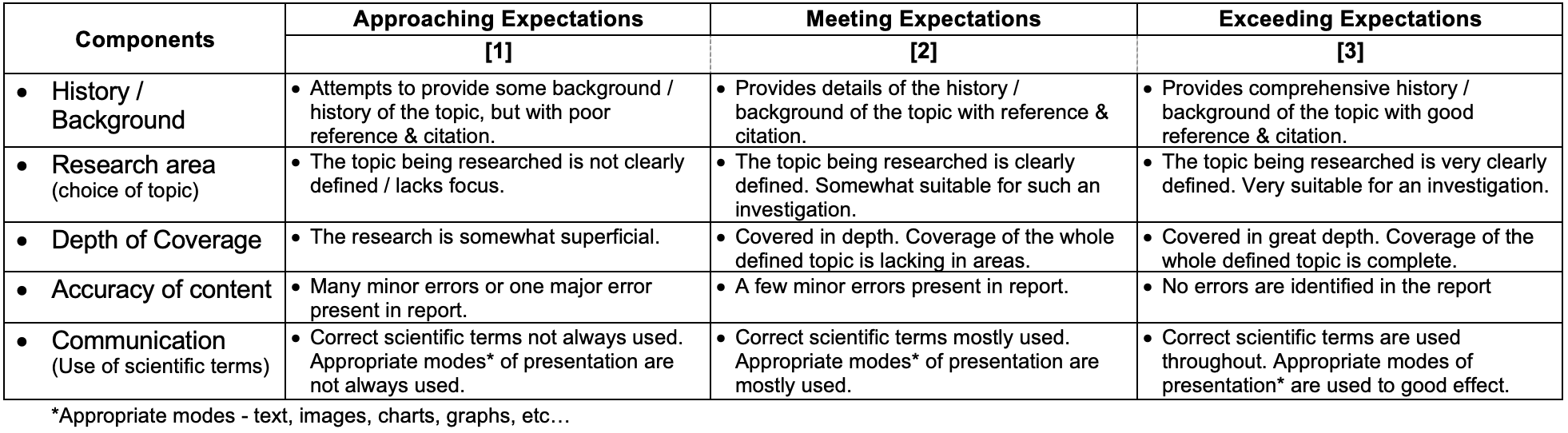
1A: CONTENT (Experimental Project)                                        {15 marks}
1B: CONTENT (Research Project)                                                  {15 marks}
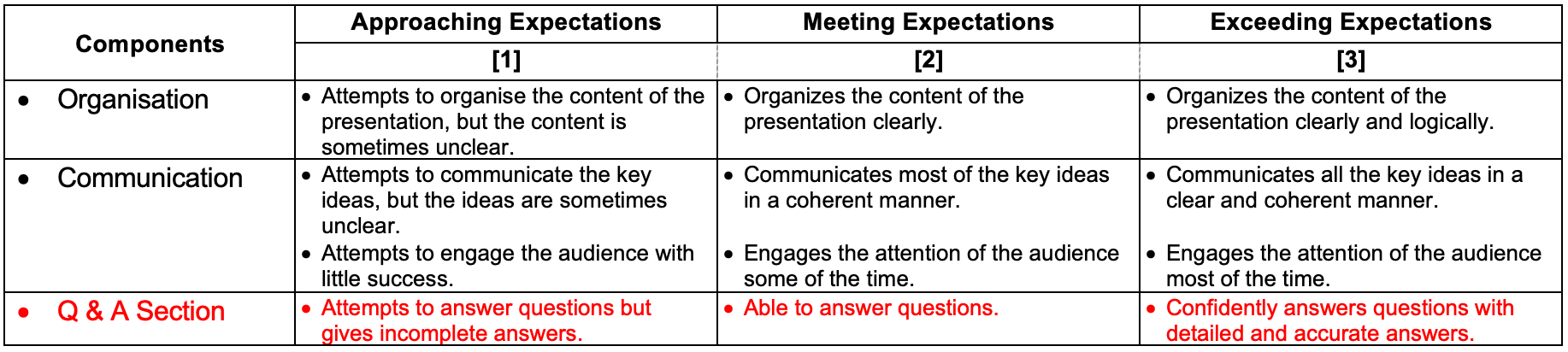
2: Presentation                                                                                              {9 marks}
3: Deadlines                                                                                                       {1 mark}

All materials submitted online before the deadline. [1]

Timeframe

Planning can start immediately.

Time for conducting practicals / doing research will be given during lesson periods at the start of term 3. (Likely 4 lesson periods will be assigned for this)

After consultation with the class the agreed dates for presentation will be TERM 3, WEEK 9.

Answers to Physics Assignment Worksheets (2025)

Suggested answers to Physics Assignment Worksheets:

AS01: Physical Quantities & Measurements

AS02: Reflection

AS03.1: Refraction

AS03.2: Total Internal Reflection

AS04: Lenses

AS05.1-5.3: Kinematics

AS06.1-6.4: Dynamics

AS07.1-7.2: Moments & Turning Effects

AS08: Energy, Work, Power & Efficiency


These answers are frequently brief answers and should not be assumed to be perfect model answers. If you are not sure, please check in with Mr Shone.

Also, no one is perfect (not even Mr Shone) so if you do spot any mistakes, please let me know…

Instagram Content (Physics Lesson for 14-2-25)

Hello!

Apologies, my cough and loss of voice are keeping me away from school again today. I am thus leaving you the following activity which I hope you will find enjoyable and relevant.

Background

At the start of the year Mr Shone started a Physics Instagram account (which I hope you are already following!):

https://www.instagram.com/nanyangphysics

He has posted a few items and will continue to create content, but he would very much like to get input and content from Physics Students  – that’s you!

Task

Create a post that can be uploaded to the NY Physics IG.

Content can be anything you like that you think would be suitable and appropriate for this IG account.

Some suggestions:

  • A worked example to a question that you had trouble with previously,
  • A trick that helps solve tricky physics problem,
  • An image (original) and explanation of some physics in the real world,
  • Explanation of a complex physics phenomena / concept in a way you found worked for you,
  • Use this as a chance to revise a topic you are less familiar with – put together the key concepts / points of a particular topic,
  • History, Life, Works of a famous physicist
  • Or anything else you think would be suitable…

Notes

  • Do try to use images / drawings where appropriate, rather than just text.
  • Don’t use any photos or images that are copyrighted (not your own).
  • I have included the outline templates that I have used – use these to keep the look of the site consistent if you like, but if you’re feeling creative, feel free to design it any way that appeals.
  • Try not to just repeat things that can be found directly in the notes or textbook.
  • Be creative, make your post stand out and appeal to viewers.
  • Target audience is yourself and other secondary school physics studying peers.
  • Don’t squeeze it all onto one “slide” you can upload up to 5 “slides” to create the post.
  • Mr Shone may alter your slides before posting for better clarity or to correct any minor physics misconceptions.
  • The posts will be posted in a random order (about 1 a day)
  • There will be a small prize for the post that gets the most likes!

Submission

Use the following Google form to submit your work:

https://forms.gle/anHg8jj5x2ap9tQm6

File(s) can be uploaded as Word, PowerPoint, etc. (which would allow me to edit them), or finalised image files such as JPG, PDF, etc.

Deadline:

Upload by Wednesday 19 February, 11:59pm.

Any questions drop me an email!

Template files below:

S4 Advanced Physics HBL (31 January)

For the Advanced Physics Home-Based Lesson on Friday 31 January you are to complete the following:

TASK 1

Take a short MCQ quiz on the topic of pressure.  Grades will not affect your results, this mini-quiz is for you to check your own understanding of the topic now that we have completed this chapter.

Link for quiz:

https://forms.gle/DYcTbS1bomRTaJxu6

(the quiz should take no longer than 10 minutes)

TASK 2

Complete the practical on Cooling Curves that we did in the lab last week. This would include:

        • ensuring your data has been recorded in a suitable manner,
        • plotting the graph, (refer to notes or https://physics.shone.sg/notes/basics/plotting-graphs/ if you have forgotten how to plot a graph correctly.
        • answering the questions on the back of the practical worksheet.

(task 2 should take no more than 30 minutes)

These tasks are to be completed by Wednesday, 5 February

Wishing you all a Happy Chinese New Year!

Gong Xi Fa Cai.


Mr Shone

Welcome to S3 Physics

Welcome to your Sec 3 Physics class – 2025

Please bookmark this site: physics.shone.sg – we will be using it most lessons.

Please ensure that you download the Google Classrooms App and have enrolled in “2025 Sec 3 Physics“. Important announcements will be posted in the classroom and all the materials are accessible there. The  code is (5vir2hj)

Softcopy notes can be downloaded from Google Classroom and you may use these (in place of the hardcopy notes) if you prefer.

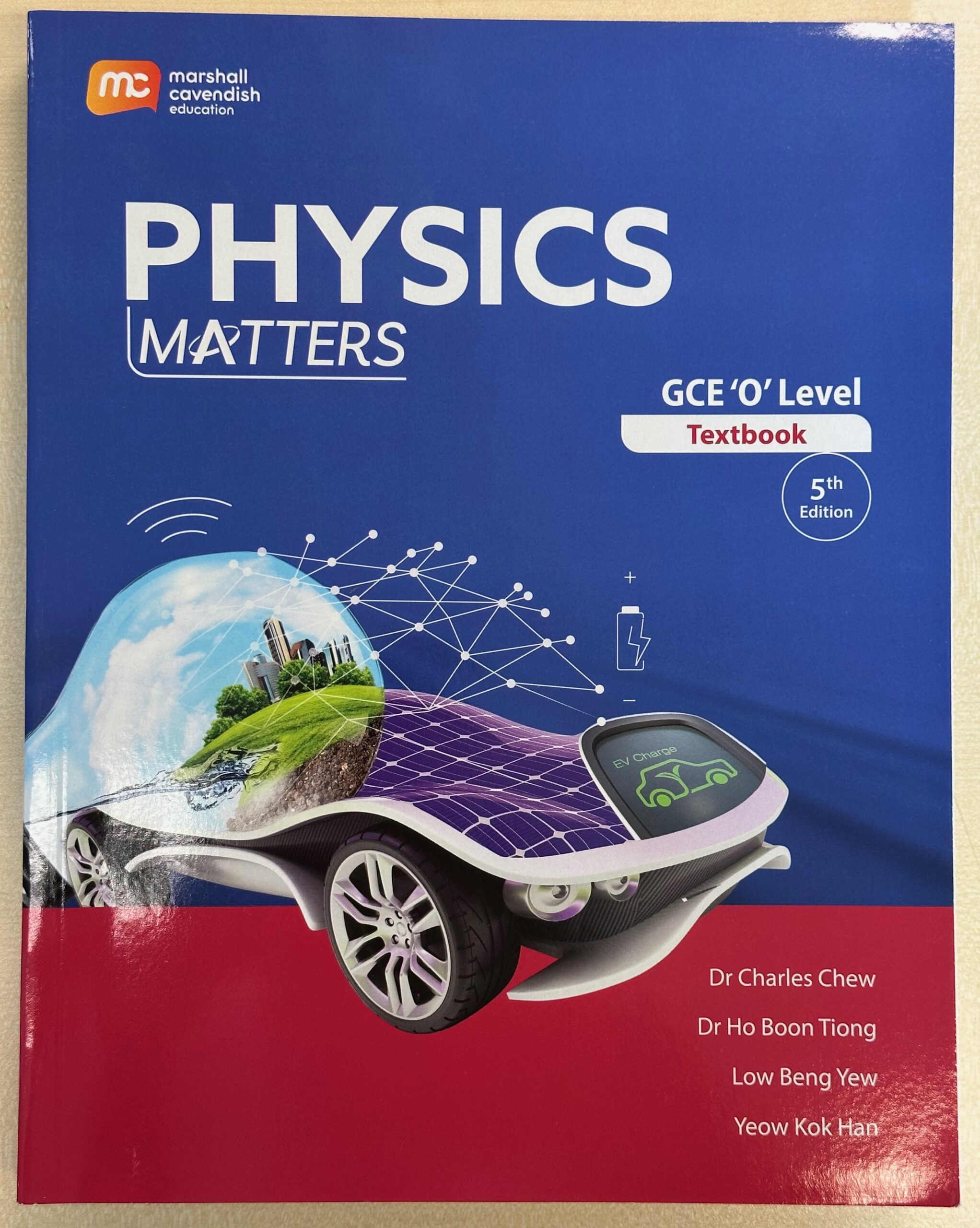
We will be using the following textbook:

Welcome to S4 Advanced Physics 2025

Welcome to your Sec 4 Advanced Physics class – 2025

Please bookmark this site: physics.shone.sg – we will be using it most lessons.

Please ensure that you download the Google Classrooms App and have enrolled in “2025 Sec 4 Physics“. Important announcements will be posted in the classroom and all the materials are accessible there. It is the same Classroom as used last year and so you should not need to enroll.

The  code is (3rjepp5)

Softcopy notes can be downloaded from Google Classroom and you may use these (in place of the hardcopy notes) if you prefer.

We will be using the following textbook:

5 minutes before taking a Physics Exam…

You are just about to take a physics exam. Here are the things you should take note of:

  • Read the question!
  • More marks – you need to write more!
  • What words are used in the question? “State” does not expect the same answer as “Calculate”, etc.
  • Try to think which section of the syllabus this question is from. That will help you to recall equations and use appropriate physics words.
  • Remember to show as much working as possible.
  • Are the values given in the expected unit (SI units) or do you need to convert them first.
  • Don’t use abbreviations – write things in full (eg Normal Contact Force,  Clockwise, Kinetic Energy, etc) at least the first time you mention them in a question.
  • A general answer such as “the current will change” will nearly never be awarded a mark. We would be expecting “the current will get larger”.
  • Always write an equation down before substituting (otherwise you’ll never get calculation marks)
  • Give all answer to 2 sig. fig. or 3 sig. fig..
  • Use the value stored in your calculator try to avoid rounding off multiple times.
  • Check your units.
  • Final answers should be in decimal format (not fraction).

The following may also help:

  • It is often good to look through a paper and attempt a really easy question first. This gives confidence and helps you to relax.
  • There is nothing wrong with writing down equations at the start of the exam. Many students do this if they are worried they will forget equation such as v²=u²+ 2as.
  • Fleming’s Left Hand Rule, Right Hand Grip rule, etc are there to be used. Don’t be shy about doing them in the exam venue.
  • “Explain” in physics doesn’t just mean using words. Feel free to include diagrams, equations or graphs if they will help with your explanation.


Physics EOY format (from email sent to you earlier)

Dear Sec 4s,

You will be taking your End of Year Physics Paper on 15 Oct.
The details are as follows:

Topics covered: Chapter 1 to Chapter 21 (all the Sec 3 and Sec 4 topics are tested)
Do note that content under enrichment will not be tested.
This means the following will not be tested:

    • Reading vernier callipers,
    • reading the sleeve on a micrometer screw gauge,
    • calibrating thermometers,
    • vector resolution,
    • Boyle’s Law,
    • acceleration in ticker-tape,


Paper 2

Time: From 0845 to 1030 hrs
Total marks: 70
Format:
Section A – Short Structured Questions (60 marks)
Section B – Long Question (10 marks; answer 1 out of 2 questions)

and

Paper 1

Time: From 1200 to 1245 hrs
Total marks: 30
Format: Multiple Choice Questions
Please bring a suitable pencil for shading and a soft eraser.

Do note that for both papers, calculators are allowed. You should also bring along a protractor and ruler.

All the best!
Warm regards,

Your Sec 4 Physics Teachers

Ask a Physics Question… (Reactivated for EOY – Slide 96 onwards)

Use the following link to ask ANY Physics Questions:

https://docs.google.com/presentation/d/1wpN4CrZme-LFILcUiwxGVAFXM5FWv6st_Xz75bzuBjM/edit?usp=sharing

Please bookmark this page for your convenience.


*****************************************************

If you want to see the questions from last year (2023) they are still up at:

https://docs.google.com/presentation/d/1fR9oyjgqir8YPiElOEw_r3lzTJu9wI3zCeu09z4Tr8Q/edit#slide=id.g207746b73df_0_108

*****************************************************

01A Mass, Weight & Density – Revision Quiz

Report a question

You cannot submit an empty report. Please add some details.

01A Mass, Weight & Density - Revision Quiz

Test your understanding of Mass, Weight & Density here:

1 / 5

1) A spacecraft is in orbit around the Earth. Why do the astronauts appear weightless?

2 / 5

2) A scientist weighs a fish using two spring balances as shown.

The spring balances read 80 N and 20 N.

What is the weight of the fish?

3 / 5

3) In a laboratory on Earth, balances show that an object has a mass of 2 kg and a weight of 20 N.

The same balances and object are then taken to the Moon.

Are the mass and weight the same, or less than before?

4 / 5

4) A weighing scale is used to estimate the normal contact force exerted on the ground by a rectangular object.

2013 S3 EOY P1 Q12

When the object laid flat on the weighing scale, the normal contact force is calculated to be 100 N. How large would the normal contact force be if the object was stood upright on the scale?

5 / 5

5) A cube with sides 2.0 cm long is made from a material of density 8.0 g/cm3.

What is the mass of the cube?

Your score is

Practical Exam

Exam Date: Tuesday, 10 September 2024

Further details such as lab venue will be emailed to you shortly.

As you are not actually graded on doing the practical, it is the things that you write down that will gain/lose you marks. Please take the following very seriously:

PRECISION

every time you record a reading from an instrument the value must be recorded to the correct precision (i.e. the precision of the instrument.)

Instruments recorded to smallest division on scale:

        • RULER (measures to 1 mm)
        • PROTRACTOR (measures to 1º)

 Instruments recorded to half of smallest division on scale:

        • EVERYTHING ELSE

Digital Instruments where we ignore the last digit:

        • STOPWATCH (measures to 0.1 s)
        • DIGITAL CALLIPERS (measures to 0.1 mm)
        • DIGITAL MICROMETER SCREW GAUGE (measures to 0.01 mm)

Advanced Physics Team-based Investigation Project (TIP)

The TIP will be conducted in Groups of 2 or done individually. (No, I will not make a special allowance for you to be a group of 3!)

The project can be experimental or research based on a physics phenomena.

Both options will require submission of a report (PowerPoint Slides) and a presentation (T3, Week 9).

Complete the following form with details of your project:

https://docs.google.com/spreadsheets/d/1KBArtpywQaW2rDcPIeX1gZ_09uFVdxvgvqbyLgEfJX8/edit?usp=sharing

The Task

Option 1: Experimental Practical

Design and conduct two (related) small experiments to investigate any suitable physics phenomena of your choice.

You will need to plan an experiment and let Mr Shone know what physics equipment you wish to borrow from the lab – a form will be sent out for this later.


Option 2: Research

Choose a topic of suitable difficulty  and suitable depth to investigate on your own.

The topic must not be something we have already looked at (or will be looking at) as part of the Physics / Advanced Physics syllabus.

Some Projects that girls undertook in previous years:

Experimental:

      • Oscillation of Connected Springs
      • Archimedes Principle
      • Circular Motion

Research Based Project:

      • Special Relativity
      • Photoelectric Effect
      • Physics of Flight
      • Physics of  Maglev Trains
      • Doppler Effect & Red-Shift
      • Ionising Radiation
      • Kepler’s Laws of Motion
      • Superconductivity
      • Physics of Black Holes
      • Physics of Star Wars
      • Physics of Rocket Propulsion
      • Orbital Resonance of Astronomic Objects
      • Doppler Shift
      • Wave-Particle Duality


The Presentation

The presentation must be between 10 – 15 mins and everyone in the group must present.

The Slides are likely to include the following to be covered within the stipulated time:

For Practical Projects

      • Brief literature review (theory)
      • Experimental setup and brief procedures
      • Results
      • Analysis
      • Conclusion
      • Brief reflections and key takeaways

For Theory Projects

      • Detailed literature review (of the topic). You will not be expected to talk on every slide as there is unlikely enough time within the presentation period. Thus summary slides might be useful at points.
      • History of the discovery
      • Background information on the key scientists involved

All presentation will end with a short Q&A session.


Rubrics

1A: CONTENT (Experimental Project)                                        {15 marks}
1B: CONTENT (Research Project)                                                  {15 marks}
2: Presentation                                                                                              {9 marks}
3: Deadlines                                                                                                       {1 mark}

All materials submitted online before the deadline. [1]

Timeframe

Planning can start immediately.

Time for conducting practicals / doing research will be given during lesson periods at the start of term 3. (Likely 4 lesson periods will be assigned for this)

After consultation with the class the agreed dates for presentation will be TERM 3, WEEK 9.

WA2 Details 2 May (Term 2, Week 7)

Date: 2 May (Thursday)

Time: (9:30-10:30 – after CCE)

Duration: 45 minutes

Venue: Your Own Classroom          (except: 412 to join 407)

Format: 8 marks (MCQ) & 22 marks (Structured)

Topics:

  • General Waves Properties (only section 2 on wave terms)
  • Sound
  • Static Electricity
  • Current of Electricity
  • D.C. Circuits
  • Dynamics (exclude sections 7 and 8 vector addition and vector resolution)
Please be reminded to bring along your calculator and mathematical set for the test.
All the best 🙂

Advanced Physics: Superposition – Revision Quiz

Advanced Physics: Superposition - Revision Quiz

Test your understanding of Superposition here:

1 / 5

1) Source S emits microwaves with constant amplitude. The microwaves hit a metal screen P and are reflected. A stationary wave is formed between S and P. The wavelength of the microwaves is much smaller than the distance between S and P.

A detector Q is moved at a slow, constant speed from S to P.

What happens to the amplitude of the signal detected by Q?

2 / 5

2) The diagram represents the pattern of stationary waves formed by the superposition of sound waves from a loudspeaker and their reflection from a metal sheet (not shown).

W, X, Y and Z are four points on the line through the centre of these waves.

Which statement about these stationary waves is correct?

3 / 5

3) The diagram shows a stationary wave on a string at two instants of maximum vertical displacement.

The frequency of the wave is 12 Hz.

What is the speed of the wave?

4 / 5

4) To produce a stationary wave, two waves must travel in opposite directions through the same space.

Which statement about the properties of the two waves must also be true?

5 / 5

5) Where, in a standing wave, do the vibrations of the medium occur?

Your score is

Physics WA1

Physics WA 1 will be happening on 20 Feb (Tuesday) (Term 1, Week 8) during the first period.

It will be a written test spanning 45 mins.

Topics tested include:
• Kinematics (motion graphs only)
• Pressure
• Thermal Physics
• General Waves Properties

Format:
Multiple Choice (8 marks)
Structured Questions (22 marks)

Calculators are allowed.

Welcome to Sec 4 Advanced Physics

Welcome to your Sec 4 Advanced Physics class – 2024

Please bookmark this site: physics.shone.sg – we will be using it most lessons.

Please ensure that you download the Google Classrooms App and have enrolled in “2024 Sec 4 Physics“. Important announcements will be posted in the classroom and all the materials are accessible there. It is the same Classroom as used last year and so you should not need to enrol.

The  code is (vzq7tyu)

Softcopy notes can be downloaded from Google Classroom and you may use these (in place of the hardcopy notes) if you prefer.

We will be using the following textbook:

Welcome to Sec 4 Physics!

Welcome to your Sec 4 IP Physics class – 2024

Please bookmark this site: physics.shone.sg – we will be using it most lessons.

Please ensure that you download the Google Classrooms App and have enrolled in “2024 Sec 4 Physics“. Important announcements will be posted in the classroom and all the materials are accessible there. It is the same Classroom as used last year and so you should not need to enrol.

The  code is (vzq7tyu)

Softcopy notes can be downloaded from Google Classroom and you may use these (in place of the hardcopy notes) if you prefer.

We will be using the following textbook:

STEM Championship – Interested?

Registration for the National STEM Championship is about to close. In the past, it was known as the National Science Challenge. It is quite a high profile competition which is televised on Channel 5 around September each year. Teams of four Sec. 3 students from different schools participate in authentic problem solving activities at places around Singapore (e.g. A*Star, Science Centre, NTU) and may be required to give presentations of their scientific understanding of the problem.
If you want Mr Shone to consider you for this then please update this spreadsheet to yes (by end of Wednesday).
Mr Shone will have to nominate three to five students from your Advanced Physics class. Apart from being very knowledgeable and enthusiastic about Biology / Chemistry / Physics, you should also have a good understanding of Mathematics and even a little Astronomy. You should be…
    1. Confident.
    2. Can think flexibly – are able to solve unfamiliar problems that are given ‘on the spot’.
    3. Able to work in a team – demonstrate empathy and understanding.
    4. Can communicate / present your ideas clearly and coherently.
    5. Be willing to represent the school on television!


Mr Shone  needs to nominate you by Friday 3rd March (end of T1W9). Nomination does not guarantee you will be selected for the team.
Mr Shone

Reposting Astrigue invite email

Dear students,

Astrigue is an annual Astronomy competition jointly organised by the Astronomy Clubs of RI (Year 5-6) and HCI (College). The event is targeted at secondary school students who display a keen interest in astronomy. The event comprises a series of engaging booth activities, project-making and quiz questions that will put participants’ knowledge on astronomy to the test. Through this, it hopes to create an organic environment for like-minded students sharing a passion for astronomy to engage in meaningful conversations on the subject matter. Hopefully the learning experience will allow students to gain fruitful takeaways while enjoying themselves and forging valuable ties among their peers.


Event details

Venue: Raffles Institution 

Date: Saturday, 1st April 2023

Time: 0830-1330 


Time

Activity

0830-0855

Registration

0900-1000

MCQ Round

1000-1100

Amazing Race

1100-1120

Break

1120-1330

Final Round


The competition will consist of a Project Round and MCQ Round for all participants as well as the Final Round for the top 5 performing teams*. The placement of the top 5 teams will be decided based on the team’s performance in the MCQ and Project Rounds. Do also note that the Project Round will be held before the event and carried out in the teams’ own time. *Each school can be represented by only one team in the finals, and each team in the finals can only be represented by 4 members. 


Registration

  • Participation fees: Free for all secondary school students
  • Each team should comprise of 4-5 students
  • Complete this form  by Friday, 24th February 2023 4 p.m.
  • Registration will stop when we have reached the capacity limit of the event.


Physics Lesson, 2nd & 3rd February

Hi Advanced Physicists!

Sorry that I’ll not be in school today. This means you won’t be able to go to the Physics Lab 4, so please just stay in your class for the Physics lesson.

Please complete the following:

  1. Practical 2 (be sure to attach the paper with pin holes, and the graph). [This should also really be complete by now!]  – can hand this up into my pigeon hole.
  2. Assignment 2: Reflection [you should have enough time to complete this during today’s lesson] I will collect this at a later time. If you find there are questions you can’t do because we haven’t covered the whole topic yet that is fine. However, I think you should be able to do most of it!
  3. Still got free time? Try looking through and completing the rest of the notes on this chapter – I suspect you’ll be able to do much of it yourselves (or by referring to my notes on this website).

Hope to be feeling better and back in the classroom soon!

Mr Shone

Physics for Thursday 2 Feb

Hi Physics students!

Sorry that I’ll not be in school today. Please complete the following:

  1. Assignment 1 [should have been done already]
  2. Practical 02 (be sure to attach the paper with pin holes and the graph). [This should also really also be complete by now!]
  3. Assignment 2: Reflection [you should have enough time to complete this during today’s lesson] I will collect this next lesson.

Please pass 1. and 2. to the physics rep who will leave them in my pigeon hole.

Mr Shone

S3 Physics WA1

Monday, 13 February

Start time: 8.35 am
End time: 9.20 am
Duration: 45 minutes

Physics Written Test
(45 mins)

Topics Covered:

Chapter 1: Physical quantities
Chapter 2: Reflection
Chapter 3: Refraction (not critical angle or TIR)

Remember to bring:

  • a sharp pencil and eraser
  • protractor
  • long ruler
  • calculator

Borrowing of these items will not be allowed during any test/exam.

Why Study Physics?

What is Physics?

Physics is a  science that deals with the structure of matter and the interactions between the fundamental constituents of the observable universe. In the broadest sense, physics (from the Greek physikos) is concerned with all aspects of nature on both the macroscopic and submicroscopic levels.

Physics is the natural science that studies matter, its fundamental constituents, its motion and behaviour through space and time, and the related entities of energy and force. Physics is one of the most fundamental scientific disciplines, with its main goal being to understand how the universe behaves.


What is Science?

Science is the systematic study of the structure and behaviour of the physical and natural world through observation, experimentation, and the testing of theories against the evidence obtained.

Science is a systematic endeavor that builds and organizes knowledge in the form of testable explanations and predictions about the universe.

The word science comes from the Latin “scientia,” meaning knowledge.


What is the Scientific Method?


What is psudeoscience?

May be an image of text that says "Science Willingness to change with new evidence Pseudoscience Ruthless peer Fixed ideas review Takes account of all new discoveries No peer review Invites criticism Selects only favourable discoveries Sees criticism as conspiracy Verifiable results Limits claims of usefulness Non-repeatable results Claims of widespread usefulness Accurate measurement "Ball-park" measurement httsp//a/oteoo http://perceptivereality. weebly. com/"

What can I do with my Physics degree?

welcome to Sec 3 Advanced Physics 2023!

Welcome to your Sec 3 Advanced Physics class – 2023

Your Teacher is Mr Shone mark_shone@nygh.edu.sg

Please bookmark this site: physics.shone.sg – we will be using it most lessons.

Please ensure that you download the Google Classrooms App and have enrolled in “2023 Sec 3 Physics“. Important announcements will be posted in the classroom and all the materials are accessible there.

The code is (vzq7tyu)

Hardcopy notes will be passed to you during the first physics lesson.

Softcopy notes can be downloaded from Google Classroom and you may use these (in place of the hardcopy notes) if you prefer.

We will be using the following textbook:


Welcome to Sec 3 Physics!

Welcome to your Sec 3 IP Physics class – 2023

Your Teacher is Mr Shone mark_shone@nygh.edu.sg

Please bookmark this site: physics.shone.sg – we will be using it most lessons.

Please ensure that you download the Google Classrooms App and have enrolled in “2023 Sec 3 Physics“. Important announcements will be posted in the classroom and all the materials are accessible there.

The code is (vzq7tyu)

Hardcopy notes will be passed to you during the first physics lesson.

Softcopy notes can be downloaded from Google Classroom and you may use these (in place of the hardcopy notes) if you prefer.

We will be using the following textbook:

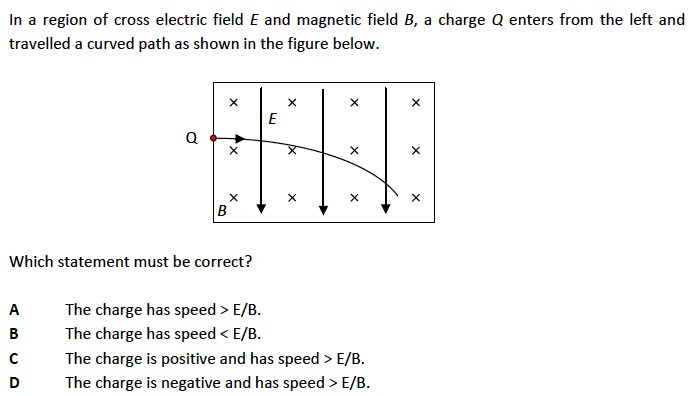
Charge moving through magnetic and electric fields

The magnitude of the force created by the electric field is given by

FE = Eq

FE = EQ (using the values in this question)

The magnitude of the force created by the magnetic field is given by

FM = Bqv

FM = BQv (using the values in this question)


Q could be +ve or -ve.

If Q is +ve, then:

    • the electric field will exert a downward force on Q
    • the magnetic field will exert an upwards force on Q (from Fleming’s Left Hand Rule)

This could still create the motion indicated in the diagram, however FM would need to be smaller than FE.

FM < FE

BQv < EQ

v < E/Q

If Q is –ve, then:

    • the electric field will exert an upwards force on Q
    • the magnetic field will exert a downwards force on Q (from Fleming’s Left Hand Rule)

This could still create the motion indicated in the diagram, however FM would need to be larger than FE.

FM > FE

BQv > EQ

v > E/Q

Which is answer D