| Definition: Principle of Conservation of Energy |
|---|
The principle of conservation of energy states that:
|
This means that the total amount of energy in the universe is always the same.
General problem solving approach:
|
| Worked Example:
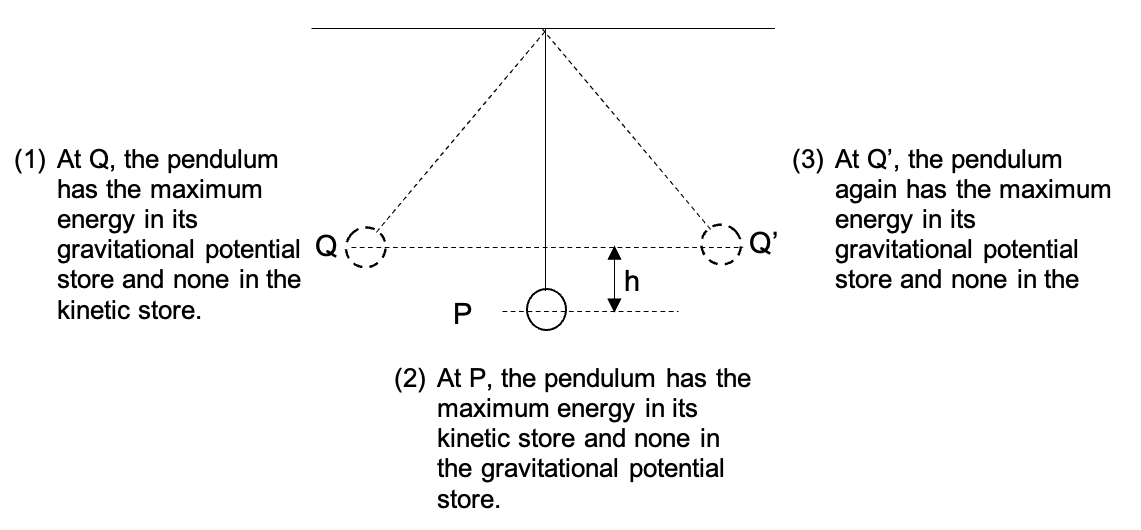
The figure shows a pendulum of mass 0.60 kg in a vacuum. The pendulum is displaced to position Q at height h above P and then released to oscillate between Q and Q’. P is the lowest position of the pendulum where its maximum speed is 0.70 m s-1.
Assuming the pendulum is ideal, the principle of conservation of energy tells us that the maximum energy in its gravitational potential store at Q will be equal to the maximum energy in its kinetic store at P, which is also equal to the maximum energy in the gravitational potential store at Q’.
Calculate maximum kinetic energy at P = ½ mv2 2. the maximum energy in the gravitational potential store of the pendulum as it rises to its greatest height at Q again during its oscillation and applying the principle of conservation of energy, the increase in energy in the gravitational potential store must be equal to the decrease in energy in the kinetic energy store; therefore, the maximum energy in the gravitational potential store is also 0.15 J 3. the greatest height h. maximum energy in the gravitational potential store = mgh = 0.15 J |
| Example |
|---|
| A stone dropped from a height of 25 m. What is its speed when it hits the ground? |
| Example |
|---|
| A ball is thrown vertically upwards with an initial velocity of 15 m s-1. What is the maximum possible height gained by the ball? |
| Example |
|---|
| A boy fires a stone from his catapult upwards and measures the height at which the stone reaches before it falls. The initial velocity of the stone is 12.0 m s-1 and its mass is 200 g.
(a) Calculate the kinetic energy the stone gains from the catapult.
(b) After several tries, the boy finds that the maximum possible height gained by the stone is 5.20 m. Calculate the stone’s loss in energy in travelling through the air. |
| Caution: Its not just KE and GPE |
|---|
| Many questions involve energy conversions between KE and GPE. However, don’t rule out the possibility of other types of energy being involved. |
| Example |
|---|
| Is kinetic energy and gravitational potential energy of the car conserved when a car accelerates up a hill? |
| << Back | Work, Energy, Power & Efficiency | Next >> |