Question: What happens if you throw an object upwards faster and faster?
At low speeds, the object rises, slows down due to gravity, and falls back to Earth. If you throw it faster, it reaches a greater height before falling back.
But what if you throw it fast enough that it never comes back?
The Key Idea
| Escape Velocity |
|---|
| Escape velocity is the minimum speed needed for an object to completely escape a planet’s gravitational pull without further propulsion. |
Why Does This Happen?
Gravity always pulls objects back toward Earth. However, if an object starts with enough kinetic energy, it can “climb out” of the gravitational field.
As the object moves away:
- Its speed decreases
- Its kinetic energy is converted into gravitational potential energy
At escape velocity, the object reaches an infinite distance with zero remaining speed.
Escape Velocity Values (Planets & Stars)
Different celestial bodies have different escape velocities:
| Object | Type | Escape Velocity (km/s) |
|---|---|---|
| Moon | Moon | 2.4 |
| Earth | Planet | 11.2 |
| Mars | Planet | 5.0 |
| Jupiter | Planet | 59.5 |
| Sun | Star (yellow dwarf) | 617 |
| Sirius A | Main sequence star | ~880 |
| Proxima Centauri | Red dwarf | ~580 |
| Betelgeuse | Red supergiant | ~90 |
| Rigel | Blue supergiant | ~700 |
The Formula
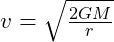
Where:
- G = gravitational constant
- M = mass of the planet
- r = distance from the centre of the planet
The Ultimate Limit: The Speed of Light
The speed of light, denoted c, is approximately:
Nothing can travel faster than this speed.
What If Escape Velocity = Speed of Light?
If a massive object becomes so dense that its escape velocity equals or exceeds the speed of light, something extraordinary happens:
This is what we call a black hole.
Since light cannot escape:
- The object appears completely black
- No information can leave it
- It marks a boundary called the event horizon
Summary
- Throwing an object faster makes it reach greater heights
- At escape velocity, it never returns
- Escape velocity depends on mass and size of the object
- If escape velocity exceeds the speed of light → black hole
Things to Think About…
1. Bigger but easier to escape?
Betelgeuse is much larger than the Sun, yet its escape velocity is much lower.
👉 Explain why this happens using the idea of mass and radius.
2. Does gravity “switch off”?
An object launched at escape velocity keeps moving away forever, even though gravity is still acting on it.
👉 Why doesn’t gravity eventually pull it back?
3. The black hole limit
Escape velocity depends on mass and radius.
👉 What would need to happen to a star for its escape velocity to reach the speed of light?
👉 Does this require increasing mass, decreasing radius, or both?