- Independent variable: Thickness of glass, t
- Dependent variable and assigned symbol: Resistance of LDR, RL
| Many students did not understand that “… and assigned symbol” was asking for a symbol (i.e. t and RL above) and they instead wrongly put down a unit. |
Quantities that should be kept constant:
- Distance between the lamp and the LDR
- E.m.f. of the cell / power of the lamp / brightness of lamp
| Try to avoid putting things that are not measurable. I don’t want to see “use the same battery”, “slides of the same type” etc. |
Arrangement of apparatus:
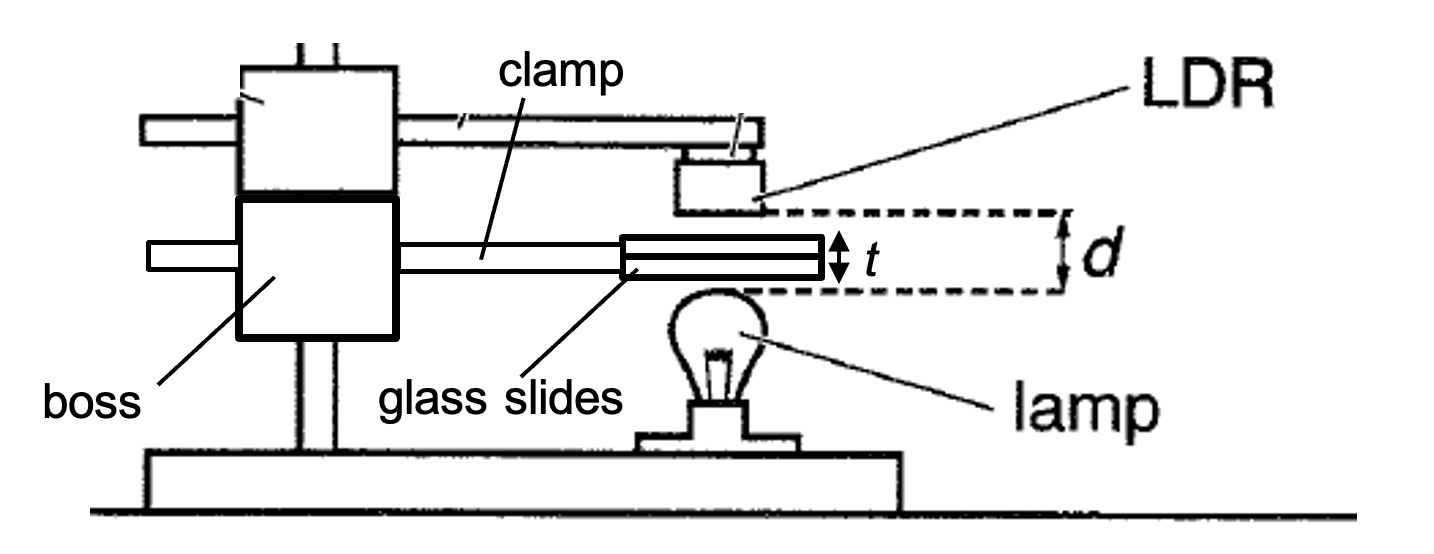
| Drawing of diagram encouraged, with thickness t indicated in diagram
If the diagram is not clear (or absent) then we would expect detailed descriptions that clearly show that the microscope slides are clamped between the lamp and the LDR. Measurement of t should be clearly described. |
Describe in detail how you will perform the experiment:
1. Using a digital micrometer screw gauge, measure and record the thickness t of a glass slide.
2. Clamp the glass with thickness t between the lamp and the LDR.
3. Repeat steps (a) to (e) of P06, while keeping the distance d fixed at 3.0 cm. Record the resistance RL of the LDR.
| As this planning activity is an extension of an existing practical (rather than a stand-alone planning experiment) you can make reference to diagrams and steps in the original experiment.
You should expect the EOY planning practical to be an extension rather than a stand-alone planning activity. |
4. Repeat steps 2 to 3 9 more times, increasing thickness t by adding one more piece of glass slide to the existing stack each time and measuring the thickness t of the stack of glass slides with the digital micrometer screw gauge.
| Why 9 more?
Why not? 6 is a minimum number that you can completed in the short time you have to do a lab experiment – but if time is not an issue we would take many more readings. Always ask for a total of TEN readings. |
5. Plot a graph of RL against t to investigate the relationship.
If you are mentioning taking any readings – be clear as to:
examples:
|
| If you ask to show in a table then sketch the table headings in full showing all the readings and calculated values as well as appropriate units.
You do not need to give any made up values of data. |
Explain two precautions (include action and the reason) that you should take to ensure the accuracy of the experiment:
- Clean all glass surfaces with a cloth to ensure that the light intensity falling on the LDR is not affected by dirt. This ensures accuracy of RL.
- With a set square, ensure that the glass surface is placed normal to the LDR and light bulb so that t is accurate.
- Ensure that the LDR is normal to the light rays by making slight adjustments to its orientation until minimum resistance RL is obtained for each value of t.
- Carry out the experiment in a dark room to ensure accuracy in the measurement of RL.
| Avoid short statements that start “Ensure…”.
eg. “Ensure the rod is vertical” is NOT ACCEPTABLE!
You need to follow up with the “how you are ensuring … “. “Ensure the rod is vertical by placing a spirit level next to it” is better.
|