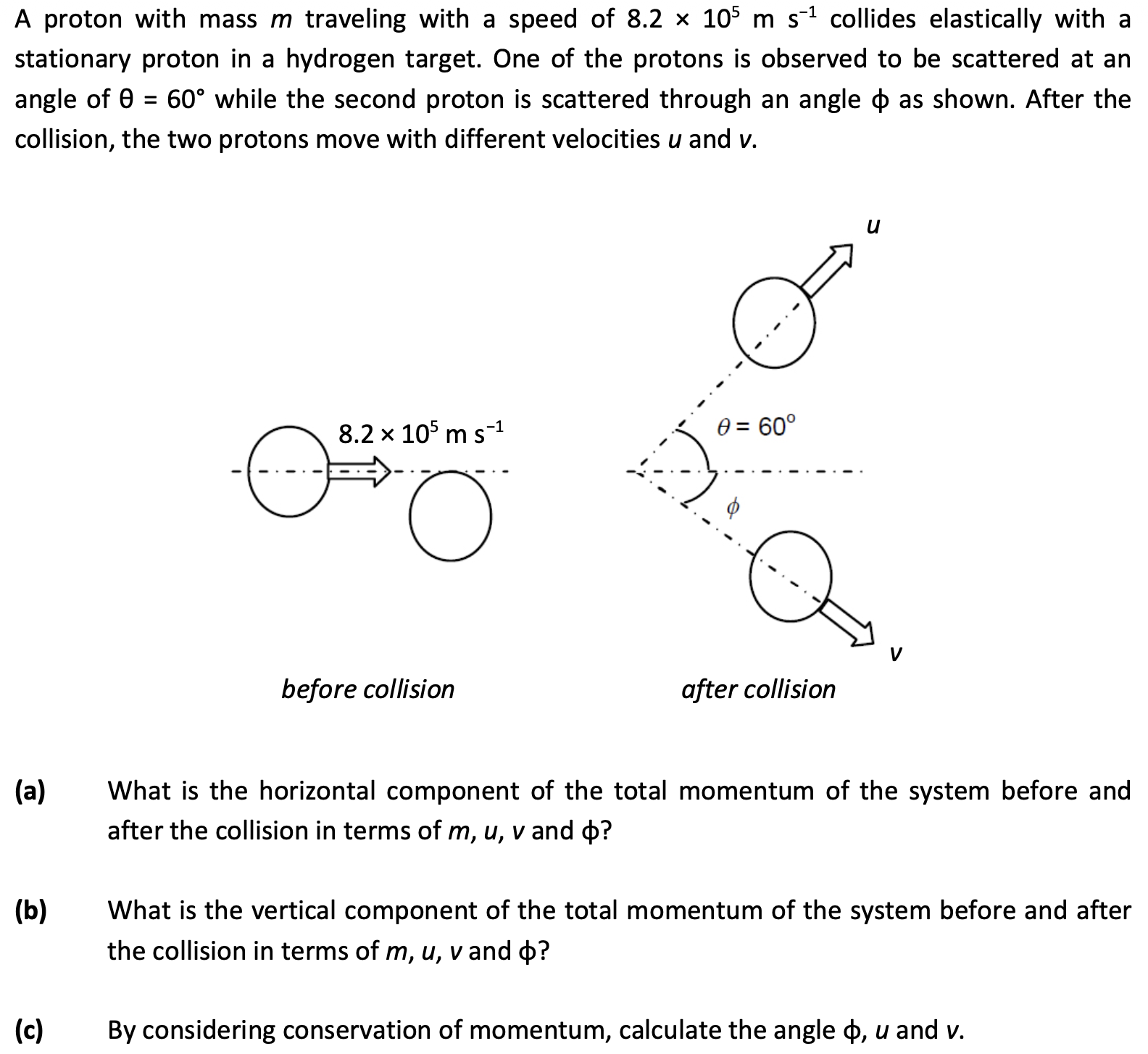
Let the initial proton speed be
![\[ w=8.2\times10^5\ \text{m s}^{-1}. \]](https://physics.shone.sg/wp-content/ql-cache/quicklatex.com-11fdf7c5556dba60003ebbb94d9c8f03_l3.png "Rendered by QuickLaTeX.com")
After the collision:
- the first proton moves at speed
 ,
,  above the horizontal;
 - the second proton moves at speed
 , at angle
  below the horizontal.
1. Conservation of momentum
Since both particles have the same mass  , the mass cancels from the momentum equations.
Horizontal direction:
![\[ mw=mu\cos60^\circ+mv\cos\phi \]](https://physics.shone.sg/wp-content/ql-cache/quicklatex.com-8da2e6861a2d9480168ca4ed20257d67_l3.png "Rendered by QuickLaTeX.com")
(1) ![\[ w=u\cos60^\circ+v\cos\phi. \]](https://physics.shone.sg/wp-content/ql-cache/quicklatex.com-b121051c75081401f76b53cd3461cb04_l3.png "Rendered by QuickLaTeX.com")
Vertical direction:
![\[ 0=mu\sin60^\circ-mv\sin\phi \]](https://physics.shone.sg/wp-content/ql-cache/quicklatex.com-9724e79afc4cd9dc833551b0b6d29b74_l3.png "Rendered by QuickLaTeX.com")
(2) ![\[ u\sin60^\circ=v\sin\phi. \]](https://physics.shone.sg/wp-content/ql-cache/quicklatex.com-4e191949a2f1e49491f5c40eecf94c10_l3.png "Rendered by QuickLaTeX.com")
In vector form, conservation of momentum gives
![\[ \vec w=\vec u+\vec v. \]](https://physics.shone.sg/wp-content/ql-cache/quicklatex.com-396f81951884680571e0d05f2710b7f2_l3.png "Rendered by QuickLaTeX.com")
Squaring the magnitudes:
(3) ![\[ w^2=u^2+v^2+2uv\cos(60^\circ+\phi). \]](https://physics.shone.sg/wp-content/ql-cache/quicklatex.com-bdbee8ffb719f7e70b4d7c287c522be8_l3.png "Rendered by QuickLaTeX.com")
The angle between the two final velocity vectors is  .
.
2. Use conservation of kinetic energy
The collision is elastic, so kinetic energy is conserved:
![\[ \frac12mw^2=\frac12mu^2+\frac12mv^2. \]](https://physics.shone.sg/wp-content/ql-cache/quicklatex.com-e1ad5df80421659b9b22054d160b486d_l3.png "Rendered by QuickLaTeX.com")
Cancelling  :
:
(4) ![\[ w^2=u^2+v^2. \]](https://physics.shone.sg/wp-content/ql-cache/quicklatex.com-05a53469cb09293b902b797fc8df6bbd_l3.png "Rendered by QuickLaTeX.com")
Comparing equations (3) and (4):
![\[ u^2+v^2+2uv\cos(60^\circ+\phi)=u^2+v^2, \]](https://physics.shone.sg/wp-content/ql-cache/quicklatex.com-7c8290fa039fc45977a9a12e097a3eaa_l3.png "Rendered by QuickLaTeX.com")
so
![\[ 2uv\cos(60^\circ+\phi)=0. \]](https://physics.shone.sg/wp-content/ql-cache/quicklatex.com-dd6cc1e0e8e0708ff19c9348211a5524_l3.png "Rendered by QuickLaTeX.com")
Neither proton is stationary after the collision, so  and
and  . Therefore,
![\[ \cos(60^\circ+\phi)=0. \]](https://physics.shone.sg/wp-content/ql-cache/quicklatex.com-fe2d519ff166f2073969a6d04a115dd2_l3.png "Rendered by QuickLaTeX.com")
For the physical angles shown,
![\[ 60^\circ+\phi=90^\circ, \]](https://physics.shone.sg/wp-content/ql-cache/quicklatex.com-cd3b0cfd9b8fd616136335e7792d556f_l3.png "Rendered by QuickLaTeX.com")
giving
![\[ \boxed{\phi=30^\circ}. \]](https://physics.shone.sg/wp-content/ql-cache/quicklatex.com-76d8b6460c6e25113769a50178939a96_l3.png "Rendered by QuickLaTeX.com")
Thus, the two protons move at right angles after the collision.
3. Calculate and
Using vertical momentum conservation, equation (2):
![\[ u\sin60^\circ=v\sin30^\circ. \]](https://physics.shone.sg/wp-content/ql-cache/quicklatex.com-5feb8dd370d7adffec943f3b14ee79fb_l3.png "Rendered by QuickLaTeX.com")
Substitute
![\[ \sin60^\circ=\frac{\sqrt3}{2}, \qquad \sin30^\circ=\frac12: \]](https://physics.shone.sg/wp-content/ql-cache/quicklatex.com-c042cf09c956df596796b8cc2ebd6527_l3.png "Rendered by QuickLaTeX.com")
![\[ u\left(\frac{\sqrt3}{2}\right)=v\left(\frac12\right). \]](https://physics.shone.sg/wp-content/ql-cache/quicklatex.com-3e67a81c0cf4d8d7ae0b60d8b5e7854a_l3.png "Rendered by QuickLaTeX.com")
Hence
(5) ![\[ v=\sqrt3\,u. \]](https://physics.shone.sg/wp-content/ql-cache/quicklatex.com-9987669788407c044f0cee157d114812_l3.png "Rendered by QuickLaTeX.com")
Now use conservation of kinetic energy:
![\[ w^2=u^2+v^2. \]](https://physics.shone.sg/wp-content/ql-cache/quicklatex.com-f062098e003f7cf95c3ee4f522f7c43e_l3.png "Rendered by QuickLaTeX.com")
Substituting  :
:
![\[ w^2=u^2+(\sqrt3u)^2 \]](https://physics.shone.sg/wp-content/ql-cache/quicklatex.com-d581072e441aac9cb4bfbfb5dfaad4eb_l3.png "Rendered by QuickLaTeX.com")
![\[ w^2=u^2+3u^2=4u^2. \]](https://physics.shone.sg/wp-content/ql-cache/quicklatex.com-06de266ac0fc519e88e01f19a0393263_l3.png "Rendered by QuickLaTeX.com")
Therefore,
![\[ u=\frac{w}{2}. \]](https://physics.shone.sg/wp-content/ql-cache/quicklatex.com-f66aa358146062dd478af25df298e537_l3.png "Rendered by QuickLaTeX.com")
With  ,
,
![\[ u=\frac{8.2\times10^5}{2} =4.1\times10^5\ \text{m s}^{-1}. \]](https://physics.shone.sg/wp-content/ql-cache/quicklatex.com-4d4f7f3e250a5f49705db6c9f5660e5e_l3.png "Rendered by QuickLaTeX.com")
Thus,
![\[ \boxed{u=4.1\times10^5\ \text{m s}^{-1}}. \]](https://physics.shone.sg/wp-content/ql-cache/quicklatex.com-32b07b4c2b231e71b89fc77cdcbf22a7_l3.png "Rendered by QuickLaTeX.com")
Finally,
![\[ v=\sqrt{3}\left(4.1\times10^{5}\right) \approx 7.10\times10^{5}\ \mathrm{m\,s^{-1}}. \]](https://physics.shone.sg/wp-content/ql-cache/quicklatex.com-7c0a7351606282071d1fe97d615f78b1_l3.png "Rendered by QuickLaTeX.com")
To two significant figures,
![\[ \boxed{v=7.1\times10^5\ \text{m s}^{-1}}. \]](https://physics.shone.sg/wp-content/ql-cache/quicklatex.com-498dc163b5f57a7221725266906ea1da_l3.png "Rendered by QuickLaTeX.com")
Therefore, the answers are
![\[ \boxed{\phi=30^\circ,\quad u=4.1\times10^5\ \text{m s}^{-1},\quad v=7.1\times10^5\ \text{m s}^{-1}}. \]](https://physics.shone.sg/wp-content/ql-cache/quicklatex.com-d3824eb16628bf39619a4750bef49633_l3.png "Rendered by QuickLaTeX.com")