Conductors are materials which allow an electric current to flow freely through them. They contain free electrons. Examples metals, graphite, etc.
1 – Charging Conductors
Conductors can be charged through two ways:
- contact with another charged object
- induction by being brought close to a charged object
1.1 – Charging Through Contact
Charging by contact with another charged conductor.
Consider two identical metal spheres, A and B.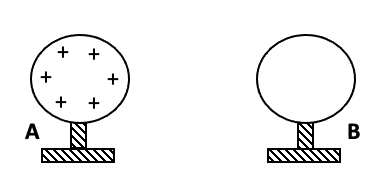 A has a positive charge, whilst B is neutral. ie A is at a higher potential than B. A has a positive charge, whilst B is neutral. ie A is at a higher potential than B.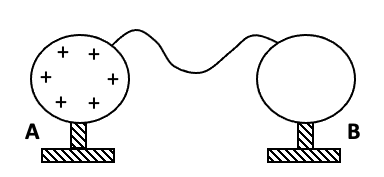 The two spheres are brought into contact or have a conductor placed between them such as this wire. The two spheres are brought into contact or have a conductor placed between them such as this wire.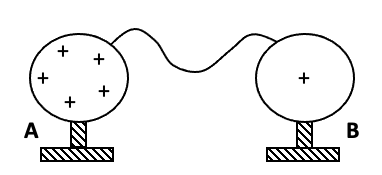 Because of the difference in potential, electrons will be attracted towards A and so a current will flow in the wire. As electrons leave B, B will become more and more positive. As electrons enter A, A will become less and less positive. Because of the difference in potential, electrons will be attracted towards A and so a current will flow in the wire. As electrons leave B, B will become more and more positive. As electrons enter A, A will become less and less positive.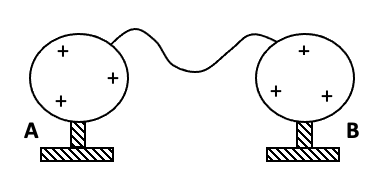 Eventually A and B will be at the same potential and the flow of electrons between the two spheres will stop.If the wire were removed, each sphere would remain like this, they would not resort back to the initial state. Eventually A and B will be at the same potential and the flow of electrons between the two spheres will stop.If the wire were removed, each sphere would remain like this, they would not resort back to the initial state. |
| Caution |
|---|
| It would be very tempting to say “positive charges flow from A to B“. But this would be wrong! Positive charges (ie the protons in the nucleus) do not move. B has become positive by losing electrons, whilst A has become less negative by gaining electrons. |
| Example |
|---|
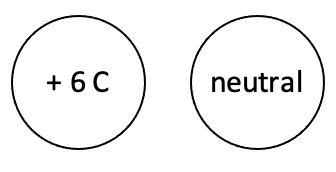
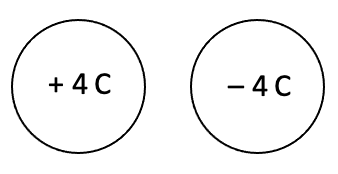
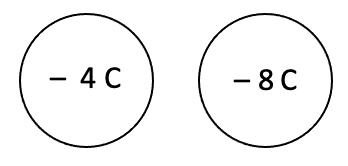
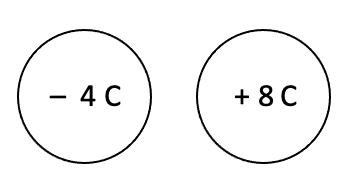
| The following pairs of identical charged metal spheres are made to touch. What is the charge on each sphere after touching?
(a) After touching there will be + 3 C on each sphere. (b) After touching each sphere will be neutral. (c) After touching there will be − 6 C on each sphere. (d) After touching there will be + 2 C on each sphere.
|
1.2 – Charging by Induction
E.g. a charged rod induces charges on a sphere without contact such that opposite charges reside on opposite ends of the sphere.
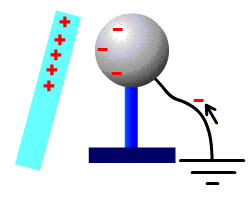
Induction can also be combined with earthing to charge an object.
Step 1:
A charged rod (blue) is brought close to a conductor (sphere). Charges in the conductor separate.
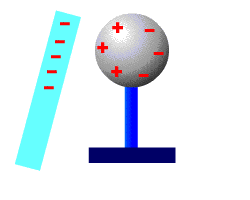
Step 2:
The conductor is earthed (touching with a finger will achieve this). This allows charges (electrons) to flow between conductor and ground.
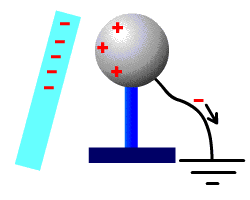
Step 3:
The earthing is removed. The conductor remains charged.
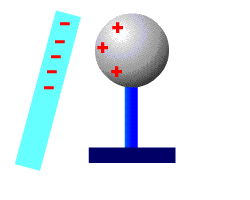
Step 4:
The charged rod can now be removed. Charges will redistribute themselves equally around the conductor.
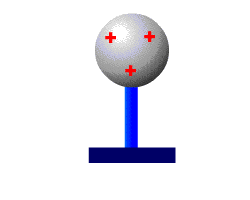
| Note 1: |
|---|
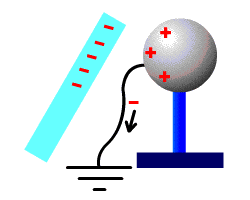
| If we had wanted to end up with a negatively charged conductor, then we should use a positively charged rod to induce the charge separation.
|
| Note 2: |
|---|
| Earthing the conductor can be carried out at any point on the conductor and the end result will be identical.
This one always seems a little strange. It is really a result of the electrons actually not being static as is suggested in the above diagrams, but rather being in constant and random motion around the conductor. |
| Animations: Charging by Induction (first 2 examples) http://www.physicsclassroom.com/mmedia/estatics |
2 – Discharging Conductors
- When exposed to a flame. Free ions in the flame remove excess charges.
- In moist conditions. Water vapour in the air remove the excess charges on the charged insulator.
- Discharging by earthing when a charged conductor is earthed (in the absence of an electric field) e.g. by connecting it to ground (earth) with a conducting wire, or touching it with a finger.
3 – Attraction of Conductors
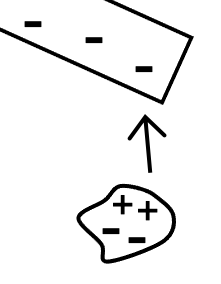
a non charged conductor, placed near to a charged conductor, will become induced and thus will be attracted.
| Example |
|---|
|
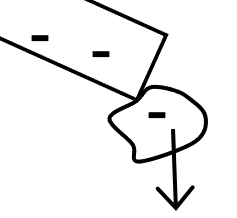
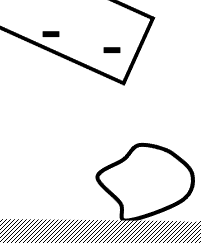
A negatively charged polythene rod is brought near to some aluminium shavings. Small aluminium shavings are attracts to the polythene rod.
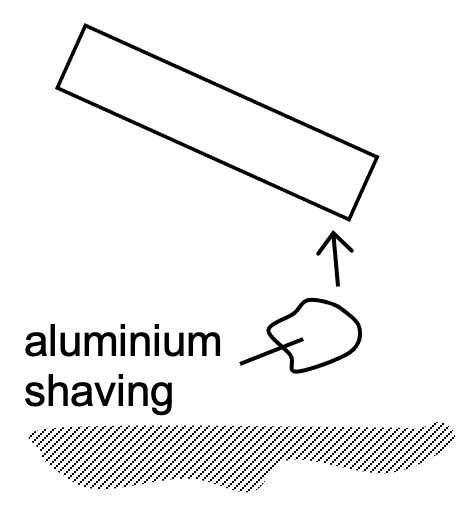 (a) Explain why there is attraction.
(b) Describe the subsequent motion of the aluminium shavings. Explain the motion. |
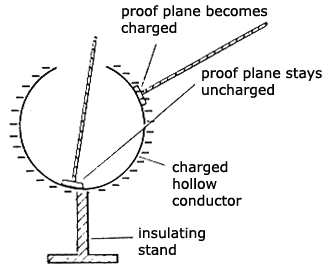
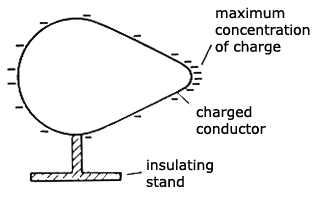
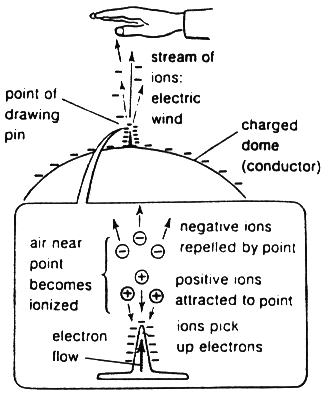
Distribution of Charges on a ConductorYou will not be tested on this Charge does not spead itself evenly over the whole surface of an object. The charge on a conductor collects only on its outside surface.
The concentration of charges is greatest where the curvature of the surface is the greatest.
For a point, the concentration of charge can be so great that ionisation of the air can take place.
|
| << Back | Electrostatics | Next >> |