Electrostatics is the study of Static Electricity; which deals with Stationary (Static) Charges.
It differs from Current Electricity, which is which charges (usually electrons) flow through conductors (wires).
Basics Points
- Objects can be neutral (positive and negative charges are equal) or electrically charged. There are two types of electrical charges, positive and negative.
- The SI unit for charge is the coulomb. The symbol for the unit is C.
- Electrons and protons have equal but opposite charges.
– The charge on an electron is 1.602 × 10⁻¹⁹ C of negative charge.
– The charge on a proton is 1.602 × 10⁻¹⁹ C of positive charge - Charged objects are formed due to the movement of negative charges (electrons) between objects. Positive charges (protons) cannot move in solids.
- An object becomes positively-charged when it loses electrons and thus, are left with excess positive charges. An object becomes negatively-charged when it gains electrons to have excess negative charges (electrons).
- The electrostatic force (or electrical force) between two charged point-objects (whether attractive or repulsive) increases with decreasing distance between them.
| Law of Conservation of Charge |
|---|
| Charge is conserved. It cannot be created or destroyed. |
| Law of Electrostatics |
|---|
| Unlike charges attract; and like charges repel. |
| Example 1 |
|---|
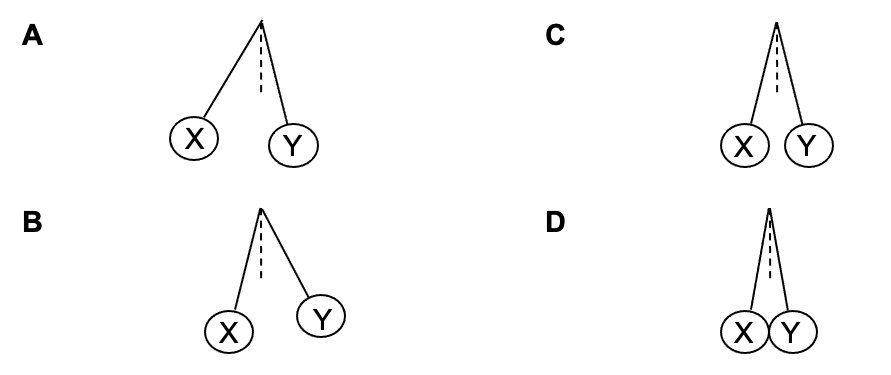
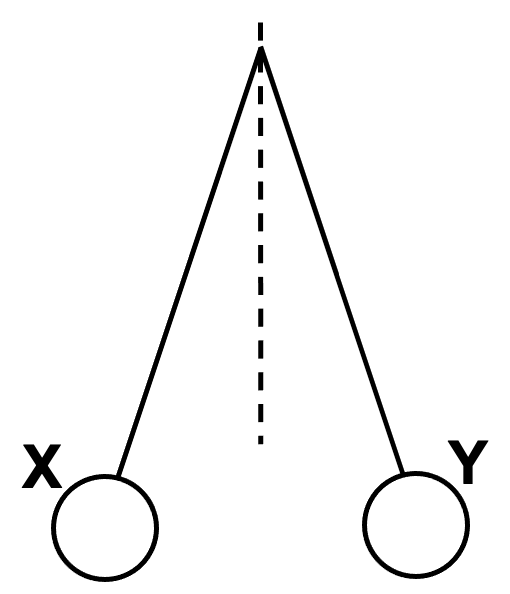
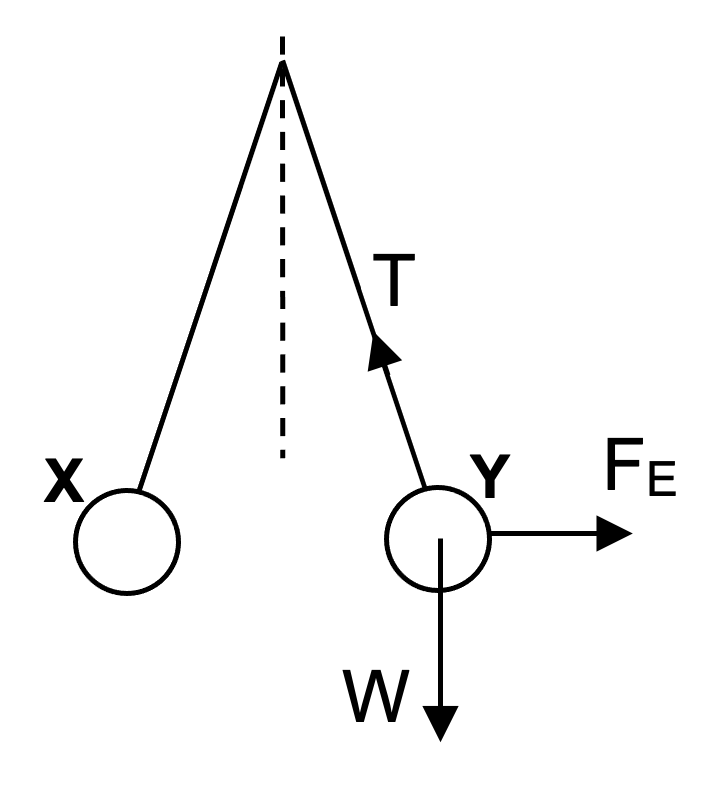
| Two identical light conducting spheres X and Y are suspended by insulating threads as shown. Both spheres carry positive charges. However, sphere X carries more positive charge than sphere Y.
Which of the following diagrams shows the correct final positions of the two spheres?
|
Guidelines on drawing of charge signs on objects:
- A neutral object has equal amount of positive and negative charge. Unless otherwise instructed, no charge sign is drawn on it.
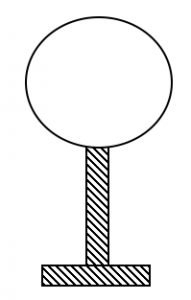
- An isolated charged object has charge uniformly distributed on its surface. E.g. a positively charged sphere.
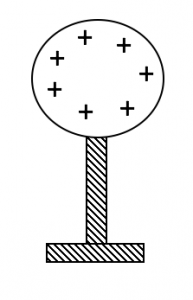
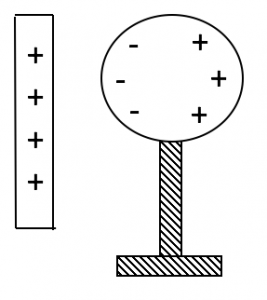
- When a charged rod induce charges on a neutral metal sphere, draw equal number of opposite charge signs on each side of the sphere.
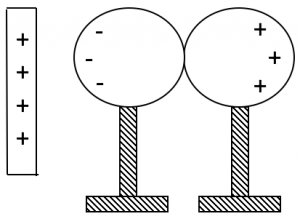
- If a charged rod induce charges on two metal spheres touching each other, the two spheres behave like a single conductor. Opposite charges are induced on opposite ends of the spheres.
| Caution |
|---|
| Consider the following:
The diagram above is telling us that the object has a net positive charge. It does not imply that the sphere contains no electrons (negative changes). All that can be deduced from this is that there are more protons than electrons on the sphere. The sphere got to this state by having “lost” some electrons. It would be wrong to state that it had instead “gained” some protons. In matter protons are found in the nucleus and have fixed positions and thus do not move around (in a solid). |
Charging and Discharging
How we charge and discharge objects depends on whether they are insulators or conductors. This will be discussed in detail in the next two pages.
Earthing (also known as Grounding)
Conductors (and not insulators), such as this negatively charged sphere, can be discharged by earthing when there are no other charged objects nearby.
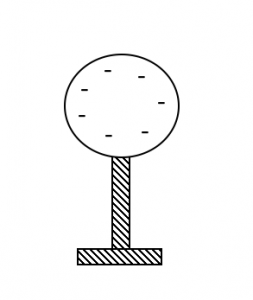 Earthing involves creating a conducting path between the object and the earth. This is easily achieved by touching the sphere which allows electrons to flow between the charged object and the earth. this will always result in the charged object becoming neutral (discharged).
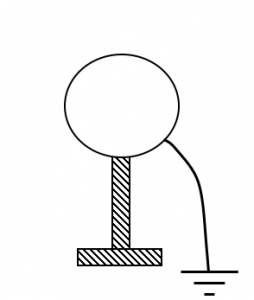 In this example electrons will have flowed down the wire from the sphere to the ground.
If the sphere had originally been positively charged then electrons would have flowed up the wire to neutralise the positive charge.
Note the three line symbol used to show earthing.
| Caution |
|---|
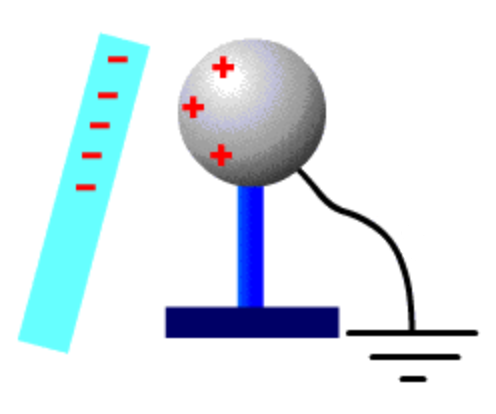
| If there is a charged object close to the object being earthed then the object will not become neutral.
e.g this sphere will not end up neutral after being earthed as there is a negatively charged rod held close to it. This is useful in charging conductors by induction. |
| Simulation: Objects brought near a charged rod https://javalab.org/en/conductor_and_insulator_en/ |
| Electrostatics | Next >> |
| Links |
|---|
| Simulation: Rubbing a Balloon https://phet.colorado.edu/en/simulation/balloons |