Marking Scheme Physics Planning Ex 1 to 3
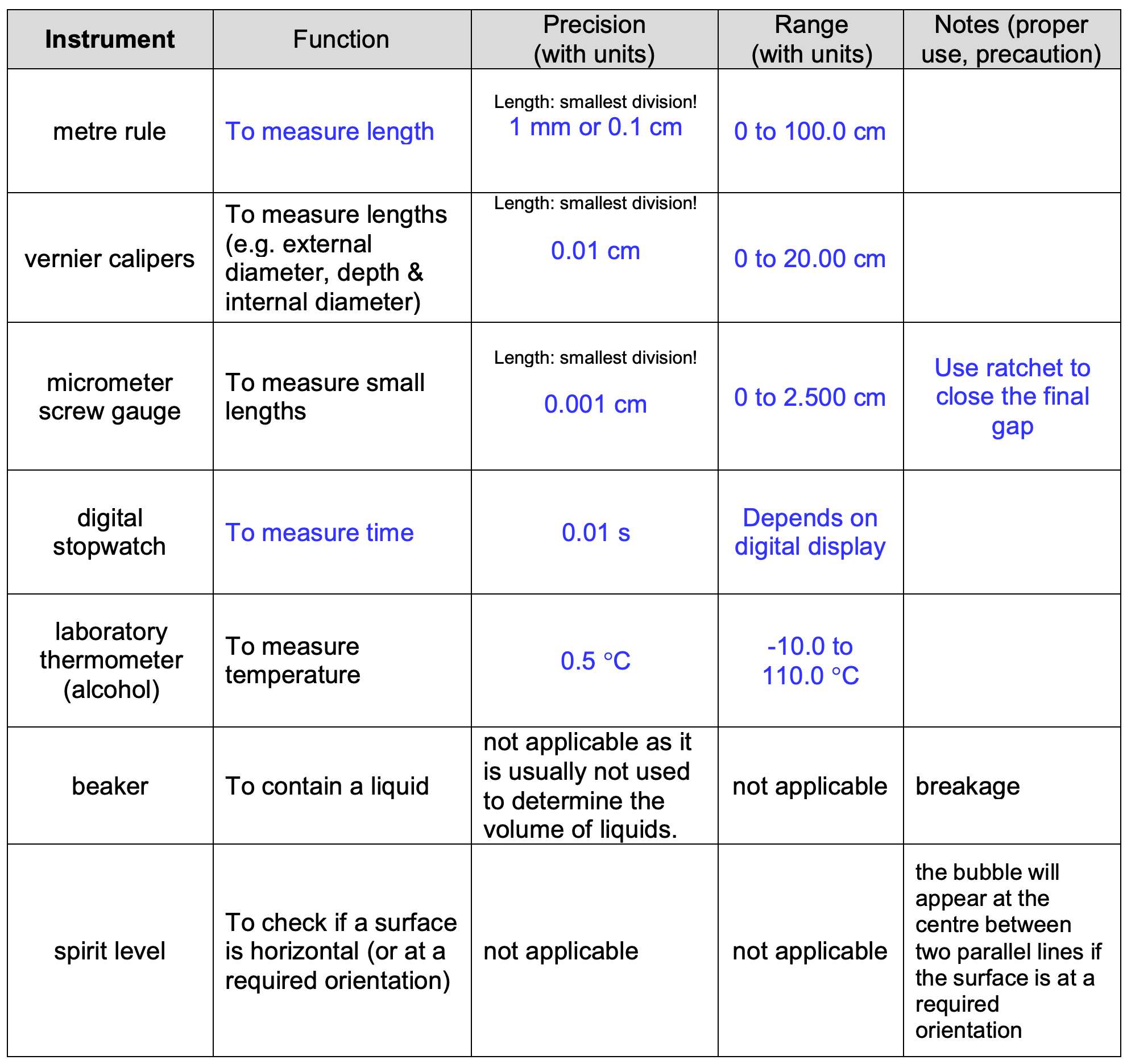
For a more complete list see:
physics.shone.sg/notes/basics/reading-raw-data/
1.
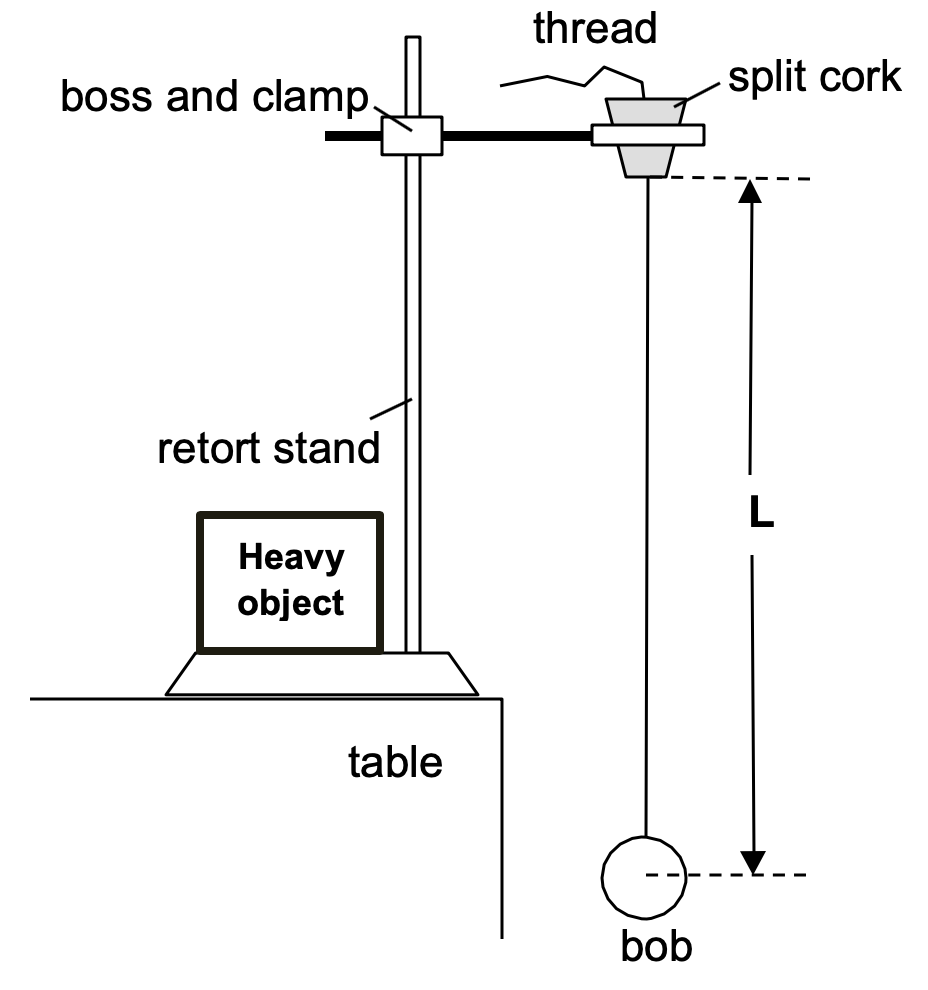 The length of a pendulum is to the centre of the bob – the CoG of the bob.
3. Place a heavy object at the base of the retort stand to ensure it will not topple. (see diagram above)
4. Any complete cycle: eg A→B→C→B→A
or
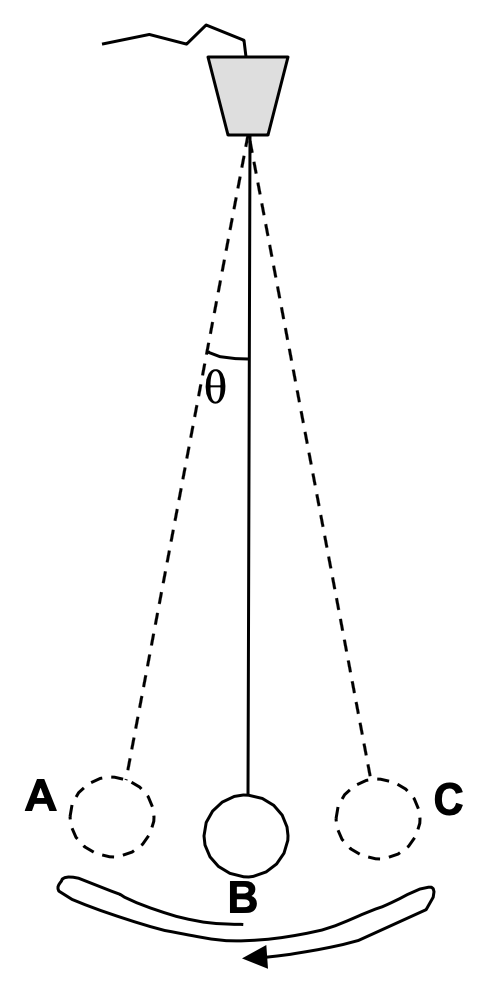
Reminder θ should be very small. Pull the bob just a few centimetres. Smaller angles actually give (slightly) better results. Max angle should be 10°. (Aim for 5° – estimate don’t need to use a protractor).
5. n =20
6. Use a reference vertical line (e.g. retort stand) at the centre of the oscillation when counting the oscillations.
7. Honestly in this experiment a single reading will suffice!
Reason: We are averaging any human reaction time over 20 oscillations. This already will likely give only a tiny error in an individual period.
8.

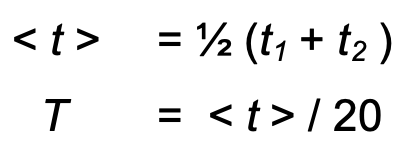
9. Ensure that the angular displacement θ (shown in Fig. 1.2) is smaller than 5° to reduce the effects of air resistanceon the oscillation.

2.

3. To account for non-uniformity in the lengths due to imprecise manufacturing.
1.
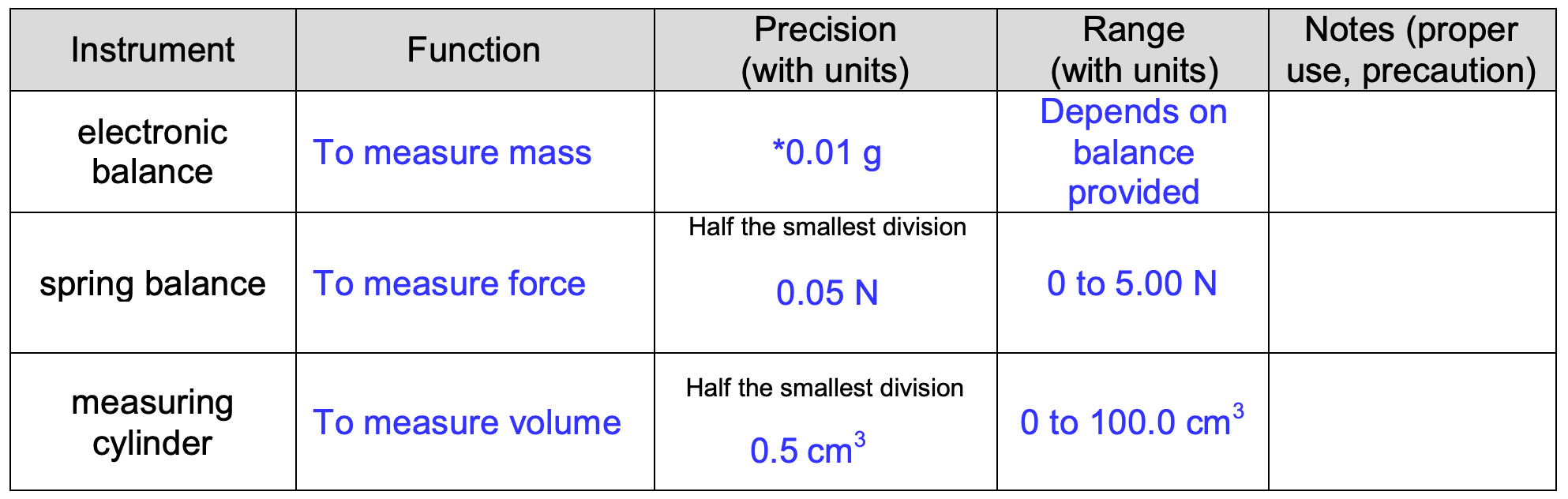
Ensure there is no zero error in the electronic balance before any measurement (press “tare”).
Ensure there is no zero error in the spring balance before any measurement. Ensure that the measuring cylinder is completely dry before any measurement.
Ensure that the 20 g mass is placed gently into the measuring cylinder with water without splashing.
2. Measure the total volume of all the 20 g mass available before taking the average.

1.
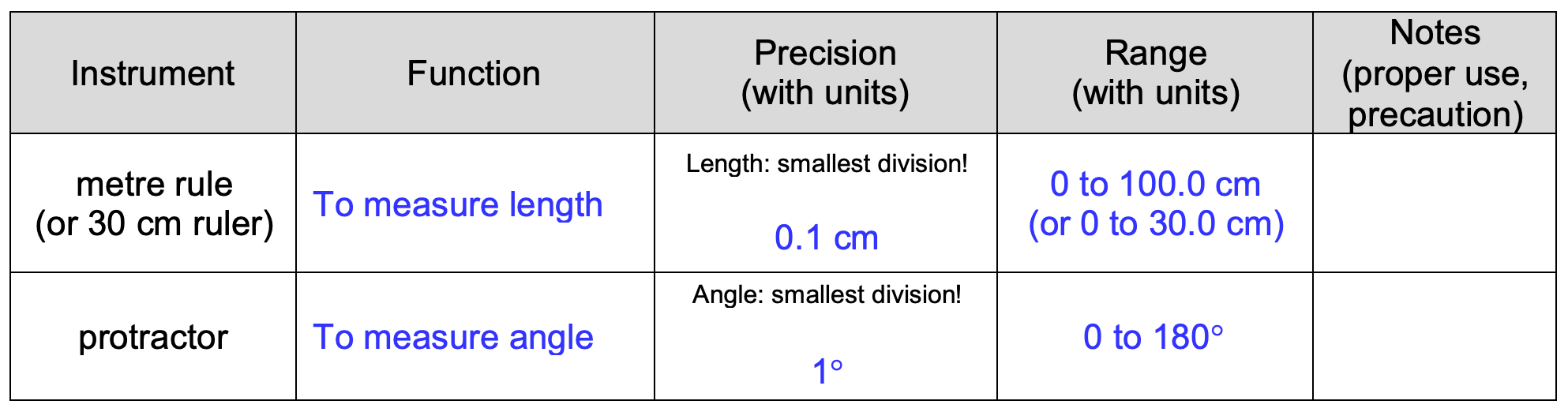
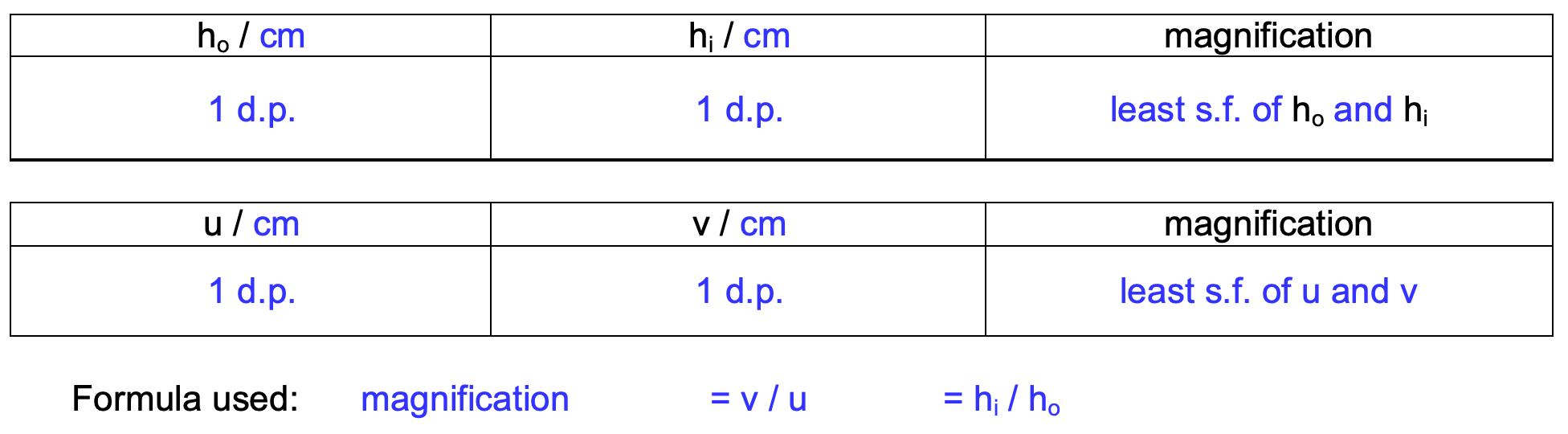
The optical pins were ensured to be vertical during the measurements.
Each pair of optical pins on each side of the glass block were ensured to be at least 5.0 cm apart.
The size of the holes made by the optical pins may be large and affect the accuracy of the lines drawn torepresent the refracted rays.
Date:
Thursday, 13 August (Week 10)
Time:
8:30 – 9:45 (75 mins)
Format:
15 MCQ (15 marks)
Structured Questions (35 marks)
Topics:
General Wave Properties
Sound
Static Electricity
Current of electricity
D.C. circuits
Practical electricity
Magnetism
Electromagnetism
7t75l24
Revised Deadlines:
Please be informed that the deadline for WA 2 is 15 June 2020, Monday. Please note that late submissions will be penalised. Zero will awarded for any submissions after 18 June 2020.
Is an infographic the same as a mind-map?
A mind-map is a type of infographic, but you don’t have to lay out everything like a mind-map. Also, mind-maps are frequently text-based, and we are encouraging you to use as many tables, charts, diagrams as possible to help in your explanations.
Can I use an App to help make the poster?
Yes.
Can I draw everything on paper?
Yes. But you will obviously need to scan this in at the end in order to submit online and meet the requirements of being an e-poster. The examples given to you on the WA2 Task Document was obviously created this way.
Can I use non-copyrighted photos/images from the internet?
No. All images must be created by you. Think of the task as being asked in an exam paper and you were given a blank piece of paper – what would you be able to come up with then?
But I can’t draw! Will I be penalised against for poor quality diagrams?
No (as long as you obviously tried your best!) Mr Shone can’t draw either, so he understands (and will not laugh) when your hand-drawn picture of a man looks like a chicken!
With the extended CB will the deadlines be changed?
The teachers have not been informed to make any changes at the current time. If there are any changes to deadlines you will be informed ASAP.
Hope this helps!
Stay safe. ?
Mr Shone
One of the most eventful of space missions!
An explosion on board on the way to the Moon left the astronauts scrambling to stay alive, and make it back to Earth.
The phrase “Houston, we have a problem!” (not an exact quote from the mission I know) is a popular quotation from the radio communications between the Apollo 13 astronauts and the NASA Mission Control Center, during the Apollo 13 spaceflight, as the astronauts communicated their discovery of the explosion that crippled their flight.
If you don’t know the story, I highly recommend watching the movie Apollo 13 – Not sure if its on Netflix at the moment.
Alternatively, listen to this great podcast
BBC Podcast – 13 Minutes to the Moon Season 2
Or present you were alive in 1970 and follow the “live”streaming from 50 years ago.
WA1 will be held on Friday, 21 February, White Space Period before school. (report by 8:00am)
Topics covered will be:
Ch 8: Refraction
Ch 9: Lenses
Ch 11: General Wave Properties
Format:
Notes:
Physics Quiz 1 (Non-graded) will beheld at the flowing times/dates:
404: Tuesday, 11 February @8:30 am
405/409/413: Monday, 10 February @9:30 am
410: Tuesday, 11 February @1:30 pm
Topic: All of Chapter 8: REFRACTION
Format: 10 marks / 15 minutes
Dear Sec 4s,
You are invited to apply for the Young Defence Scientists Programme (World of Science Modules 2020).
A total of 7 exciting WOS enrichment modules are offered this year! To help you better understand the fun and enriching WOS modules, the organiser prepared a short video which presents the highlights of WOS 2019. More details of the modules can be found in the attached WOS Synopsis 2020.
The WOS modules are open to IP4 (the equivalent of Sec 4) & IP5 (the equivalent of JC1) students, with a strong interest in Physics, Mathematics and Information Technology, and are able to commit their time fully.
A Certificate of Participation will be given to students who achieve 100% attendance for the modules. Please note that students may select up to three modules according to their preference. If selected, they will only attend ONE module.
Please note that WOS 2020 is only to Singaporeans.
Interested applicants who are able to fully commit may fill up an application form at https://forms.gle/vrCF1sfCLmsbqD5j9
The application will close on 7 Feb 2020. Places are limited.
Late applications will not be entertained.
Regards,
Your Physics Teachers
Dear students,
Interesting interview with one of the world’s most popular scientists – Neil deGrasse Tyson.
https://podcasts.apple.com/us/podcast/talk-nerdy-with-cara-santa-maria/id832350989?i=1000461778340
Welcome back!
We will continue to use the same Google Classroom as last year. Please rejoin this if you are no longer in the group: k9nzs50