Since all measurements are never actually perfectly precise, all measurements taken in the laboratory are approximations to the true value with some uncertainty. For most of the instruments that you are handling, a general rule of thumb is to simply assign one half the smallest scale-division as the uncertainty in your measurement.
As an example, say you need to measure 4 cm3 of water. Using a measuring cylinder with the finest graduation marked to 0.2 cm3, your measurement will have an uncertainty of ±0.1 cm3; this means that you could record your measurement to 4.0 cm³ quite reliably. If you use a 10-cm3 measuring cylinder with graduation marked to 0.02 cm3, you could report your measurement to 4.00 cm3.
With a reading of 4.00 cm3, which specifies the volume down to the hundredth of a cubic centimetre, there is no information on the thousandths place, but we are sure that the digits 4.00 are reliable. These three digits are referred to as significant digits. Significant digits, which are also called significant figures, are very important in measurements and calculations. Each recorded measurement has a certain number of significant figures.‘Decimal Places’ is not the same as ‘Significant Figures’.
For any measurement, the number of decimal places will depend on the unit used. Whereas the number of significant figures shows us the precision to which the measurement has been made and is independent of the unit.

- None of the three readings is more or less precise than the others. They all have the same degree of precision (as expressed by the no. of sig. fig.).
The number of decimal places is determined by the choice of units.
Rules for Significant Digits
- All non-zero digits (1 to 9) are always significant.
- Zeros between two other significant digits are always significant
- Trailing zeros (on the right) in a number containing a decimal point are significant.
- Leading zeros (on the left) in a number containing a decimal point are not significant.
- The significance of trailing zeros in a number not containing a decimal point can be ambiguous.
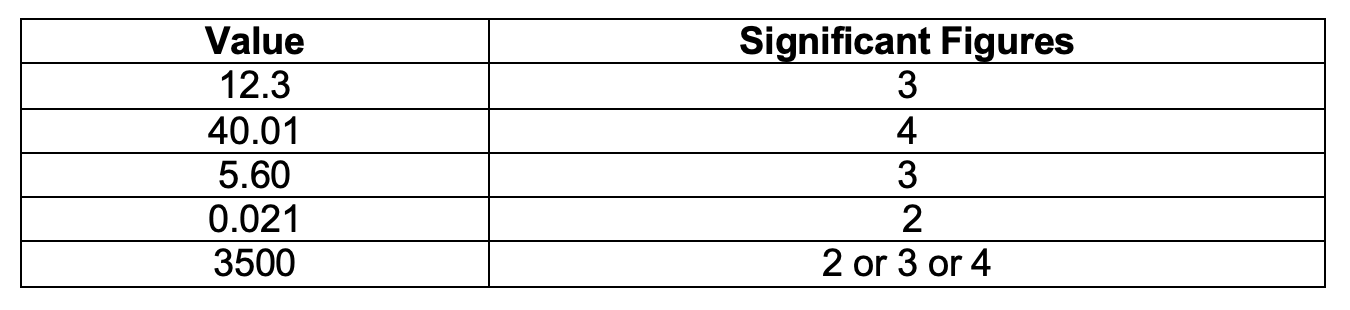
The number 3500 is ambiguous; it can either be 2, 3 or 4 significant figures. To remove ambiguity, use standard form or scientific notation for representation.
| Basics |