| Definition: Work Done |
|---|
| Work done by an object is the amount of energy that has been converted from one form to another or transferred from one body to another. |
| Understanding |
|---|
| Being asked to “find the work done” is the same as being asked to “find the energy change“. |
SI unit is joule (J).
Work is a scalar quantity.
- Work is done when a force F acting on an object moved it a distance, d, in the direction of the force as given by
| Equation |
|---|
|
work done = force x distance moved in the direction of the force work = F × d
Where work is the work done measured in joules (J) F is the force applied measured in newtons (N) d is the distance moved in the direction of the force measured in metres (m) |
| Work Done by an object or on an object |
|---|
| When work is done by an object the object is losing energy.
When work is done on an object the object is gaining energy. |
| Is Work Done? |
|---|
| Is work done in lifting a child up into the air?
Is work done by person skiing down a mountain?
Is work done by a man pushing against a wall?
Is work done by a mother pushing a baby cart? |
| Example |
|---|
| Find the work done when a force of 50 N moves an object through a distance of 40 cm in the direction of the force. |
| Example |
|---|
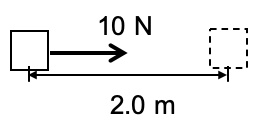
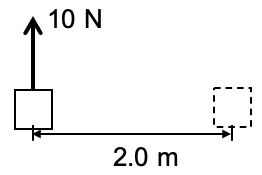
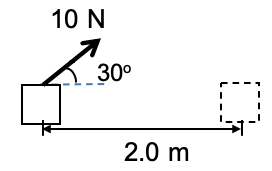
| An object under the action of a force of 10 N, moves 2.0 m. What is the work done by the 10 N force on the object in each of the following scenario?
(a) F is parallel to the direction of motion
(b) F is perpendicular to the direction of motion
(c) F is30° to the direction of motion
|
| Example |
|---|
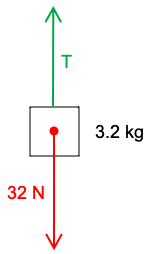
| A man pulls a bucket of water slowly up from a well. Given that the mass of the bucket of water is 3.2 kg, calculate the minimum work done by the man to bring the bucket of water up from a depth of 5.0 m. |
| Example | ||
|---|---|---|
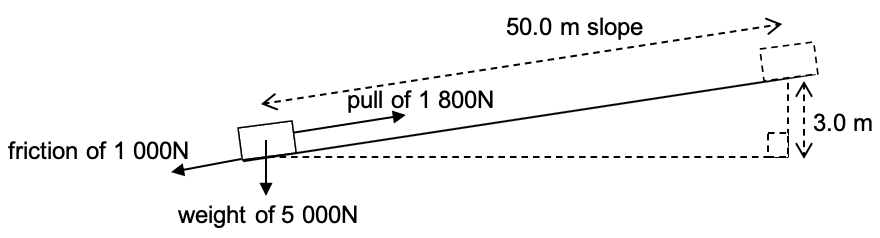
| A block of weight 5000 N is at rest at the bottom of a slope. It is pulled up the slope for 50.0 m by an applied force of 1800 N. The friction between the block and the slope is 1 000 N.
(i) the work done by the pulling force,
(ii) the work done against friction,
(iii) the work done against gravity,
(iv) the potential energy gained by the block.
(b) Using your answers to (a), determine the change in kinetic energy of the block as is it reaches the top of the slope.
(c) calculate the speed of the block at the top of the slope. |
| << Back | Work, Energy, Power & Efficiency | Next >> |