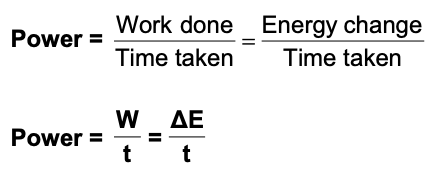
Since work involves energy, we can also define power as:
Power is also the rate at which energy changes from one form to another.
The SI unit is watt (W).
One watt is equal to one joule per second or 1 W = 1 J s-1.
Example
Calculate the power of a crane that lifts a 500 kg load through a vertical height of 10 m in 25 s.
Work done on load = gain in GPE = mgh
=500 kg × 10 N kg⁻¹× 10 m
= 50 000 J
Power = Work Done / Time Taken
= 50 000 J /25 s
= 2 000 W
= 2.0 kW
Example
How long will it take an electric motor of power output 25 kW to lift a mass of 1000 kg through 20 m?
Time = Work Done / Power
= (1000 × 10 × 20) / 25000
= 8.0 s
Example
A sprinter of mass 60 kg reaches a speed of 7.6 m s-1 after accelerating for 0.90 s from rest. What is the useful power provided by his leg muscles?
Gain in KE = ½mv²
= ½ (60) (7.6)2 = 1732.8 J
Useful Power developed = energy gain / time
= 1732.8 / 0.90
= 1925.33
= 1900 W (2 s.f.)
Example
A spacecraft must at least have a velocity known as “escape velocity” in order to leave the earth to fly to outer space. The engine of a rocket accelerated the rocket of mass 1500 kg from rest to the escape velocity of 11 km s-1 in 10 minutes.
(a) What is the lowest kinetic energy the rocket must possess to leave the earth?
Lowest KE = ½mv2
= ½(1500) 110002
= 9.1 × 10¹⁰ J
(b) What is the average power of the rocket engine?