| Definition: Energy |
|---|
| Energy is defined as the capacity to do work. |
- SI unit is joule (J).
- It is a scalar
Energy appears in various forms like:
-
- kinetic energy
- gravitational potential energy
- elastic potential energy
- chemical potential energy
- magnetic potential energy
- light energy
- sound energy
- electrical energy
- thermal energy
- nuclear energy
Energy can be converted (changed) from one form to another.
Kinetic Energy (EK)
The kinetic energy EK of an object of mass, m, moving with velocity, v, is given by the equation:
Where: m -mass of the moving object measured in kilograms (kg) v – velocity of the object measured in metres per second (m/s) |
| Example |
|---|
| A ball of mass 520 g is moving with a velocity of 5.0 m s-1. Calculate its kinetic energy. |
| Example |
|---|
| a) What is its KE of a 1 kg trolley moving at 10 m s⁻¹?
b) What is its KE of a 2 kg trolley moving at 10 m s⁻¹? |
When the mass of a moving object is doubled, its kinetic energy increases by two times.
| Example |
|---|
| A trolley has a mass of 2 kg.
a) What is its KE when it is at rest?
b) What is its KE when it moves at 10 m s⁻¹?
c) What is its KE when it moves at 20 m s⁻¹?
|
When the velocity of a moving object is doubled, its kinetic energy increases by four times.
| Example |
|---|
| An object of mass 420 g accelerates from 5.0 m s-1 to 20.0 m s-1. Calculate its change in kinetic energy. |
| Caution |
|---|
| In the above question, the change in kinetic energy at each speed must be calculated. We cannot just take the KE associated with a speed of 15 m s⁻¹. |
Gravitational Potential Energy (EP)
The change in gravitational potential energy EP when an object of mass, m, is raised through a height, h, where g is the gravitational field strength is given by:
Where: m -mass of the moving object (kg) g – gravitational field strength (m s¯²) h – vertical distance through which the object is raised (m)
|
| Example |
|---|
| What is the gain in gravitational potential energy that an object of weight 30 N gains as it is lifted by 3.0 m? |
| Example |
|---|
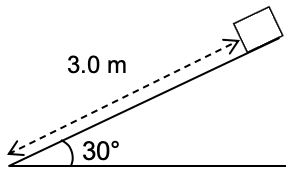
| If an object of mass 3.0 kg slides 3.0 m down a smooth plank slanted at an angle of 30° to the horizontal, what is its loss in gravitational potential energy?
|
| Caution |
|---|
| Although we often state that an object posses X joules of GPE, it is always with reference to a certain (arbitrary) height.
For example, we often state that an object on the floor will have zero GPE. However, we need to understand that if a hole is dug and the object is lowered into it, it will have less GPE. However, it should not be confused with possessing negative energy. |
| Work, Energy, Power & Efficiency | Next >> |