Ultrasound
Ultrasounds are sounds above the audible range of humans. i.e. sounds of higher frequency than 20 kHz.
Dogs can hear many frequencies higher than humans are able to. Dog whistles make use of this.
Uses of Ultrasound
- Bats and many other animals use ultrasound for echo-location.
| Echo-location is also used by moths and other insects as well as dolphins.
Many animals can hear much higher sounds than humans can. Dogs can hear up to about 45 kHz, whilst cats can hear up to 65 kHz. |
- SONAR (Sound Navigation and Ranging): To measure distances in air or water. Detector calculates the distances from the reflected ultrasonic pulse.
| Ultrasound is better for echo-location and SONAR as ultrasound tends to be more directional than audible sounds. |
- Medical imaging: To examine internal tissues, organs of a patient, development of unborn baby (foetus). Ultrasound allows imaging because of the difference in time taken for the waves to return from different depths of the medium. Computers constructs images of tissues/organs/foetuses from reflected ultrasonic signals.
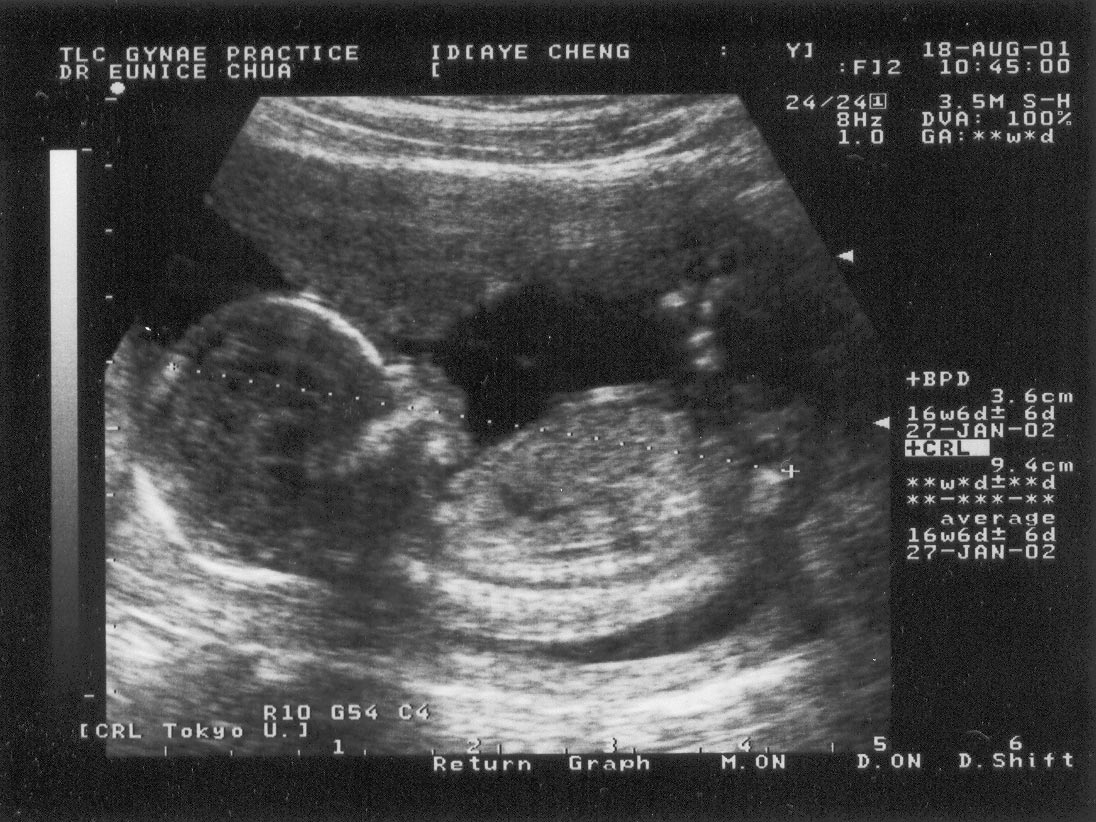 An example of an ultrasound scan of a foetus.
Understand that the image should not be thought of as a photograph,
but rather a cross-section through the patient.
- Non-destructive quality control in manufacturing: Detector monitors the strength of the ultrasonic signals passing through a product. Flaws or inconsistency in the product will affect the strength of the signals.
- Cleaning surfaces ultrasound causes formation of bubbles (cavitation) that can lift dirt away. This is frequently used to clean jewellery or delicate watches, rather than using strong chemical agents.
- Mixing chemicals, and accelerating chemical processes
| Example |
|---|
| To make a sufficiently detailed ultrasound image of a foetus in its mother’s uterus, a physician has decided that a wavelength of 0.50 mm is needed. What frequency is required? Take speed of ultrasound in the body to be 1540 m s⁻¹.
v = ƒ λ 1540 = ƒ × 0.00050 ƒ = 3.1 MHz |
Infrasound
Infrasounds are sounds below the audible range of humans. i.e. sounds of lower frequency than 20 Hz.
High power sound waves below 20 Hz are felt in the body, not heard by the ear as sound. You may have experienced this when standing next to a loudspeaker at a concert.
Elephants communicate through infrasound as the sounds can travel great distances in the forests without becoming weaker.
| Many other animals communicate via infrasound such as hippopotamuses, rhinoceroses, giraffes and whales. |
| Example 7 |
|---|
| Ultrasound is used to detect a crack in a piece of metal.
The scanner emits a pulse of ultrasound which is reflected from the crack. Which quantity does the scanner measure to determine the position of the crack? A the wavelength of the reflected pulse |

| << Back | Waves & Sound |
| Links |
|---|
| https://en.wikipedia.org/wiki/Ultrasound |
| https://en.wikipedia.org/wiki/Infrasound |