(ADVANCED PHYSICS TOPIC)
If a stretched string is plucked or struck, stationary waves may be produced.
Since the velocity of the waves along the string remains constant, a change in frequency causes the wavelength to change and different modes of vibration arise.
As the ends are fixed in position, there must be a node at each end of the string.
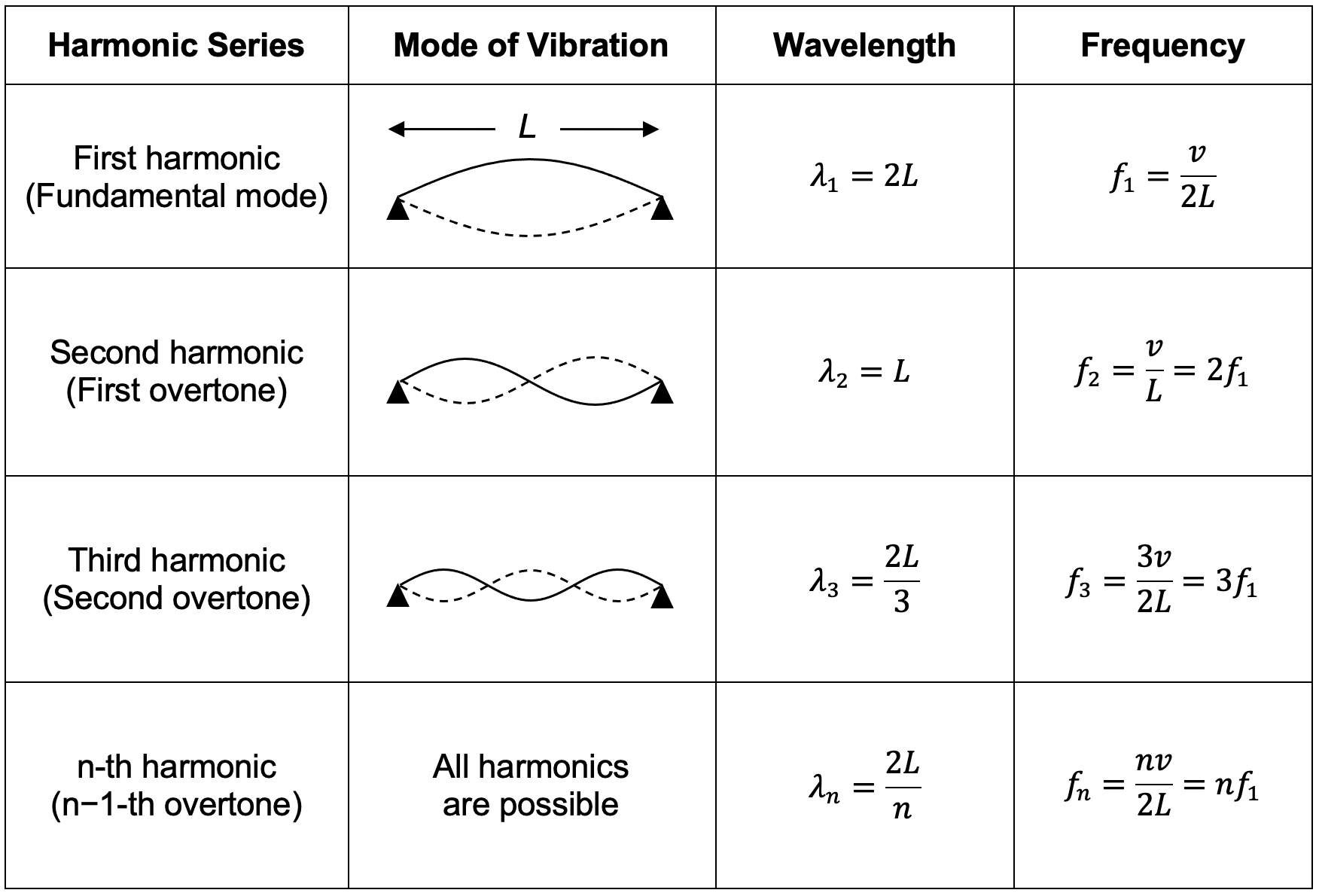
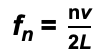
In general we can see that the frequency for the nth harmonic is given by:
All stringed instruments such as guitar, piano, violin are musical instruments that behave like a wave on a string.
| Example |
|---|
| A wire is fixed at each end under tension. A transverse wave of speed 300 m s⁻¹ is propagated along the wire and forms a standing wave pattern. In a certain mode of vibration, it is found that the nodes are 0.40 m apart.
What is the frequency of this standing wave? |
| << Back | Waves & Sound | Next >> |
| Links |
|---|
| Demo of Standing Waves Part 1: https://www.youtube.com/watch?v=-gr7KmTOrx0 |
| Demo of Standing Waves Part 2: https://www.youtube.com/watch?v=QcoQvzNQp6Q |
| “A Better Description of Resonance” Steve Mould – Rubens Tube https://www.youtube.com/watch?v=dihQuwrf9yQ |
| https://en.wikipedia.org/wiki/Harmonic |
| https://www.youtube.com/watch?v=wYoxOJDrZzw |