(ADVANCED PHYSICS TOPIC)
Stationary Waves in Air Columns
Stationary waves can also be formed in both open pipes (both ends are opened) and closed pipes (one end is closed).
Since the velocity of sound remains constant in air, different frequencies will produce different modes of vibration.
The closed end of the pipe is always a node because the layer of air molecules directly in contact with this end cannot vibrate.
The open end of the pipe is always an antinode since the air molecules at this end are free to vibrate.
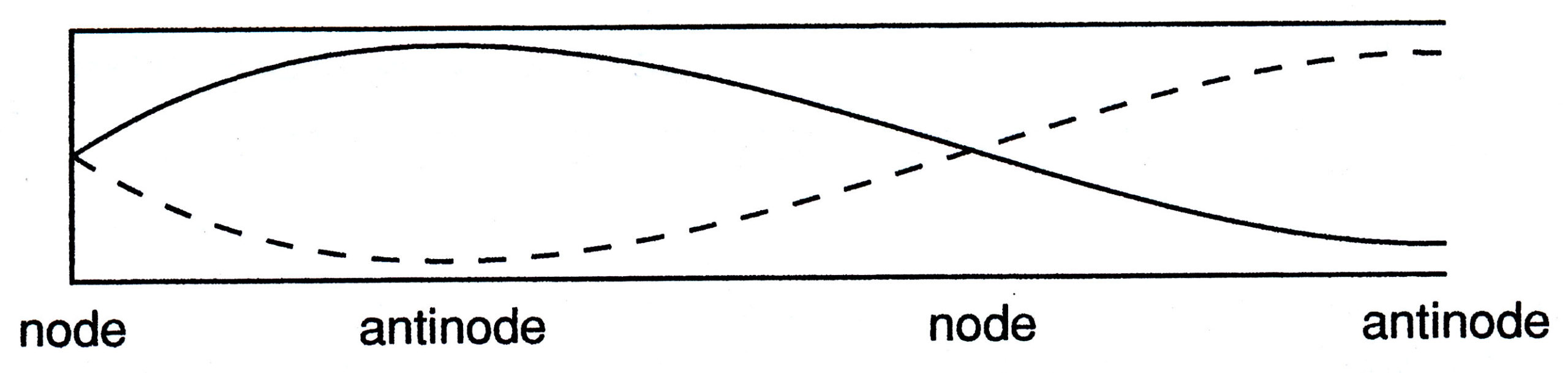
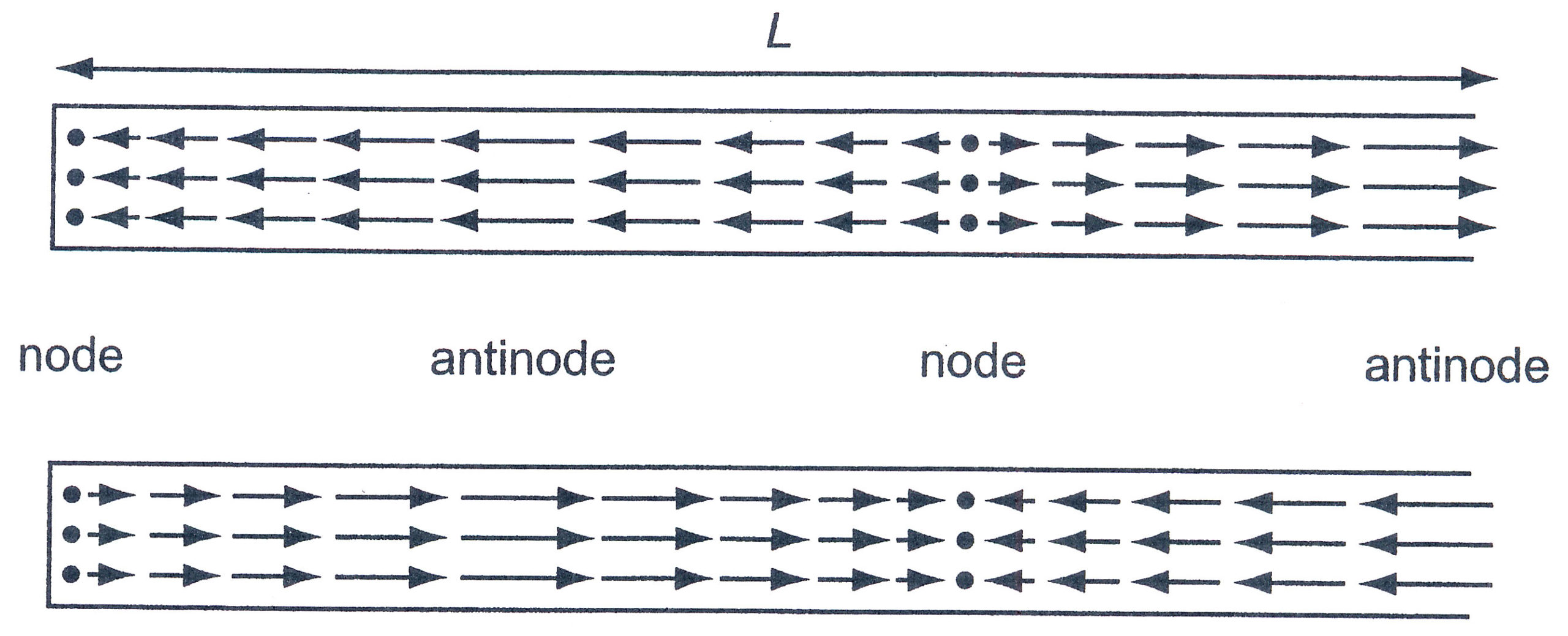
| Standing waves in pipes are often represented by diagrams such the this:
Note: here we have a closed pipe, having one end closed (and therefore a node) and the other end open (and therefore an antinode). Despite the lines going up and down, of course a sound wave is longitudinal wave and the lines can be thought of as a representation of the displacement of molecules in a particular direction. The pressure at the nodes changes by the maximum amount. The pressure at the antinodes does not change. |
| Interactive Applet: Demonstrating the Harmonics of Air in a Tube https://www.walter-fendt.de/html5/phen/standinglongitudinalwaves_en.htm |
Stationary Waves in Open Pipes
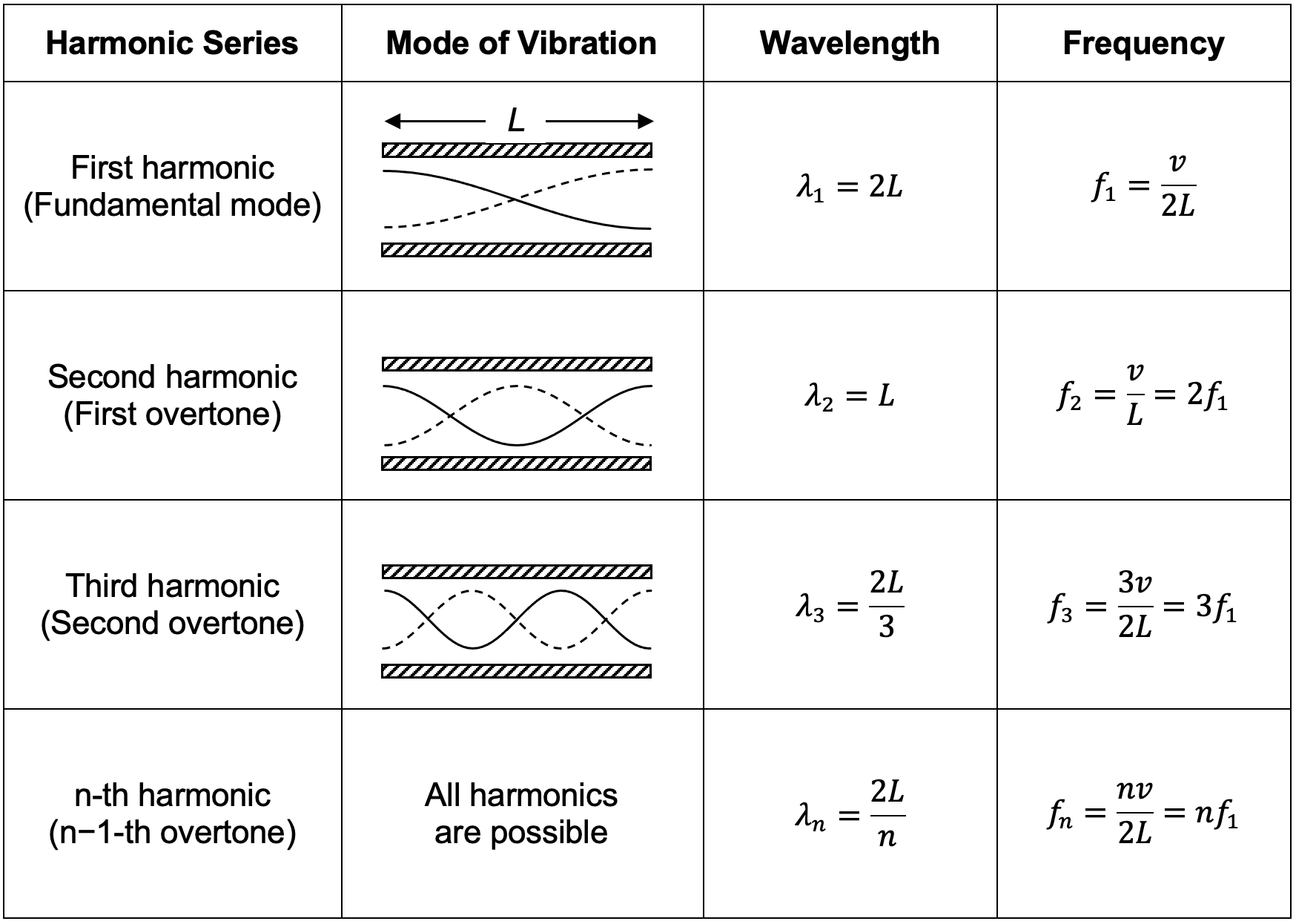
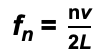
In general we can see that the frequency for the nth harmonic is given by:
A flute or an organ pipe are musical instruments that behave like an open pipe.
| Example |
|---|
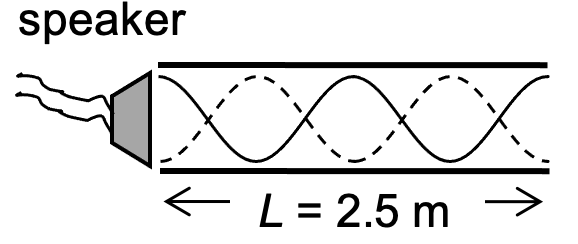
| A speaker is placed near one end of an open pipe of length 2.5 m. When the frequency of the speaker is 260 Hz, a stationary wave is formed within the pipe as shown.
Calculate the speed of sound. |
| << Back | Waves & Sound | Next >> |