(ADVANCED PHYSICS TOPIC)
Stationary waves (or standing waves) arise from the superposition of two progressive waves of the same frequency and amplitude moving with the same speed in opposite directions.
(For best effect right-click and select “Loop” for the videos below to see the animation play continuously).
Consider two waves (red and blue) with the same frequency and amplitude, moving with the same speed but in opposite directions.
These waves would add together to form the purple wave.
The purple wave (resultant of the red and blue) is shown by itself here. This is all that would actually be observed.
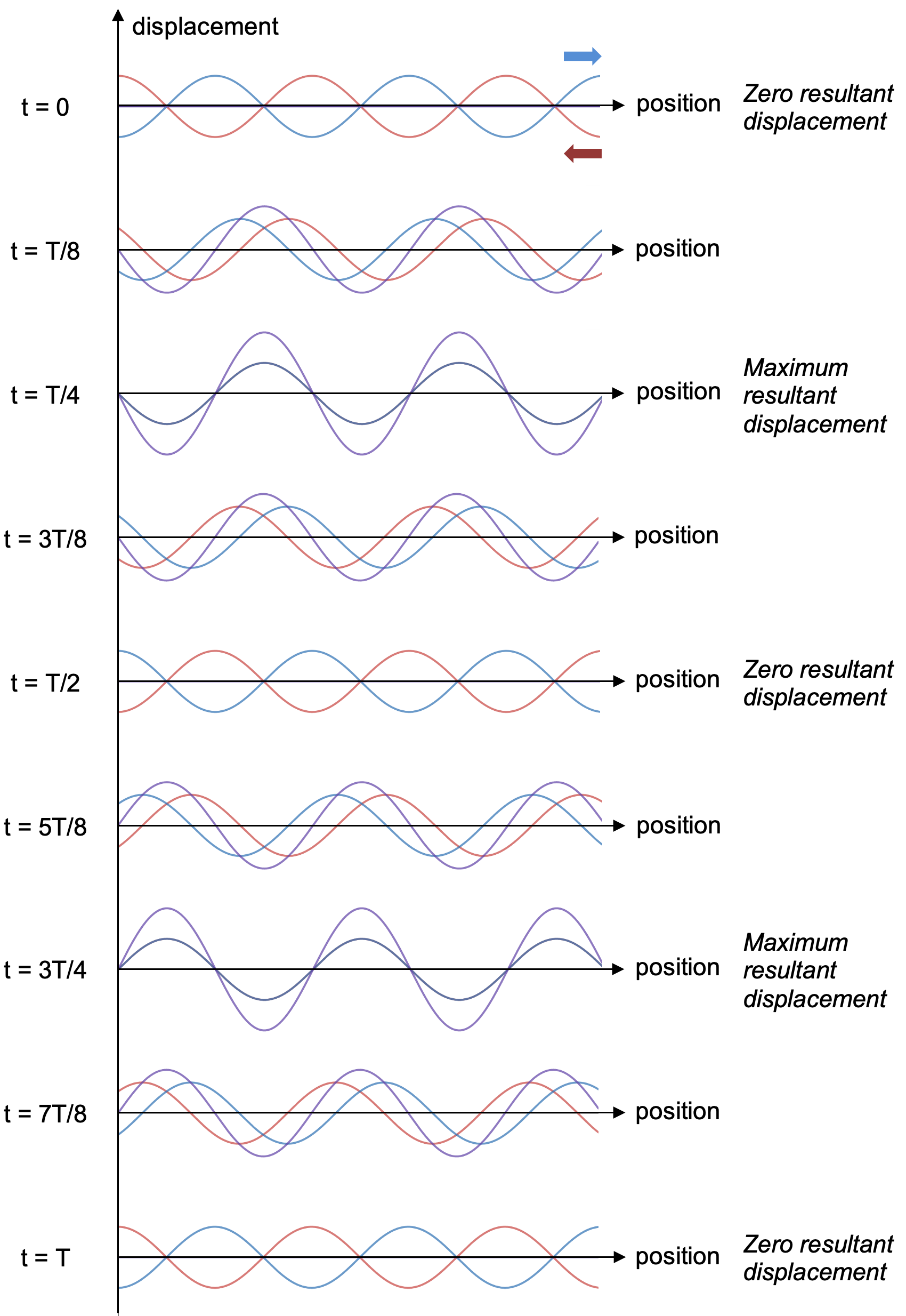
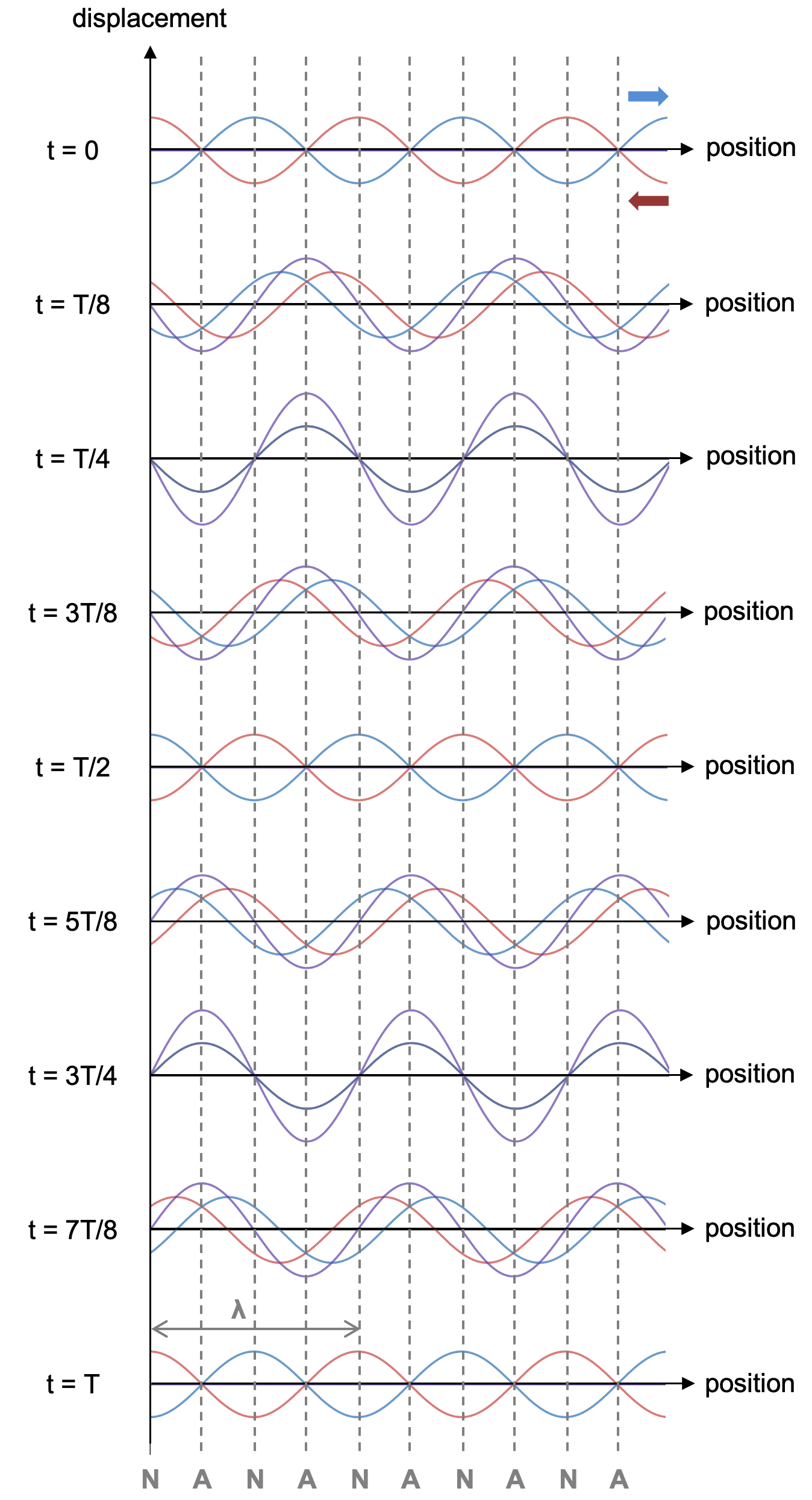
Different positions on the stationary wave will have different amplitudes.
Nodes are positions on the stationary wave where the displacement is always zero.
Anti-nodes are positions on the stationary wave where the amplitude is the largest.
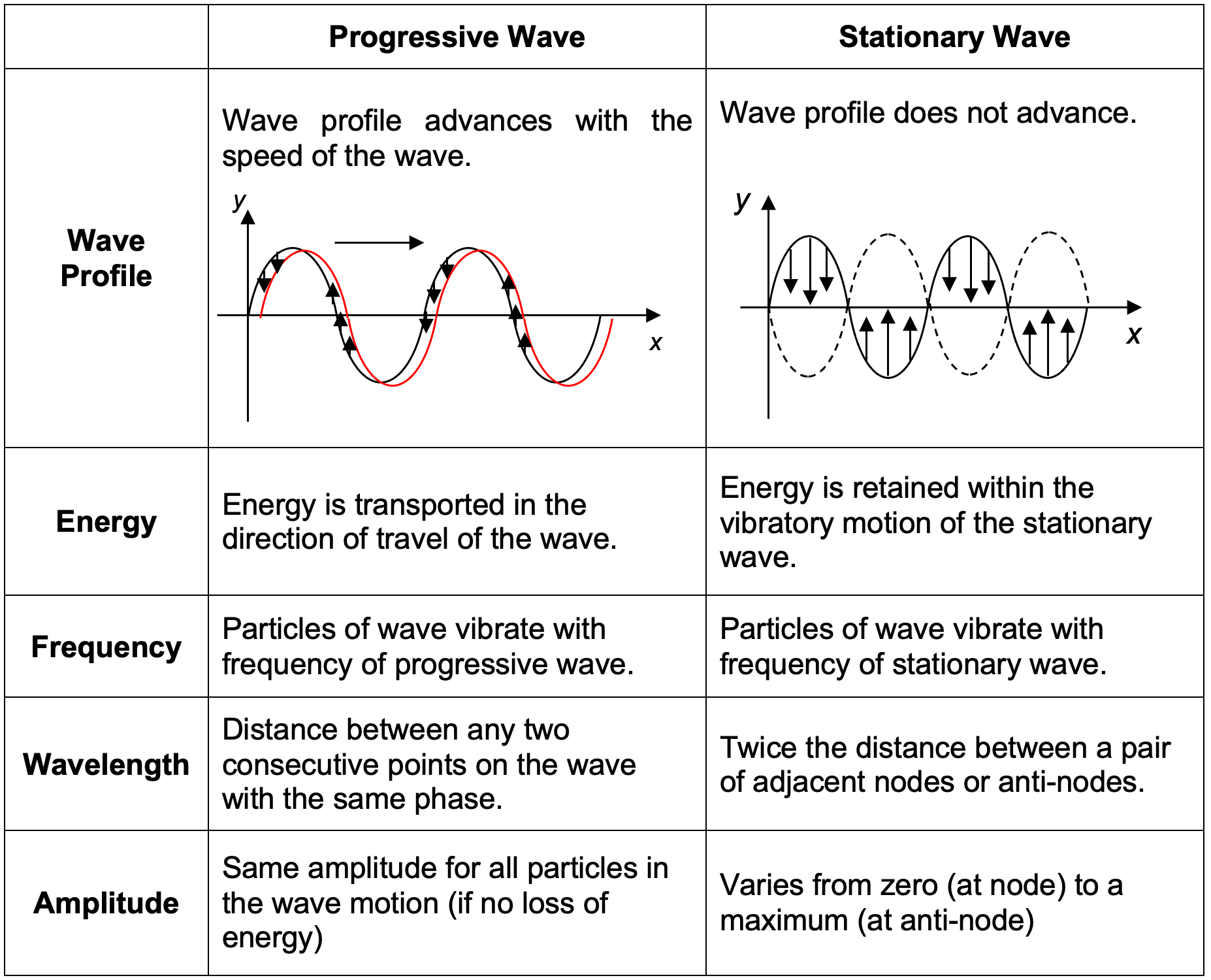
Comparing Progressive and Stationary Waves
| << Back | Waves & Sound | Next >> |
| Links |
|---|
| Wave simulation https://phet.colorado.edu/sims/html/wave-on-a-string/latest/wave-on-a-string_en.html |
|
Superposition graphs
|