Speed of sound differs in gases, liquids or solids due to differences in the strength of the interatomic forces, closeness of the atoms/molecules, and temperature.
Compressions and rarefactions propagate faster in denser media.
Some examples of speeds of sound are:
speed of sound in air ~330 m/s
speed of sound in water ~1500 m/s
speed of sound in solids ~5000 m/s
Why do we see lightening before we hear the thunder?
| Example |
|---|
| A lightning flash occurs 5.0 km away.
(a) Calculate the time taken for the sound to reach your ears.
(b) Calculate the time taken for the light to reach your eyes. |
| Note |
|---|
| Speed of light can be seen to be approximately one million times the speed of sound in air.
In most cases, the time taken for light to travel to the eye is considered so fast that it can be considered to be instantaneous. |
| Watching fireworks |
|---|
| Have you ever noticed, whilst watching fireworks, that the flashes you see and the bangs you hear are not synchronised! This is because the explosions are usually some distance away and the time taken for the sound to reach you is considerably longer than the time taken for the light to reach you. |
Measuring the Speed of Sound
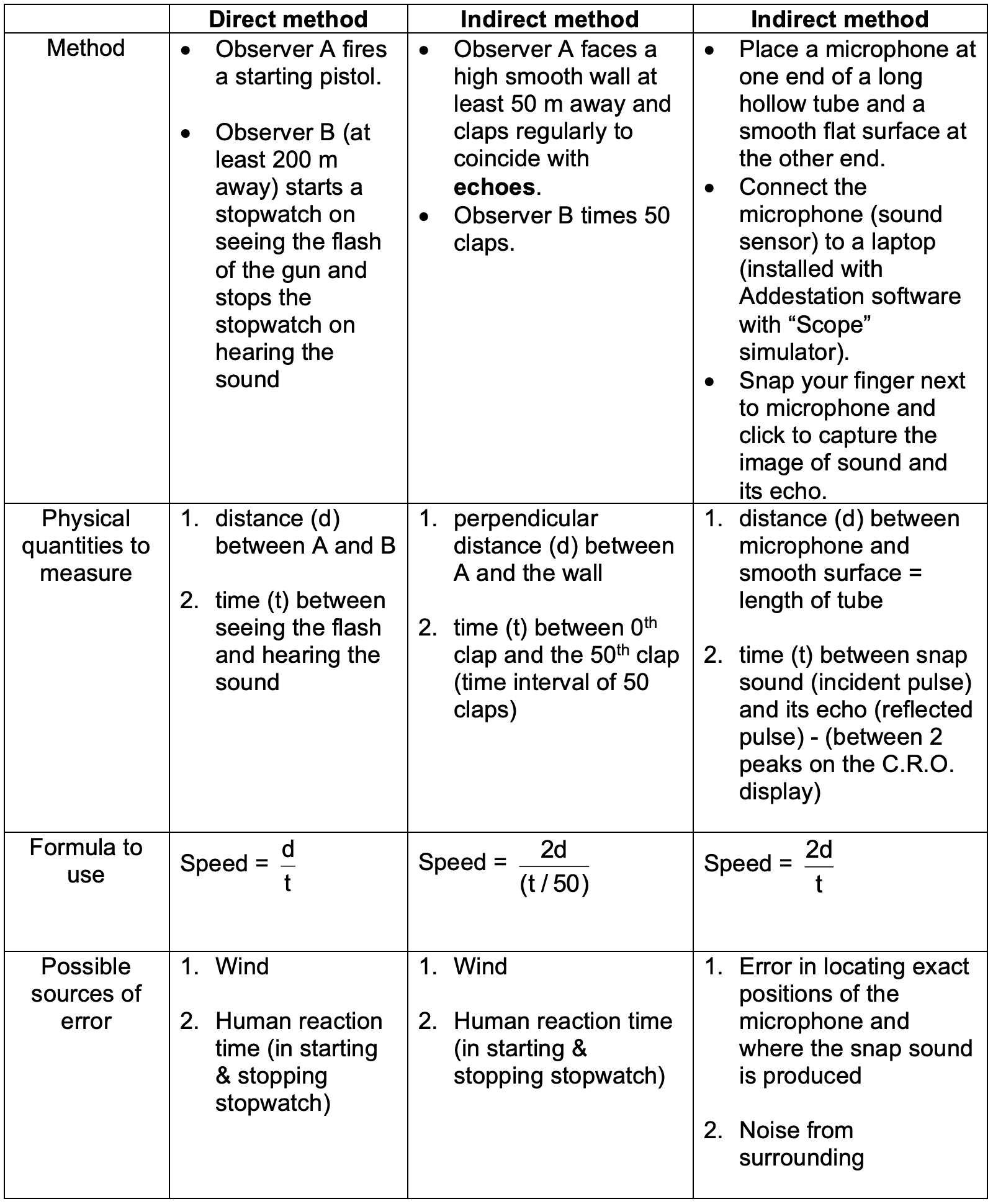
The speed of sound can be measured in several ways, either directly or via a reflection (indirect methods).
| Example 5 |
|---|
| A student stands some distance away from a cliff. She gives a shout and hears her echo 4.0 s later. Calculate the distance between the student and the cliff.
Take the speed of sound in air to be 330 m/s. |
| Example |
|---|
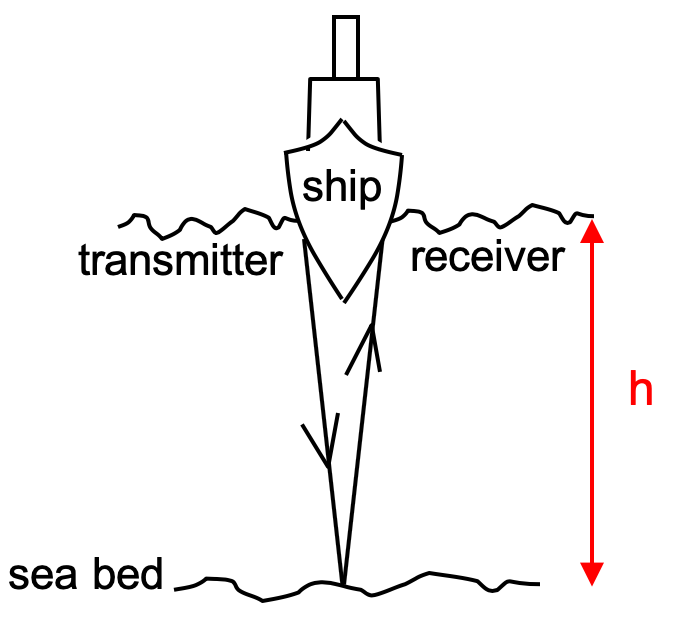
| A fathometer measures the depth of water below a ship by sending out a pulse of ultrasound and measuring the time taken for its echo to return. A simple diagram of the arrangement is shown below.
(a) Calculate the depth of the water if the time taken between transmission of a pulse of ultrasound and its echo arriving back from the seabed is 0.80 s and the speed of ultrasound is 1500 m/s.
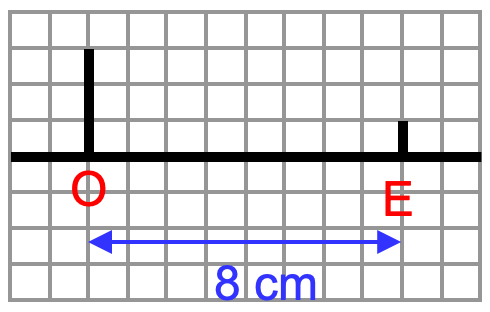
(b) The ship was using a c.r.o. to measure the time taken for the echo to return. Identify the original pulse (O) and the returning echo (E) on the c.r.o. display and state the time-base of the c.r.o.. 
|
| << Back | Waves & Sound | Next >> |