- Sound waves are produced by the vibration of objects, e.g. drum, tuning fork or vocal cords.
- Sound waves are propagated as longitudinal waves which travel in a direction parallel to the direction of the vibrations.
- Sound waves require a medium to travel, so they are classified as mechanical waves.
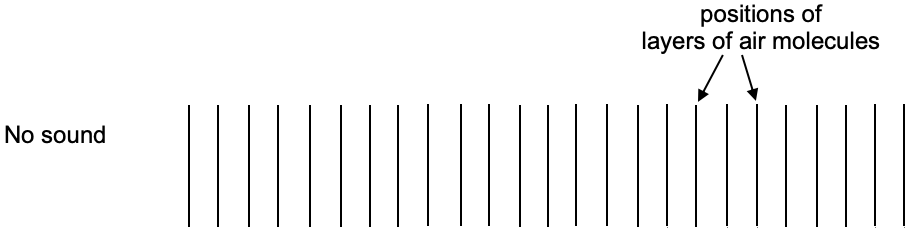
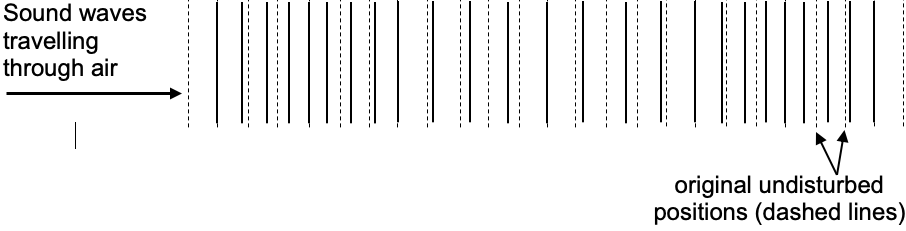

- When the vibrating object alternately pulls or pushes on the layers of air adjacent to it, it causes small but rapid changes in air pressure.
- Where the air layers are pushed closer together (than normal), the air pressure becomes higher than normal, and a region of compression is formed.
- Where the air layers are pulled further apart (than normal), the air pressure becomes lower than normal, and a region of rarefaction is formed.
| Pronunciation Guide |
|---|
| RAREFACTION
rair-uh-FACK-shuhn |
One wavelength is the distance between two successive compressions or between two successive rarefactions. The distance from compression to rarefaction is half a wavelength.
| << Back | Waves & Sound | Next >> |
| Links |
|---|
| Simulation of sound waves (longitudinal waves): https://www.geogebra.org/m/FDGVdN3J |