Whilst we can talk about waves moving in a certain direction (propagating), we need to understand that the particles that make up the wave are only able to oscillate (vibrate about a fixed point).
Therefore, the velocity of a wave and the velocity of the particles are different and the wave equation can only be applied to determine the velocity of the wave.
| Definition: Transverse waves |
|---|
| Transverse waves are waves which travel in a direction perpendicular to the direction of vibrations. |
Examples of transverse waves are: Water waves, electromagnetic waves, waves along a rope or string.
| Definition: Longitudinal waves |
|---|
| Longitudinal waves are waves which travel in a direction parallel to the direction of vibrations. |
Examples of longitudinal waves are: Sound waves
Longitudinal waves can also be called pressure waves or compression waves.
Waves along a slinky spring can be either longitudinal or transverse.
Earthquakes produce many different types of wave:
P-Wave (Primary) fastest (first to arrive) pressure wave and are longitudinal.
S-Wave (Secondary/Shear/Shaking) are transverse waves.
If matter (particles/atoms) is involved then the wave is said to be a mechanical wave. Otherwise it is an electromagnetic wave.
Describing Motion with Graphs
Two types of graph are commonly used to describe a wave both have displacement of particles (away from their mean position) on the y-axis.
Both types of graph can apply to longitudinal or transverse waves. (Do not be fooled by the fact that they look like a transverse wave.)
Displacement-Position Graph

Amplitude, A, can be measured from this graph by messing the maximum heights (displacements) of the particles from the mean position.
Wavelength, λ, can be found by measuring along the position axis (x-axis) as shown above.
Displacement-Time Graph
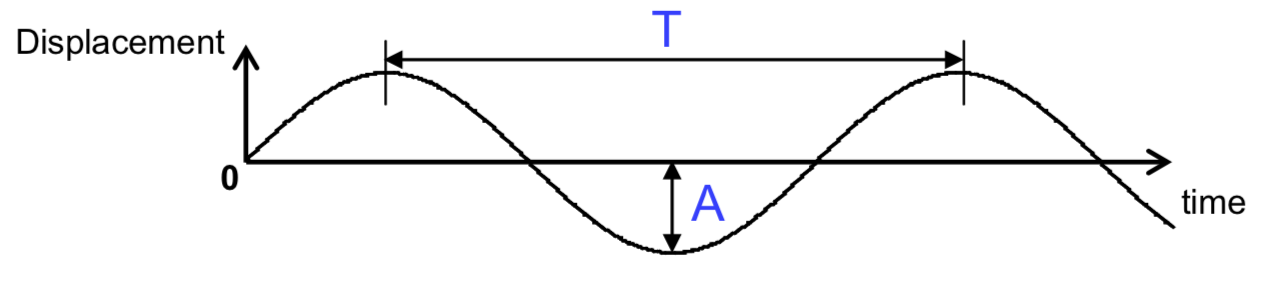
Amplitude can be found from this graph as above.
As the x-axis is now time, the distance from one wave to the next similar point on a wave is a measure of time and thus represents the period, T, of the wave.
Direction in Which Particles Are Moving
Direction of motion of particles from a displacement-time graph of a transverse wave.
Consider a transverse wave moving to the right as shown.
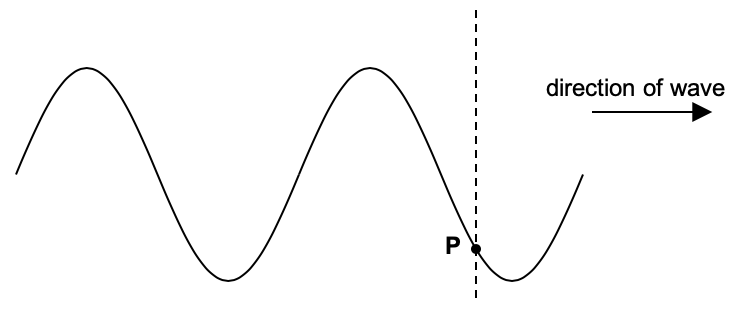 Any particle, such as P, must be moving perpendicular to the direction of propagation of the wave, i.e. will be vibrating up and down and thus will always be somewhere along the dashed line shown.
As we know the wave is moving to the right we can considering what the wave will look like a short while later (red line).
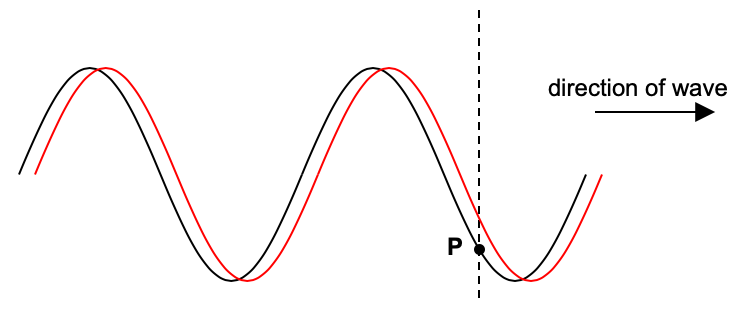
So P must now be at the position shown by the red dot.
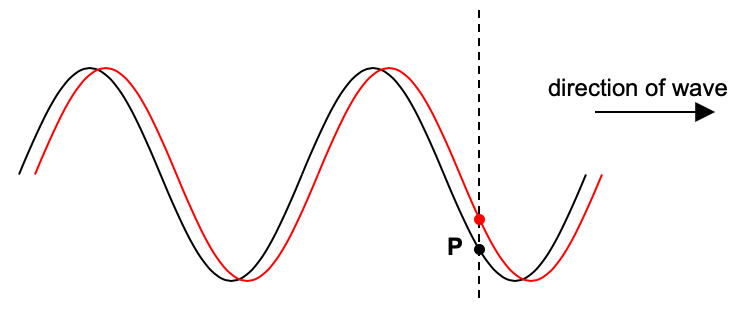 i.e. particle P must have been moving upwards at the instant shown.
As each particle vibrates up and then down, each particle at the crest or trough must be in the process of changing direction and so will actually be stationary. (In a similar way to a pen thrown into the air will be instantaneously stationary when at the highest point.)
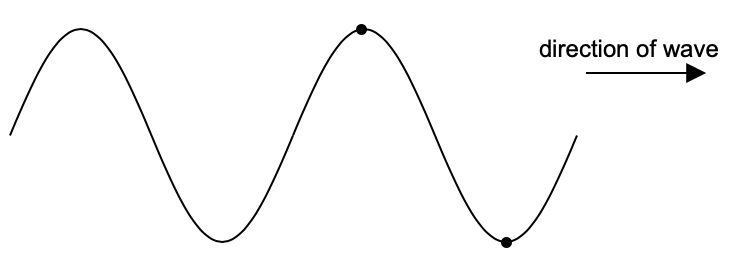 Two point at which the particle is momentarily at rest.
Conversely, the midpoint between these will be when the particles are travelling the fastest.
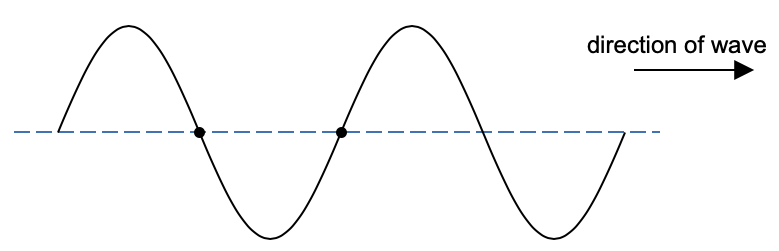
Both of these particles will be moving vertically at their greatest speed. You should be able to see that one is moving up whilst the other is moving down.
| << Back | Waves & Sound | Next >> |
| Links |
|---|
| http://phet.colorado.edu/sims/html/wave-on-a-string/latest/wave-on-a-string_en.html |