| Definition: Moment of a force |
|---|
| Moment of a force (or torque) about a point is defined as the product of a force and the perpendicular distance from the line of action of the force to the point. |
Moments of a force = Force x Perpendicular distance from the line of action of the force to the pivot
moment = F x d
- SI unit for moment is newton-metre (N m).
We may also use newton-centimetres N cm
(where 1 N m = 100 N cm) - It is a vector quantity with magnitude and direction.
- The direction is either clockwise or anticlockwise.
- The point about which the object rotates may be referred to as a pivot or turning point or fulcrum.
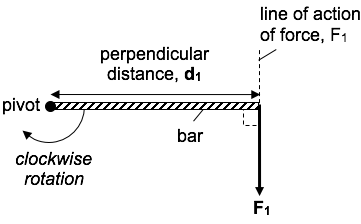
Clockwise Moments about the pivot = F1 x d1
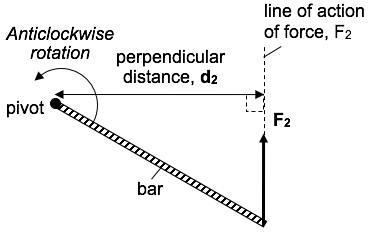
Anticlockwise Moments about the pivot = F2 x d2
| Taking moments about a point |
|---|
| Although we will usually be taking moments about a turning point, they can in fact be taken about any point. It is thus important to state where we are taking moments about. |
| Example 1A |
|---|
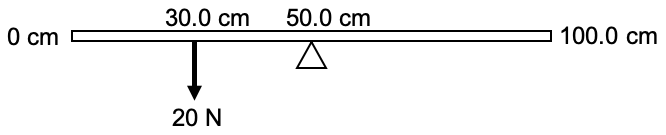
| A light metre rule is freely pivoted on a triangular prism at the 50.0 cm mark.
A force of 20 N is applied on metre rule at the 30.0 cm mark. Calculate the moment of the force on the metre rule about the pivot and state its direction. |
| Example 1B |
|---|
| The 20.0 N force is now applied to the 80.0 cm mark but in an upwards direction.
Calculate the new moment of the force on the metre rule about the pivot and state its direction. |

| Example 1C |
|---|
| The 20.0 N force is now applied to the centre of the rule as shown.
Calculate the new moment of the force on the metre rule about the pivot and state its direction. |

| Zero Moments |
|---|
| Whenever the line of action of a force passes directly through the pivot there will be zero moments and the object will not begin to rotate. |
| Is it a ‘light’ object |
|---|
| If we are told an object is ‘light’ it means we can assume it has negligible weight/mass and so we do not need to take this into consideration when calculating moments. |
| Example 2 |
|---|
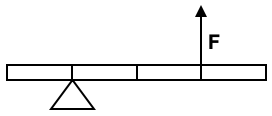
| Which method of applying a force, F, 2.0 m away from a pivot on a 4.0m plank will produce the larger turning effect about the pivot?
|
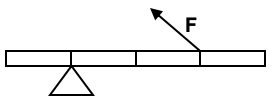
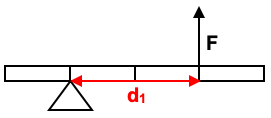
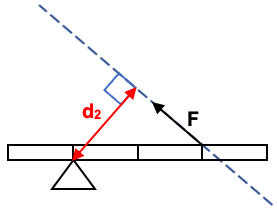
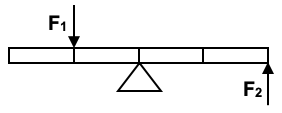
When two (or more) forces act on an object we add the individual moments produced by each force.
| Example 3 |
|---|
| Two 10 N forces act on a 4.0 m plank as shown below.
Calculate the resultant moment about the pivot. |
If the moments are in opposing directions then we need to subtract one from the other.
| Example 4 |
|---|
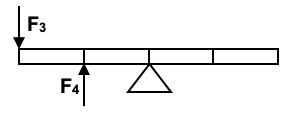
| Two 10 N forces act on a 4.0 m plank as shown below.
Calculate the resultant moment about the pivot. |
| Example 5 |
|---|
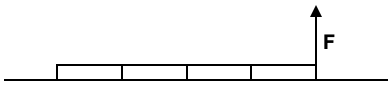
| A 1 m long uniform beam of mass 2 kg is being lifted by a vertical force, F, at the 100 cm mark.
What if the minimum force, F, that will lift the beam? |
| Turning Effects of a Force | Next >> |