| Definition: Centre of Gravity (CoG) |
|---|
| Centre of gravity of an object is defined as the point through which the entire weight of the object appears to act.
OR A point from which the weight of a body may be considered to act. |
Gravity acts on every point (atom) within a mass:
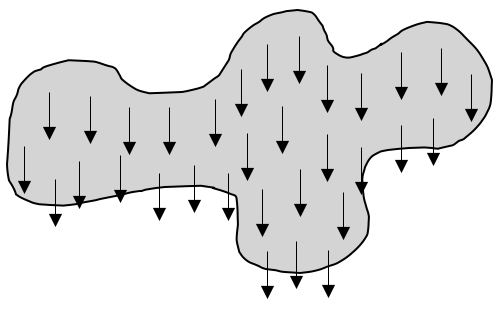
The concept of Centre of Gravity helps us simplify things by considering the whole gravitational force as a single force acting on a single point – the centre of gravity.
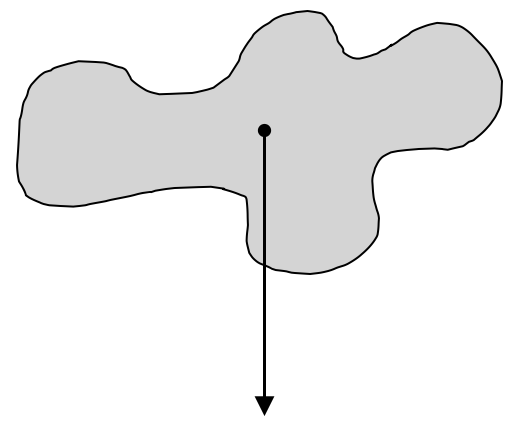
You have already been using the idea of CoG – every time we draw weight on a free-body diagram. We show the weight force emanating from a dot in the middle of the object.
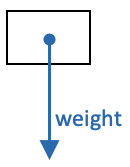 blue dot represents the CoG of the object
The term centre of mass can be used interchangeably with centre of gravity for all the problems we will attempt.
The point remains at the same place (for a rigid object) irregardless of the orientation of the object.
Finding Position of CoG
For geometric shapes (of uniform density) the CoG will be at the geometric centre.
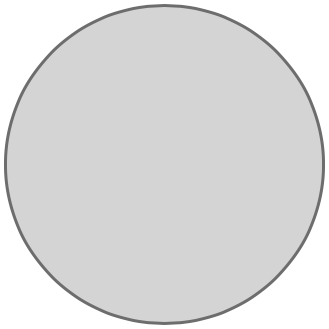
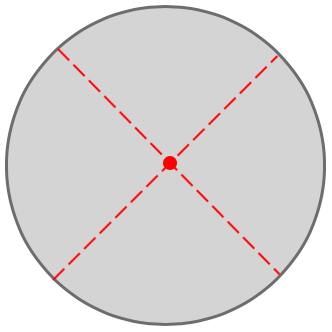
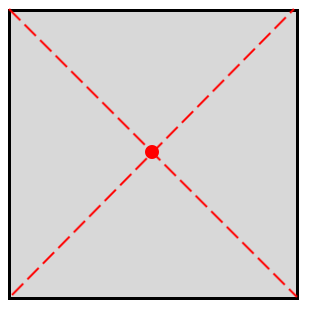
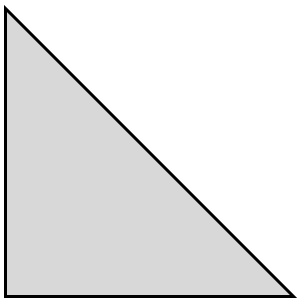
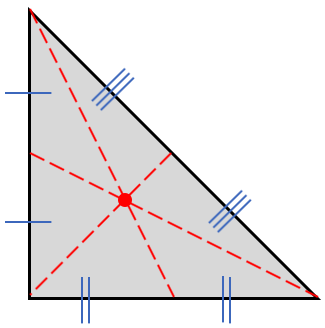
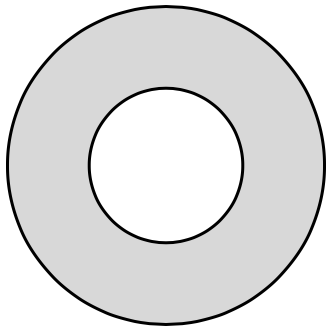
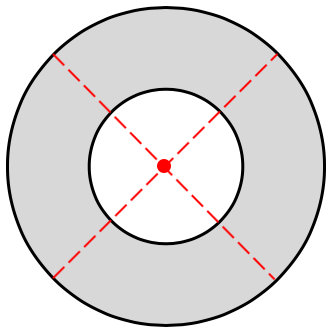
Mathematically these positions are called the centroids of the shape and are an average position of the shape.
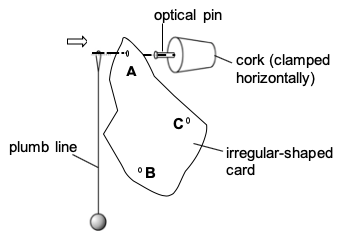
For non geometric shapes the centre of gravity can be determined experimentally.
| Determining the CoG of a Uniform Lamina |
|---|
|
| Plumbline |
|---|
| A plumbline is a string with a lead (Latin plumbum -hence chemical symbol Pb) weight or plumb bob, used to provide a vertical reference line. |
| 2D and 3D |
|---|
| The above examples have all considered flat rigid objects. We call these lamina objects. They can be considered as 2-dimension (2D) shapes. e.g. a piece of cardboard.Of course 3-dimensional (3D) objects also have CoGs. They are harder to visualise and so most of our examples will be 2D only. |
CoG for Composite Objects
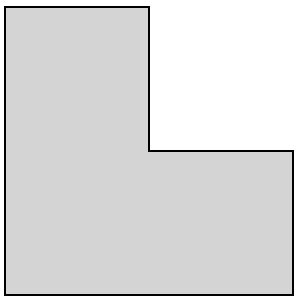
Consider the following shape. Where would its centre of gravity be?
| Look for Symmetry |
|---|
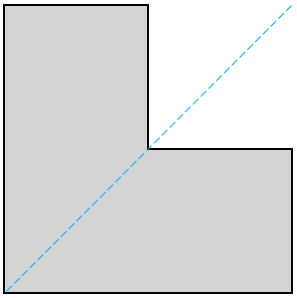
| For a symmetrical shape, the CoG must lie along a line of symmetry.
Consider the above example, we know that the CoG must lie along the line of symmetry. i.e. along this blue line.
(We are making an assumption that the lamina is of uniform density.) |
| Estimation |
|---|
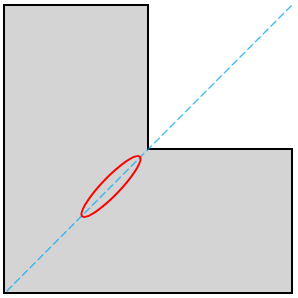
| Realising that the top-right corner of the square has been removed it should be possible to estimate the position of the new CoG along this line as having moved into the lower-left part of the square.
For many questions an estimation of the position of CoG is required. Any point in approximately the area marked by the red ring would be considered a reasonable attempt. |
Method 1
It can be considered as a combination of two shapes
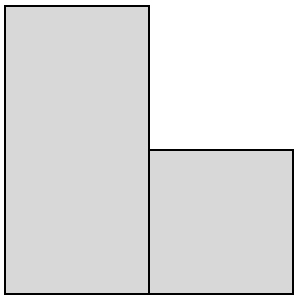 We can easily find the CoG of each of the component shapes:
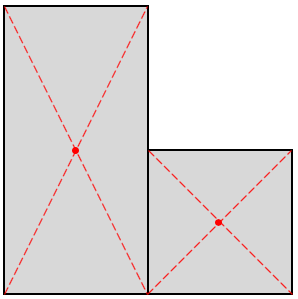
The CoG of the combined shape lies along the line joining the two individual CoGs. (The line shown in blue here.)
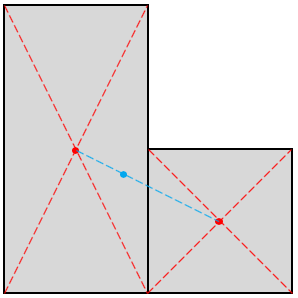 Assuming the mass of the smaller shape is M and the mass of the larger shape is 2M, the combined CoG will divide the blue line in the ratio 2:1.
Note: the new CoG is closer to the larger mass.
Method 2
Rather than think of it as addition of two shapes we can think of it in terms of subtraction.
It is this shape:
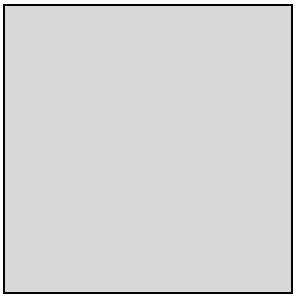
with this piece removed:
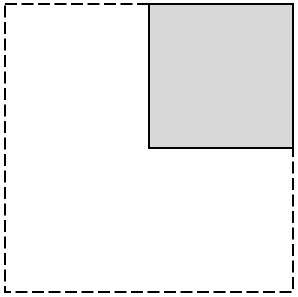
Again we know the CoG of these shapes separately:
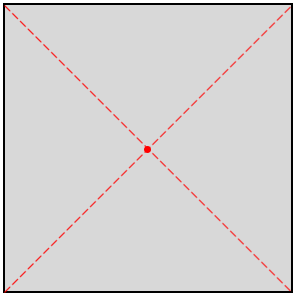
and
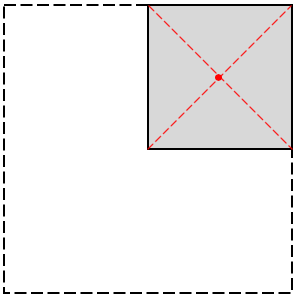 Together we will have:
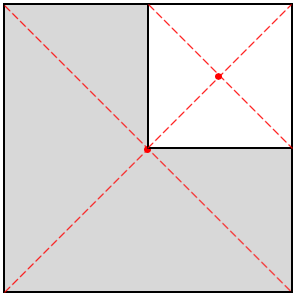
As previously, the new CoG lies on a line connecting the two CoGs of the separate shapes. However, as there is now subtraction, the CoG does not lie between the two CoGs.
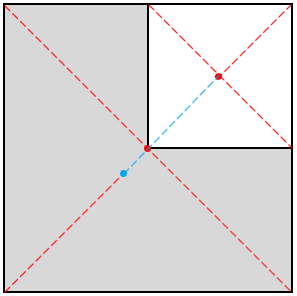 The ratio of the distances from the new CoG to each of the component parts is 1:4. (This is the same as the ratio of the masses of the two components – e.g. 4M for the big square and M for the cutout square.)
| Example |
|---|
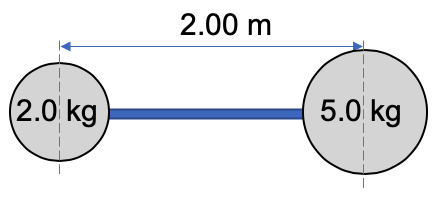
| A mass of 2.0 kg is connected to a mass of 5.0 kg, their CoGs are separated by 2.00 m. What is the position of the CoG of the combined masses?
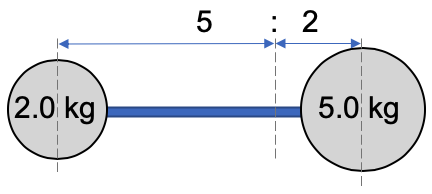
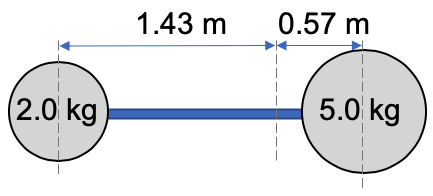
The masses in the ratio 2:5 will divide the 2.00 m distance into two sections with lengths in the ratio 5:2.
Note the new CoG will nearer to the larger mass.
Thus the combined CoG will be 0.57 m from the CoG of the 5.0 kg mass. |
| << Back | Turning Effects of a Force | Next >> |
| Links |
|---|
| Online Text – mathematical Approach to finding the CoG |