- Thermal energy flows from a region of higher temperature to a region of lower temperature.
- When two objects of different temperatures are placed in thermal contact with each other, thermal energy transfer will take place between them.
- Temperature of the initially hotter object will decrease and temperature of the initially colder object will increase until they reach the same temperature (provided there is no change in state).
- We say they have reached thermal equilibrium.
Heat transfers between objects via three different mechanisms. Namely convection, conduction and radiation.
Conduction
Occurs in: Solids, liquids and gases. Mechanism: Thermal energy is transmitted through a medium from one particle to another through vibrations of particles (atoms or molecules) with their neighbouring particles.
Factors Affecting Rate of Heat Transfer via Conduction: 1. Presence of free electrons 2. Distance between particles Applications: Copper is used to make quality pans as it is a very good conductor. The handle of a pan is likely to be made of plastic or wood (poor conductors). Materials with poor heat conducting abilities are used to make warm clothes or thermal insulation. Air is a poor conductor, clothes and hair/fur are good insulators as they trap air. |

Convection
Occurs in: Fluids (liquids and gases) Mechanism: Thermal energy is transmitted from one place to another by the movement of heated particles of a gas or liquid due to density changes. Rate of convection depends on the position of heat source and whether convection currents can be set up. [warm fluid rises, colder fluid sinks] Factors Affecting Rate of Heat Transfer via Conduction: 1. Position of the heat source. Applications: Sea breeze and land breezes. Kettle
Air Conditioners
|

Radiation
Occurs in: Does not need a medium and so can occur in a vacuum. Also occurs in gases (e.g. air) and liquids. Mechanism: Heat sources emit electromagnetic waves (in the form of infra-red radiation). These do not require any medium to travel. The colour, surface texture, surface area, temperature of the emitting surface will determine the rate at which heat is emitted. [dark/dull surfaces are good radiators or emitters of radiation]. Factors Affecting Rate of Heat Transfer via Radiation: 1. Colour of the Object 2. Surface Area 3. Temperature of the Surroundings
Applications: Houses in hot countries and factory roofs are painted in white, light-coloured paint/ aluminium paint so as not to absorb too much heat. The fins at the back of a fridge are painted black, and have a large surface area, This allows them to emit heat efficiently. |
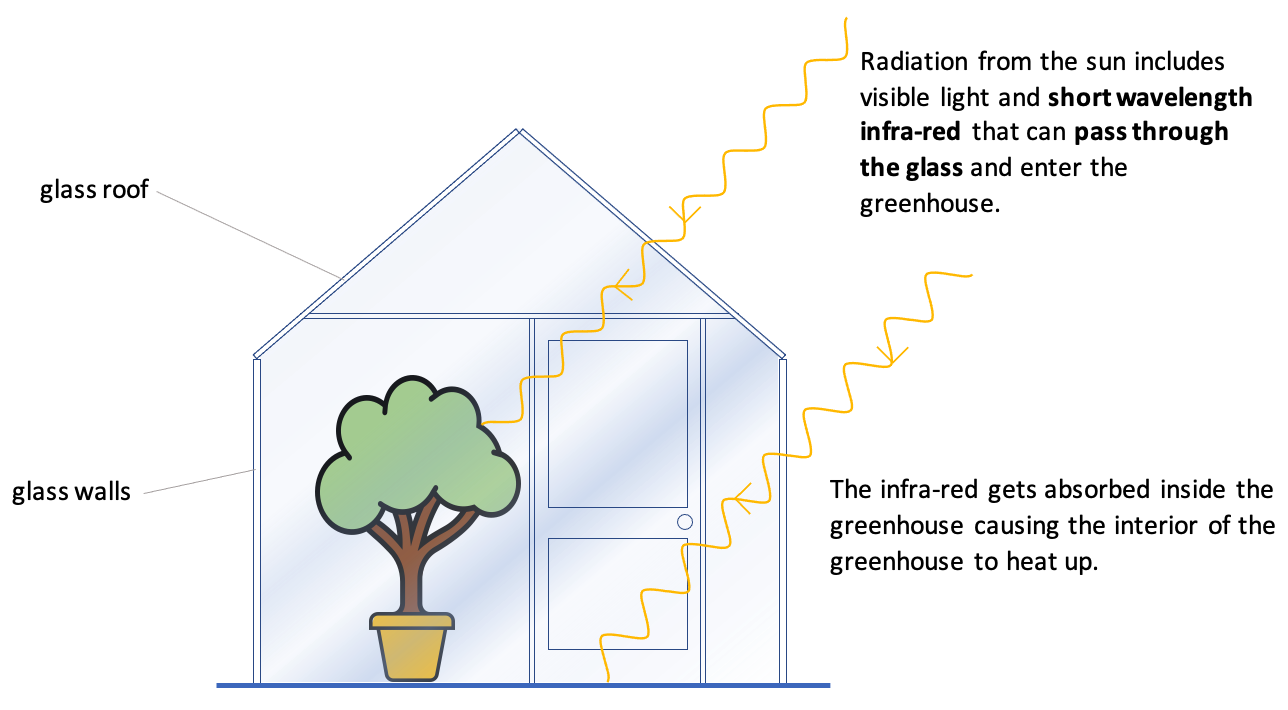
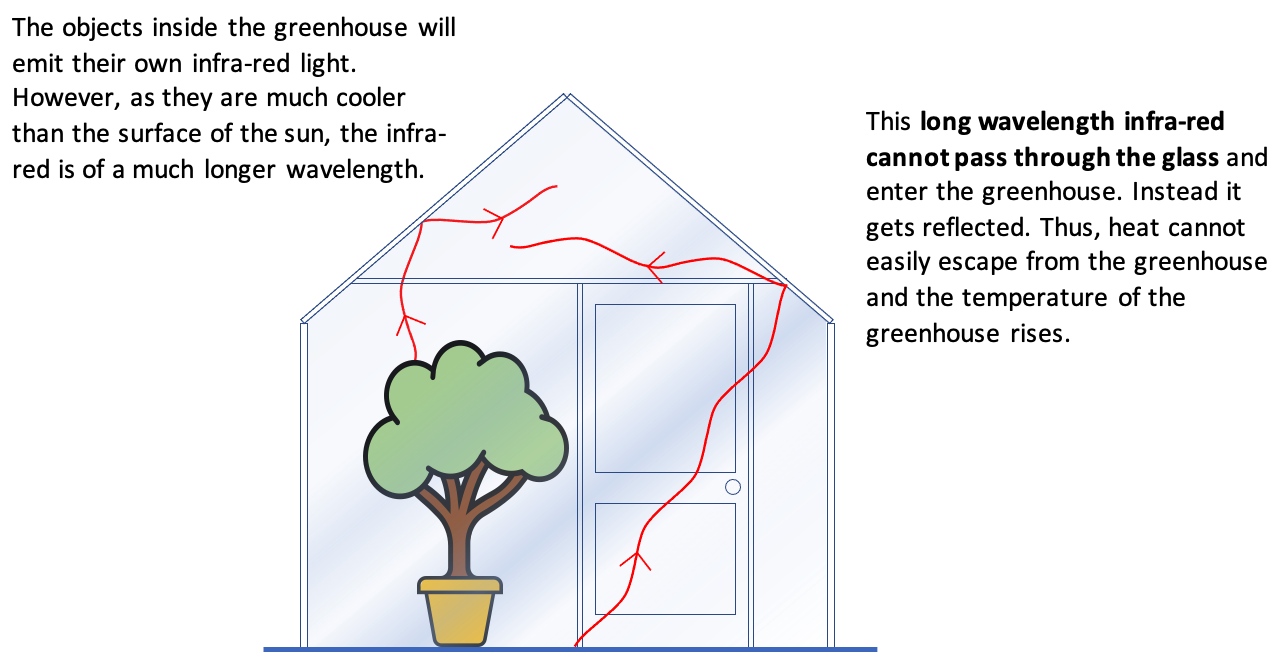
Greenhouse Effect
The same process occurs in the Earth.
|
| Example |
|---|
State three ways in which heat is lost from a black cup of hot tea.
|
| Example |
|---|
| Should the following surface be black or white? In each case explain why.
(a) The roof of the school (a) The roof of the school – WHITE. To reduce the amount of heat absorbed by the building, thus keeping the temperature lower. |
| << Back | Thermal Physics | Next >> |
| Links |
|---|
| SELF-STUDY VERSION OF THIS SECTION |