[Advanced Physics Topic]
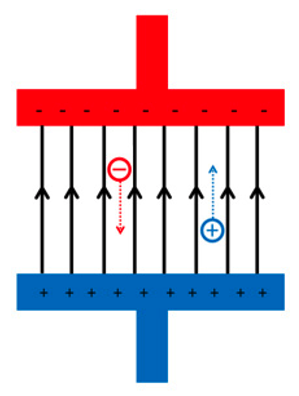
When charged particles enter a uniform electric field, they experience an electric force that will be parallel to the direction of the electric field.
When the charged particles are initially stationary or moving parallel to the direction of the electric field, the motion will be linear and can be directly analysed using equations of motion.
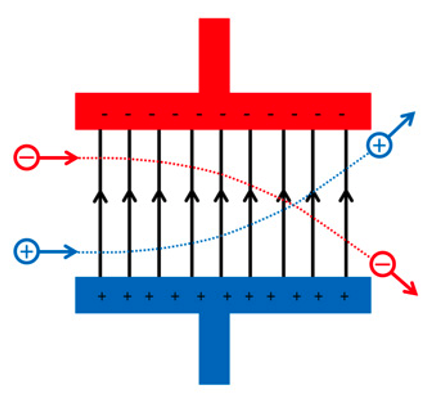
Otherwise, the charged particles will move in a parabolic path and the trajectory can be analysed in a similar way to projectile motion, which will require breaking down the motion into two perpendicular directions.
| Example |
|---|
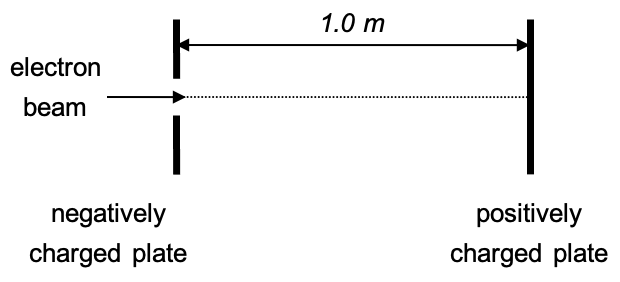
| Consider a beam of electrons accelerated from rest through an electric field of 500 N C⁻¹ in the region between two parallel charged plates 1.0 m apart.
Given that the mass of an electron is 9.11 × 10⁻³¹ kg and its charge is −1.60 × 10⁻¹⁹ C, determine the time taken for the electrons to hit the far plate. |
| Example |
|---|
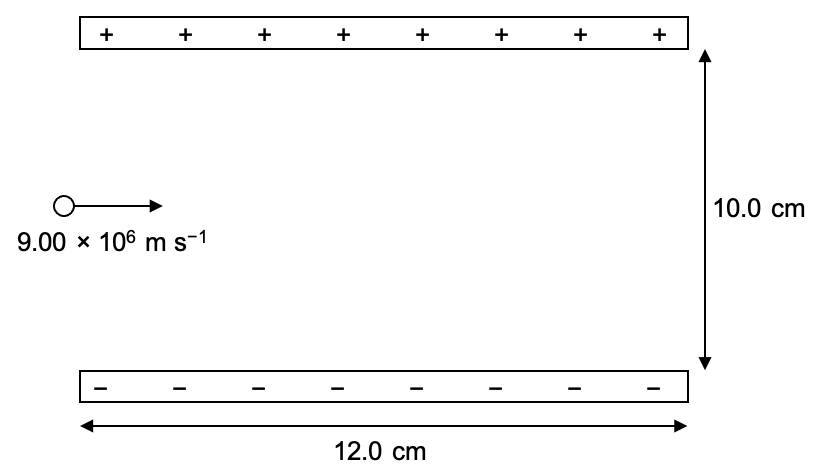
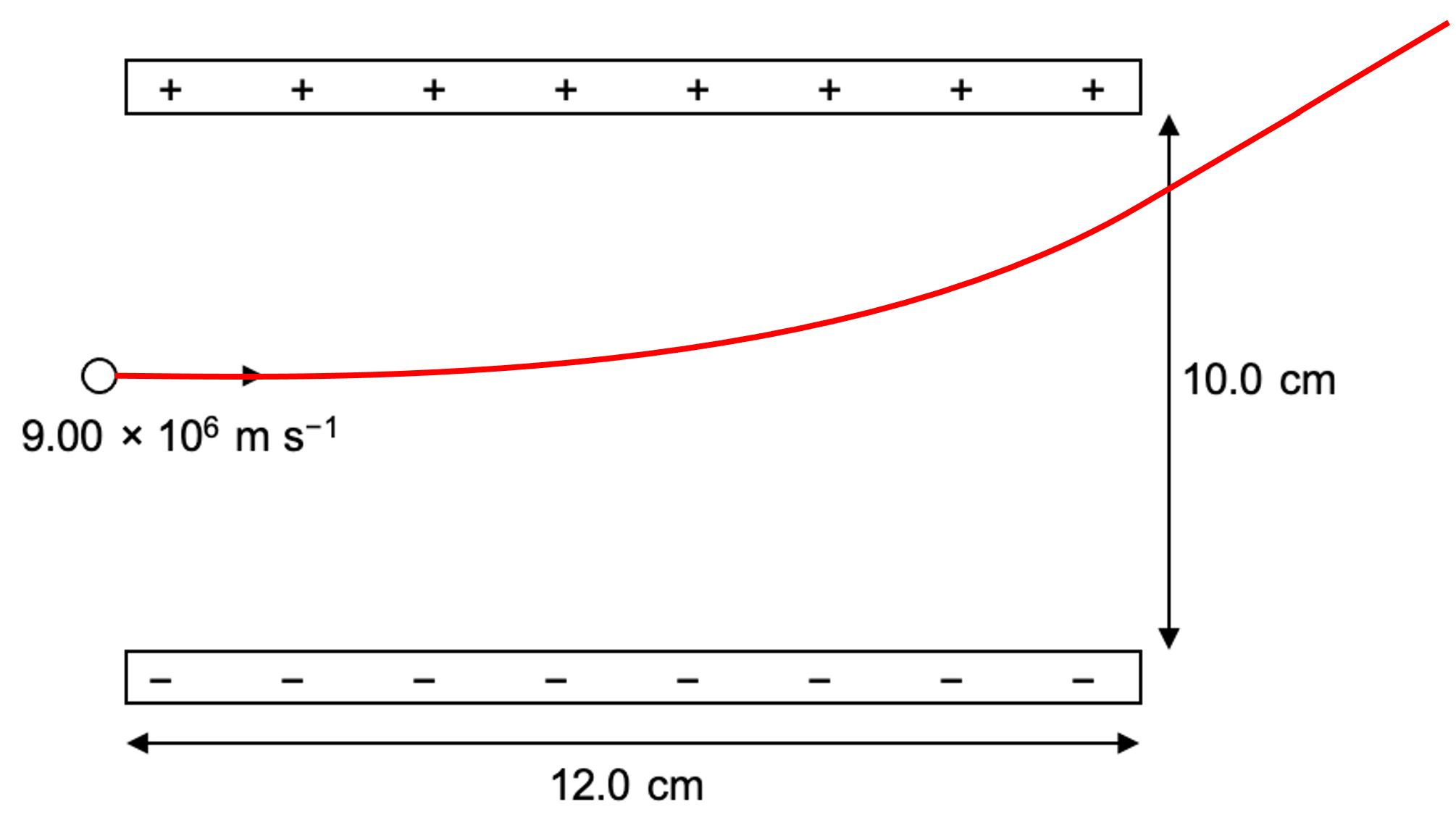
| An electron is projected with a speed of 9.00 × 10⁶ m s⁻¹ into the space between two 12.0 cm parallel conducting plates with electric field strength 1.60 × 10³ N C⁻¹. The plates are separated by 10.0 cm. The mass of an electron is 9.11 × 10⁻³¹ kg and its charge is −1.60 × 10⁻¹⁹ C.
(a) Determine the time taken for the electron to emerge from the field. (b) Calculate the acceleration of the electron when it is between the plates. You may ignore the weight of the electron. (c) Calculate the total vertical deflection of the electron due to the electric field. (d) Sketch the path taken by the electron to emerge from the electric field. |
| Note |
|---|
| Notice the similarity between this type of question and the questions we looked at previously on Projectile Motion. |
| << Back | Electrostatics |