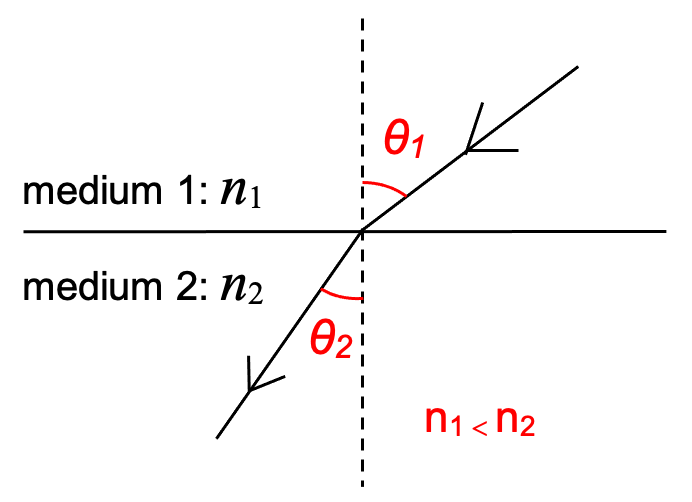
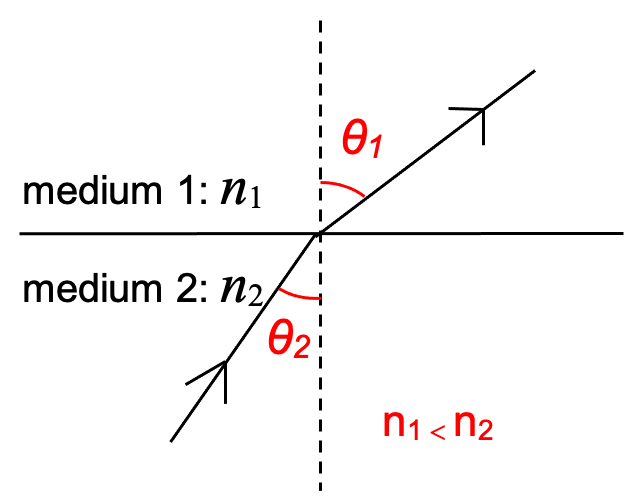
Snell’s law can be represented as:
| n1 sinθ1= n2 sinθ2 |
Where each side of the equation corresponds to one medium.
- n1 and n2 being the refractive indices of the materials, and
- θ1 and θ2 being the angles between the light rays and the normal
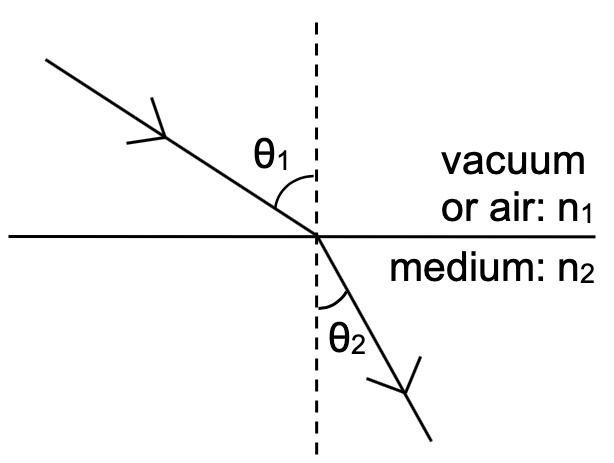
| Special case: for a light ray travelling from vacuum (or air) into a medium,
Applying Snell’s law, 1 (sin i) = n sin r,
hence (sin i / sin r) is the constant n, the refractive index of the medium (2ndlaw of refraction). You will see this simplified equation in many textbooks. When using it be reminded that it is only valid when the light is travelling from vacuum/air into a medium. |
| Note |
|---|
| For n1 sin θ1= n2 sin θ2: this version of Snell’s Law does not require us to know which ray is the incident ray and which ray is the refracted ray.
This is because the light ray will travel along the same path regardless of which direction it started from. This is called the Principle of Reversibility. |
| Definition: Principle of Reversibility of Light |
|---|
| The principle of reversibility of light states that light follows the same path if the direction of the travel of light is reversed. |
| Example 4 |
|---|
| Calculate the refractive index of the substance Y.
|

| << Back | Refraction | Next >> |