Optical fibres are thin, flexible fibres made by drawing glass or plastic to a diameter slightly thicker than that of human hair. The fibres transmit light between two ends of the fibres by total internal reflection and are widely used in telecommunications to transmit large amount of data and in medical endoscopes for viewing internal organs of a patient.
The following shows a typical example of a small length of optical fibre.
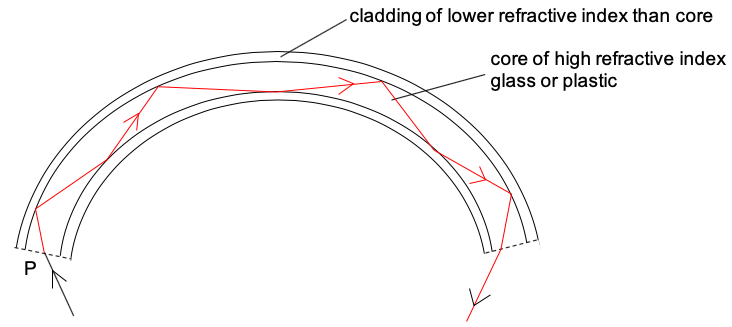

The light undergoes multiple TIR reflections and so is transmitted down the optical fibre from one end to the other. Optical fibres can be many kilometres in length.
Since optical fibre can only transmit light when it travels from an optically denser to less densemedium (by total internal reflection), the cladding ensures that this condition is always present
i.e. even when the optical fibre is placed in a medium denser than the core.
If there were no cladding light would ‘leak out’ of the optical fibre if it were to come into contact with water or if the core were to be scratched.
Advantages optical fibres have over copper wires in telecommunications are:
-
- The data transmission rate is much faster as compared to using copper wires.
- There is less signal loss as compared to copper cables.
- Optical fibres are lighter and cheaper as compared to copper cables of the same length.
- The free electrons in copper wires are affected by lighting and strong magnetic fields, while data transmission using optical fibres is not.
Singapore has installed optical fibre to a majority of households
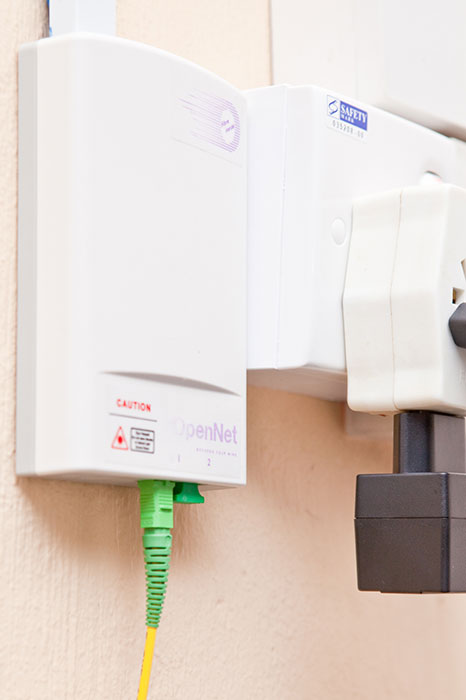
You likely have an NetLink Trust (formerly OpenNet) fibre-optical terminal like this in your house to provide you with high speed internet.
Singapore was the first country to offer 1 Gbps on a nationwide basis, with prices that are amongst the most affordable in the world – 1 Gbps below US$38/month
| << Back | Refraction |
| Links |
|---|
| https://en.wikipedia.org/wiki/Optical_fiber |
| https://www.explainthatstuff.com/fiberoptics.html |