Introduction to refraction
The phenomenon of refraction had been studied experimentally since the 2ndcentury AD. From his experiments, Claudius Ptolemy proposed a version of the law of refraction which is inaccurate and works only for a very limited range of angles. During the 17thcentury, Willebrord Snell derived a better mathematical model for the law of refraction, but he did not live to publish his work. René Descartes eventually arrived at the same mathematical model independently and published his work in 1637 titled La Dioptrique. Hence, Snell’s law is also known as Descartes’ law.
Refraction as the bending of light rays
Refraction can be described as the bending of light when it passes from one medium to another.
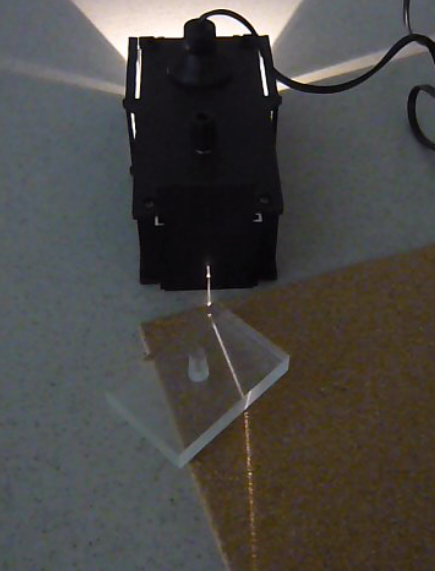
The photo above shows how a light ray bends as it travels through a rectangular plastic prism.
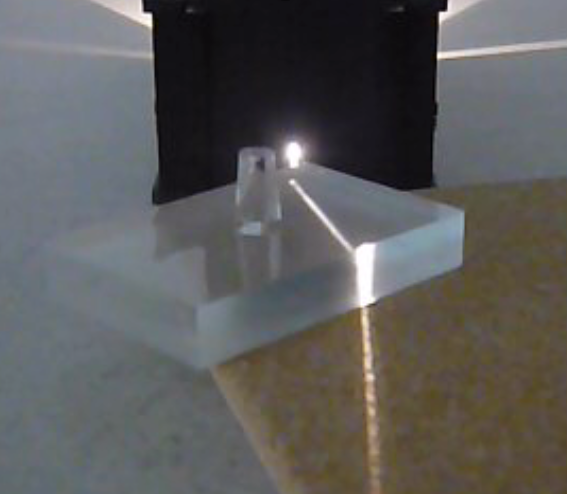 The photo above shows the ray of light emerging from the rectangular plastic prism.
Cause of Bending
Light bends when it enters another medium (material) because the speed of light changes when it enters the other medium (see textbook pg. 244 for an analogy).
Refractive Index
The exact amount of ‘bending’ depends on the refractive index of the medium.
| Definition: Refractive Index |
|---|
|
The refractive index (n) of a medium may be defined as the ratio of the speed of light in vacuum (c) to the speed of light in that medium (v):
n = c / v |
refractive index is an example of a physical quantity that has no unit (it is just a number).
Some common values for n
vacuum: 1.000 (exact)
air: 1.0003
water: ~1.3
glass: ~1.5
diamond: ~2.4
(you are not required to memorise these)
Some textbooks use the term “optical density” to describe refractive index; materials with higher refractive index are described as “optically denser”, and materials with lower refractive index are described as “optically less dense”.
| Note |
|---|
|
Light of different frequencies (colours) will actually bend by slightly different amounts resulting in the characteristic spectrum of light seen when white light (a mixture of all the different colours) is passed through a triangular prism.
|
| Definition: Monochromatic Light |
|---|
|
Light of a single colour / frequency / wavelength. [mono: single; chroma: colour] |
Which Direction Does the Light Bend?
When a ray of light travels from a medium of lower refractive index to a medium of higher refractive index, it bends towards the normal (and vice versa).
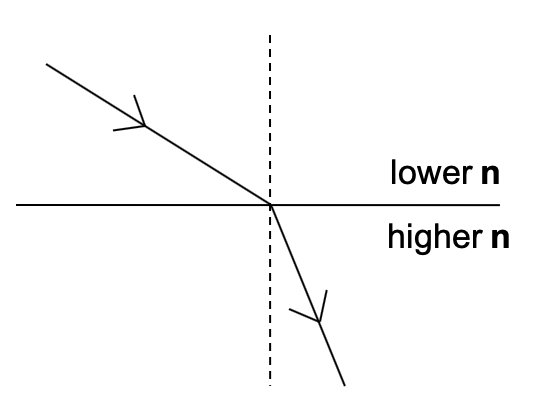
- Light travels fastest (3.0 x 10⁸ m s-1) in vacuum. Hence, vacuum has the smallest possible refractive index (n = 1.00). Air has approximately the same refractive index (n = 1.0003), so we normally assume light travels at the same speed in air as in vacuum.
- Hence, as light travels from vacuum (or air) into other media, it bends towards the normal, and vice versa.
 light travelling into a media of higher optical density
will bend towards the normal
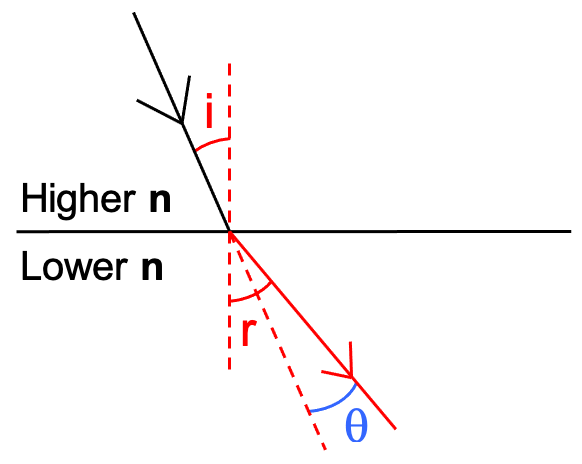 light travelling into a media of lower optical density
will bend away from the normal
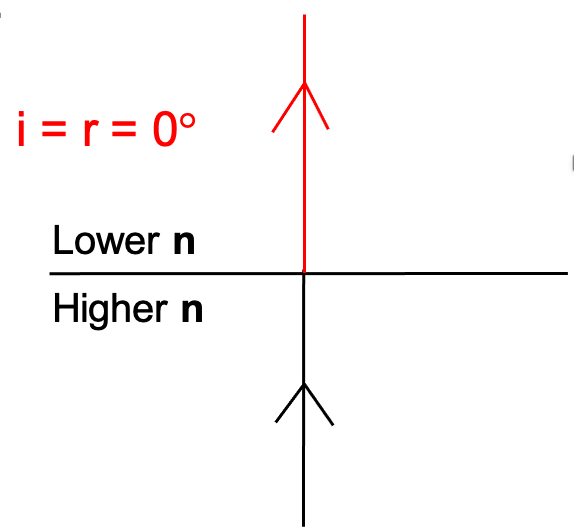 light travelling normally into a media of
differing optical density will not be deviated
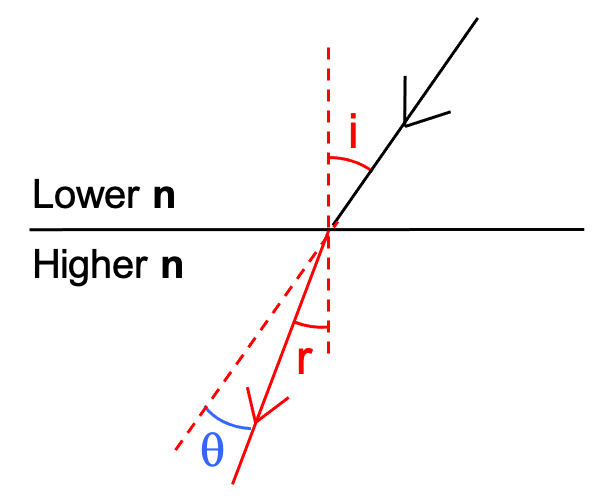
Angle of deviation
Angle of deviation of a light ray is the angle between its incident direction and its refracted direction. The larger the angle of deviation, the greater the ray is refracted or “bent” from its original direction.
(Shown in blue as θ is the above two diagrams.)
| Example |
|---|
|
Complete the diagrams to show the light passing through the given objects. (a) light entering a regular rectangular glass prism
(b) light entering a triangular glass prism
(c) light entering an irregular prism at 0º incidence
(d) light entering a semi-circular prism at 0º incidence
(d) light entering a spherical glass ball
(f) light entering a spherical air bubble in water
|


| Investigate Refraction |
| Refraction | Next >> |