Consider a light ray travelling from an optically denser medium (of refractive index n) to vacuum (or air) (optically less dense).
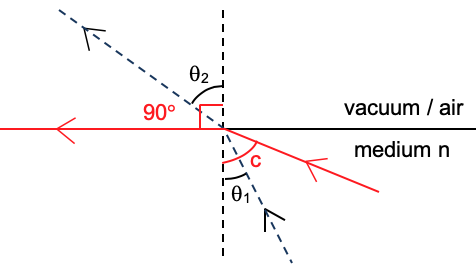

θ1 is smaller than θ2. If the angle of incidence θ1 of the incident ray is gradually increased, the angle of refraction θ2 would increase and reach 90° At this point, let θ1 = θC.
We call angle c the critical angle.
| Definition: Critical Angle |
|---|
| Critical angle c is defined as the angle of incidence in an optically denser medium for which the angle of refraction in the less dense medium is 90º. |
It is related to refractive index, n, by the relationship:
| n = 1 / sin c |
- Note: this relationship only applies when light is travelling from a medium into vacuum or air
- Therefore, the critical angle is formally defined as the minimum angle of incidence in the medium with higher refractive index (n) at which a light ray is totally reflected.
- The phenomenon where light is completely reflected is known as total internal reflection (TIR).
| Example 5 |
|---|
|
Consider a light ray travelling from an optically denser medium (refractive index n) to air at the critical angle c. Apply Snell’s law to show that n = 1 / sin c |
| Example 6 |
|---|
|
The refractive indices of glass and air are 1.5 and 1.0 respectively. A ray of light travels from glass into air. (a) State the angle of refraction in air when the angle of incidence in glass is equal to the critical angle.
(b) Calculate c, the critical angle of the glass-air boundary. |
| Enrichment |
|---|
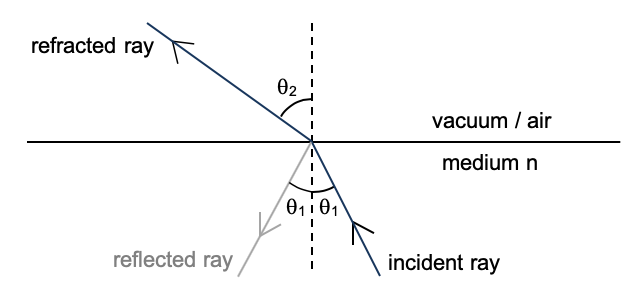
| However, it has been observed that at critical angle, the refracted ray is either faint or cannot be seen.
This is due to two factors:
|
| https://phet.colorado.edu/sims/html/bending-light/latest/bending-light_en.html |
| << Back | Refraction | Next >> |