Consider the case of Sam standing next to a large mirror.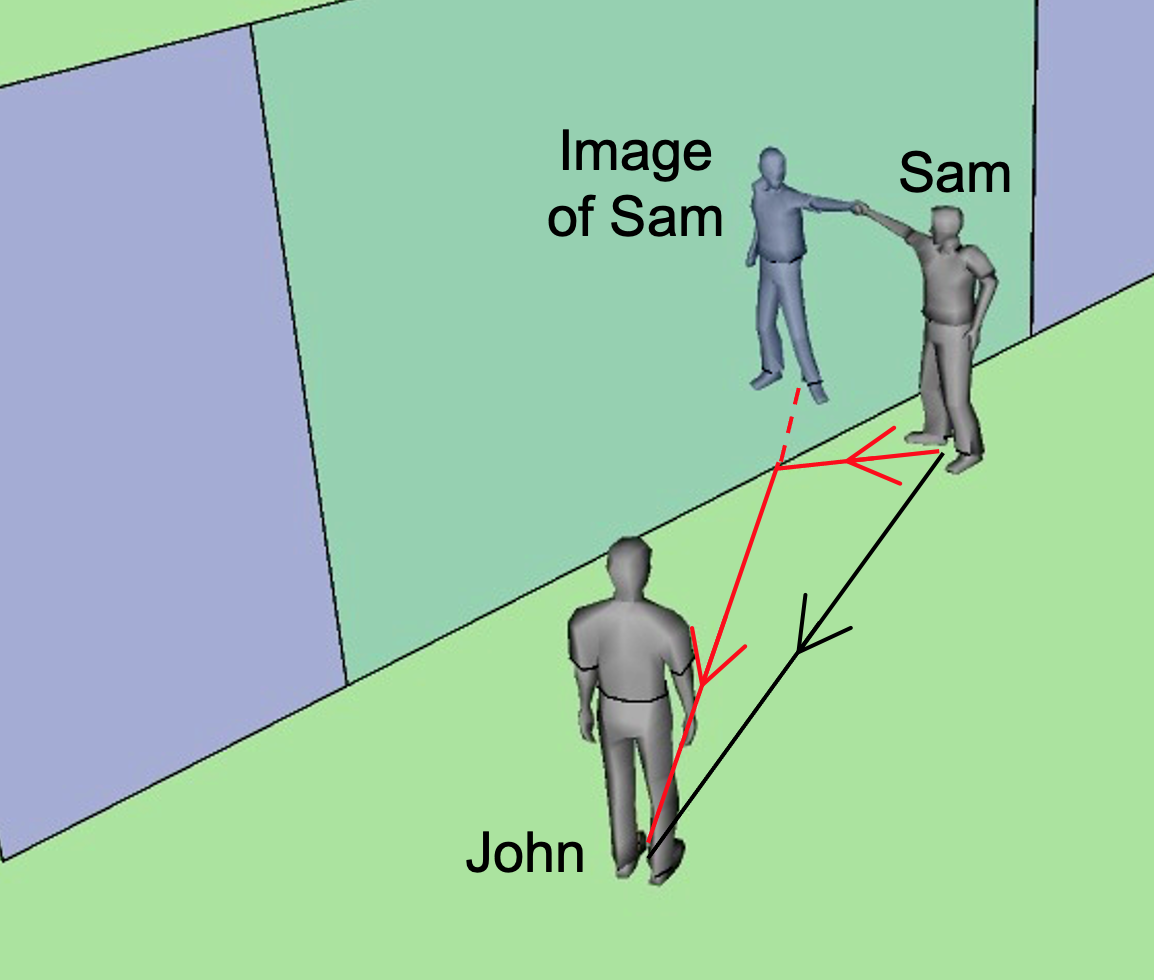
John can see Sam (black light ray) and a reflection of Sam (red light ray). The reflection is caused by the light ray reflecting (specularly) off the mirror.
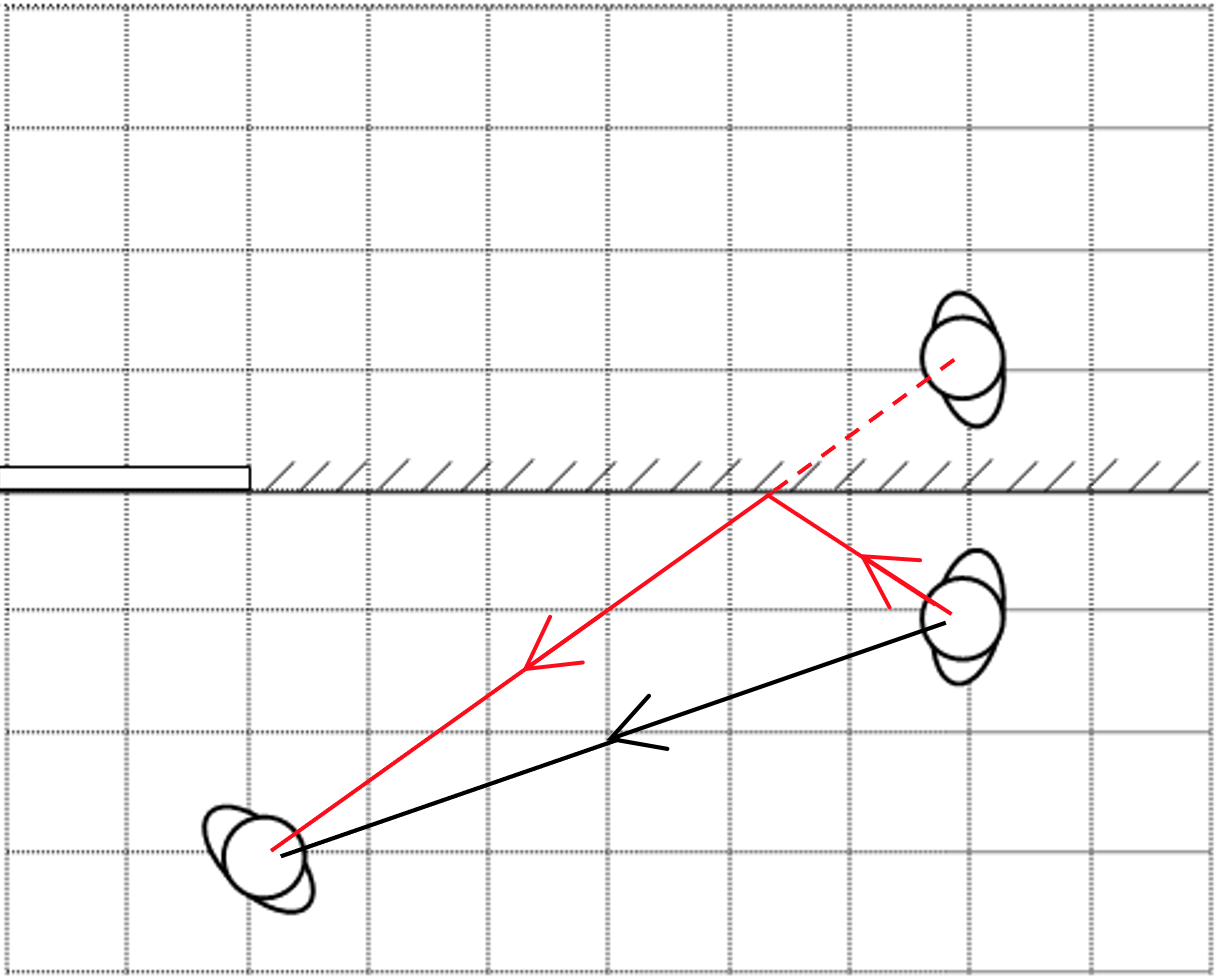
From the point of view of an observer (such as John) there will some differences and similarities between Sam and Sam’s image.
Images in a plane mirror are:
- upright
Sam’s image is upright, not inverted.
. - the same size as the object
If you put a ruler next to Sam, Sam’s image will also have a ruler beside it which will indicate the same height.
Don’t be fooled by distance. If I walk away from you I may look like I’m getting smaller, but of course I am not changing size!
. - the same distance behind the mirror as the object is in front of the mirror
Sam’s image is one tile “inside” the mirror, just as Sam is one tile in front of the mirror.
The image will also be perpendicularly on the other side of the mirror. i.e. a line joining image and object will always cut through the mirror at 90°.
. - laterally inverted
Sam is touching the mirror with his right hand; Sam’s image is using his “left” hand.
Do not just say “inverted” that is something different and would also imply Sam’s image was standing on his head!
. - virtual
Sam’s image is virtual because the light rays do not actually start at Sam’s image.
If you went behind the mirror you would not find Sam’s image!
Real & Virtual Images
An image is virtual…
-
- if NO light rays come from this image
- when the image CANNOT be formed on a screen.
An image is real…
-
- if light rays come from this image
- when the image CAN be formed on a screen.
A screen here actually means any appropriate surface. e.g. a whiteboard, piece of paper, retina of the eye, camera film, etc. Usually flat and white.
| Caution |
|---|
| Not all of the above will be true for curved mirrors. The above statements are true specifically for a flat (plane) mirror. |
How are real plane mirrors made?
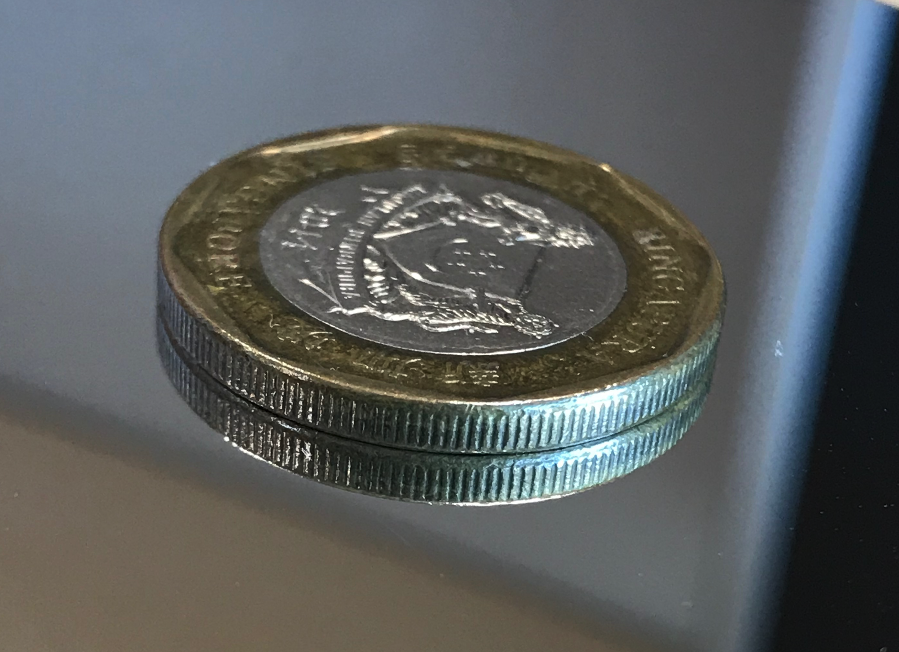
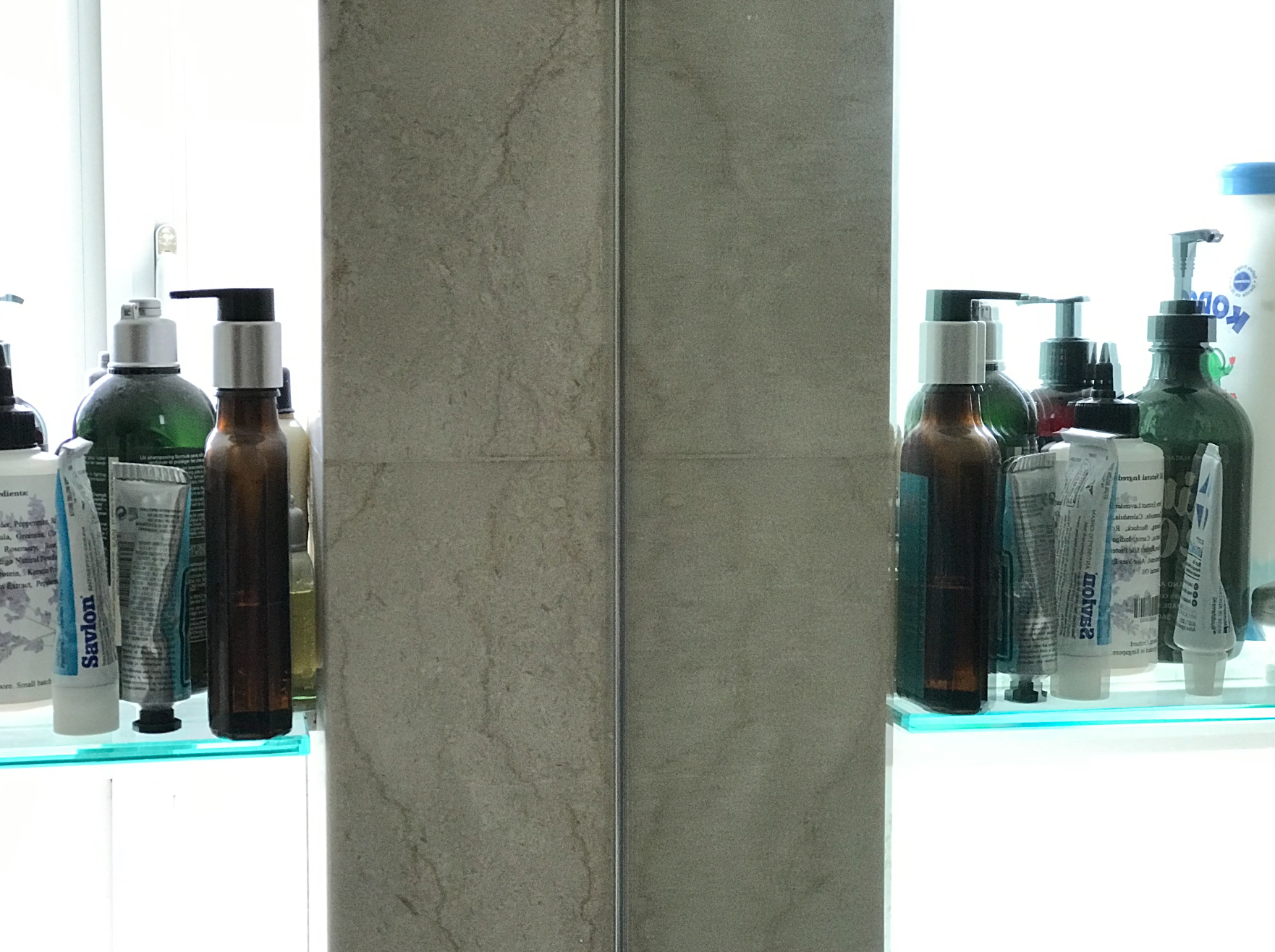 Most mirrors we come across are made by silvering the far side of a sheet of glass. These mirrors will show double reflections – especially obvious (like in this photo) when looking at an acute angle into them or when looking at bright objects. This can be eliminated by silvering the near surface of the mirror. However, this will result in a more costly mirror and is probe to scratching as the mirrored surface is not protected.
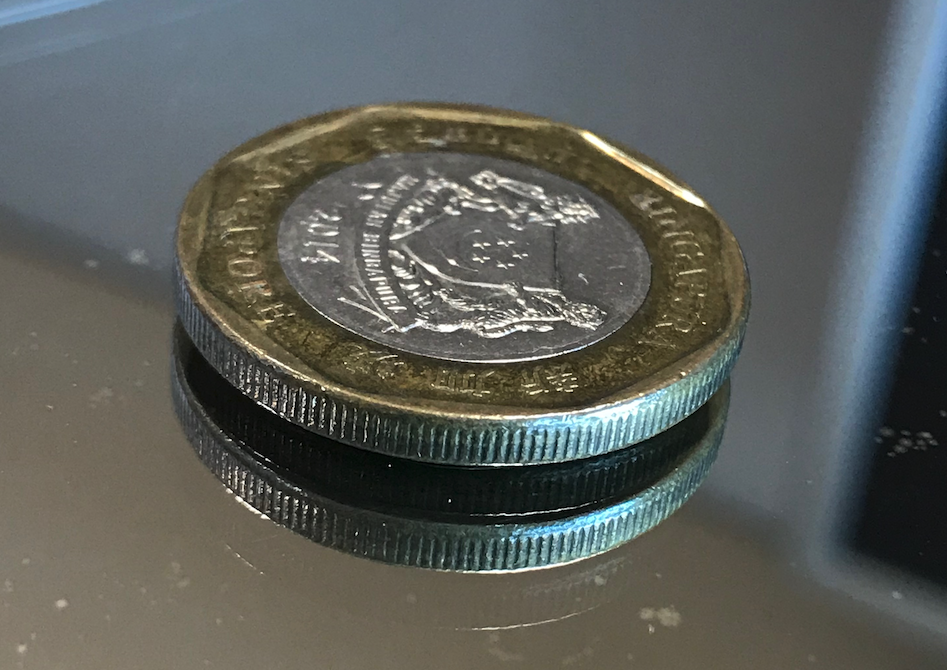 Coin placed on a regular mirror – an obvious gap exists
between the object and its image.
 Coin placed on a first surface mirror – no gap exists
between the object and its image.
| Actually… | |
|---|---|
| Actually, images in a mirror are NOT laterally inverted in the true sense of the phrase.
If you stand in front of a mirror and look into it, your head is still on the top and your feet are still on the bottom. But if you look at your hands, your left hand is still of the left and your right hand is still on the right – they have not been swapped around. So left-right is NOT flipped just as top-bottom is not flipped. In fact what is flipped is front-back. Imagine you’re facing North as you stand in front of your mirror. Your mirror image will be facing South. It’s as if you’ve been turned inside out. Which is not a thing that can happen to us in the real world. So we make the assumption that right and left have been reversed. If a person were to lie down next to a large mirror, what would happen then? Would left and right be swapped for them? If you were to stand on a mirrored floor and look down at your reflection, how do you think you would explain it?
|
| << Back | Reflection | Next >> |
| Links |
|---|
| https://ophysics.com/l9.html |