Before we start looking at reflection, maybe we should think a little bit about light.
Physics
The branch of physics dealing with light is known as Optics.
Light travels in straight lines.
The speed of light is a constant in Physics and is given a special symbol, c.
The speed of light is 299,792,458 m/s. We will approximate this to 300,000,000 m/s or 3 × 10⁸ m/s.
Light is a form of electromagnetic radiation. There are many forms of electromagnetic radiation, but in this chapter we are specifically referring to visible light.
Light can be reflected or absorbed by materials. It can also pass right through some (transparent materials e.g. glass)
Sources
Light is emitted from luminous objects. Examples of luminous objects are the Sun, lightbulbs (incandescent/filament, fluorescent, halogen, LED), stars.
Detectors
The human eye is a detector of light.
Other detectors of light include photographic film, camera CCDs. Plants are also sensitive to light, being able to move their leaves to face a light source and using the light for photosynthesis.
Colours
White light can be split up through use of a prism.
Colours of the spectrum typically referred to as Red, Orange, Yellow, Green, Blue, Indigo & violet. Although in different cultures and languages the number and ranges of the colours actually can be different.
Indigo is actually a dark blue (named after the plant dye from India) the blue is therefore actually a light blue (cyan).
The mnemonic to rememberer the colours is Roy G. Biv.
White light is made up of all the other colours of visible light.
Light of a single colour is known as monochromatic light.
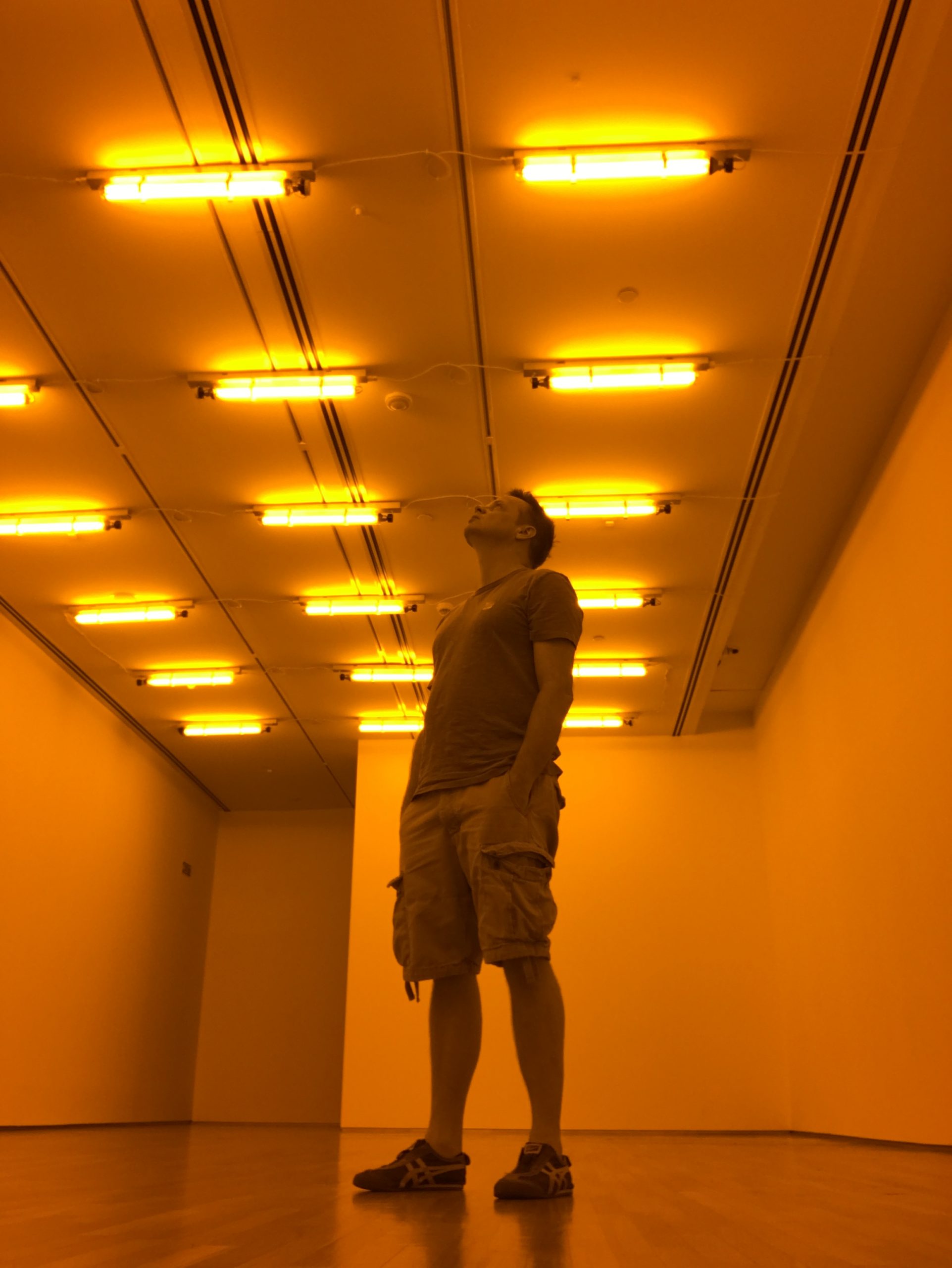 Notice that under these monochromatic sodium lights it is impossible to identify the colours of my shoes & teeshirt.
The three primary colours of light are red, green, and blue (RGB). Adding light together (mixing light) gives different results from mixing paints (pigments).
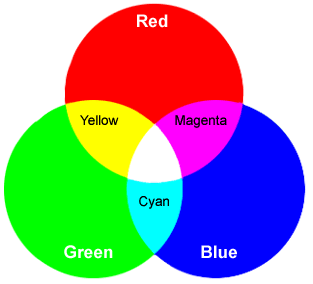
addition of light
Colour Perception
What we perceive as colours are actually partially determined by the properties of the light and partly by our brain.
Colours such as pink, brown, grey and black are not found in the spectrum. They are really
Visible light for different animals may not be the same as for humans.
Human eye has 3 types of cone cells that respond to different frequencies (colours) of light.
| Reflection | Next >> |
| Links |
|---|
| https://en.wikipedia.org/wiki/Light |
| https://en.wikipedia.org/wiki/Color_mixing |
| https://en.wikipedia.org/wiki/Color_vision |