Hydrostatic pressure is the pressure exerted by a fluid at equilibrium at a given point within the fluid, due to the force of gravity.
The following video shows a series common experiments looking at pressure changes within liquids:
Hydrostatic pressure increases in proportion to depth measured from the surface because of the increasing weight of fluid exerting downward force from above.
In equation form:
| P= hρg |
Where:
P – Pressure due to the liquid above measured in pascals (Pa)
h – Height of liquid column (depth) measured in metres (m)
ρ – (“rho”) Density of the liquid (kg/m³)
g – Gravitational field strength measured in newtons per kilogram (N/kg)
| Derivation of P= hρg |
|---|
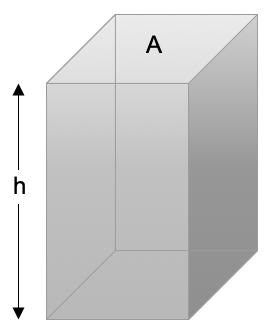
| Imagine a column of liquid of height h, and cross sectional area A.
The volume of liquid is given by: V= hA The mass of the liquid is given by: m = ρV weight of liquid given by W = mg W = ρVg W = ρhAg As pressure is given by P = F / A we get P = ρhAg / A P = hρg
You will NOT asked to recall this derivation! |
Pressure is a scalar quantity and as such does not act in a specific direction.
Force Exerted Due to Liquid Pressure
Consider a box submerged under water:
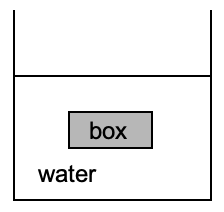 Lets consider the forces acting on the 6 faces.
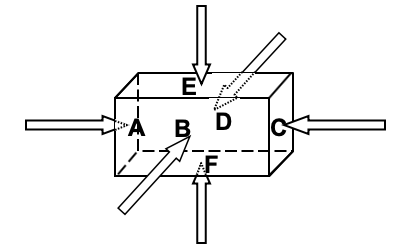 A, B, C and D (the vertical surfaces) will experience increasing forces towards the lower part of the box as they are deeper in the liquid and so will experience a greater pressure.
Surfaces E and F will both experience a similar force over the whole of their surface. However, as F is deeper than E, F will experience a larger pressure (and thus force) compared to E.
Looking at all of the forces we can see that A will cancel C, and B will cancel D.
But E and F will not cancel each other. As F is larger, the net force on the box will be a force acting upwards. This net force acting upwards is the upthrust that the object experiences.
A variation of the equation is:
| ΔP= Δhρg |
Where:
ΔP – Pressure difference between two points in the liquid measured in pascals (Pa)
Δh – Vertical height difference between the two points (difference in depth) measured in metres (m)
| Example 1 |
|---|
| A box displaced in water.
If the height of the box is 2.0 m and the density of the surrounding water is 1000 kg m¯³ , what is the pressure difference between top and bottom? |
| Example 2 |
|---|
| The normal maximum safe depth a diver can go is 30.0 m in seawater. Calculate the safe depth for a diver in fresh water. (Assume ρseawater = 1025 kg m-3 and ρfreshwater = is 1000 kg m-3.) |
Communicating Vessel
A communicating vessel (sometimes called pascal’s vessel) is a vessel that is joined at the base.
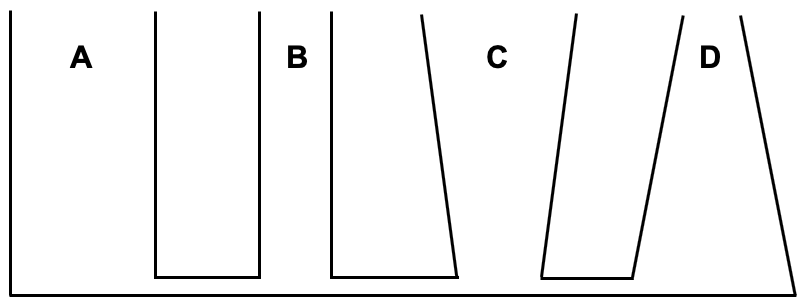
When a liquid is poured into any of the vessels it will flow along the bottom connecting tube and into the other vessels. The end result will always be the liquid having the same level in each vessel.
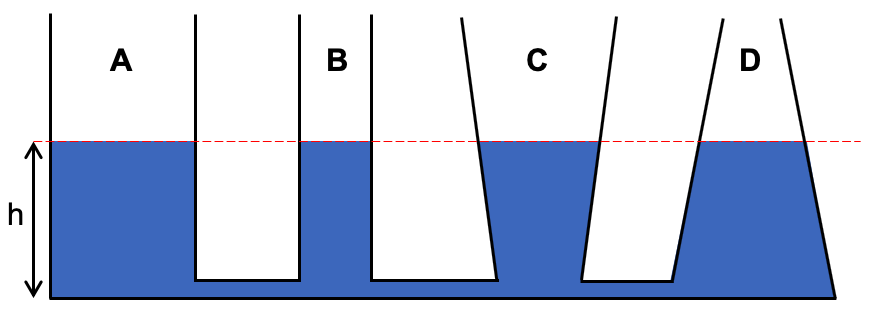 This can be explained by understanding that the height of each is the same (h).
| Example 3 |
|---|
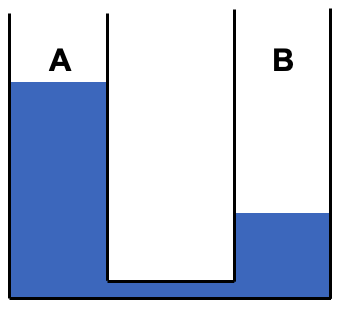
| What would happen if two joined vessels (A and B) initially had different levels of water in them, like this?
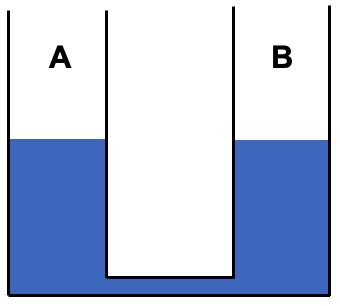
Column A is higher than column B. Thus the pressure at the bottom of A will be larger than the pressure at the bottom of B. The difference in pressure will cause the liquid to flow from A to B (fluids will flow from high pressure to low pressure.) The liquid will stop flowing when the column heights are the same. At that point the pressures will be the same.
|
| A Liquid Seeks its Own Level |
|---|
| Sometimes you may see the phrase “A liquid seeks its own level” to describe this phenomenon. |
| Example 4 |
|---|
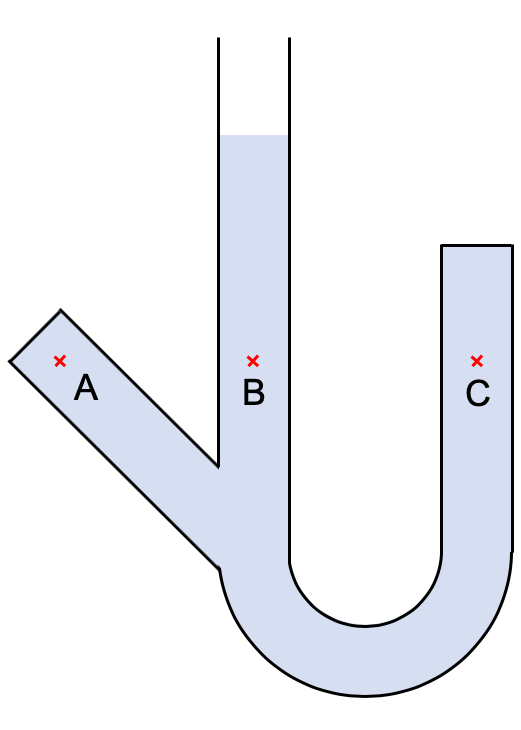
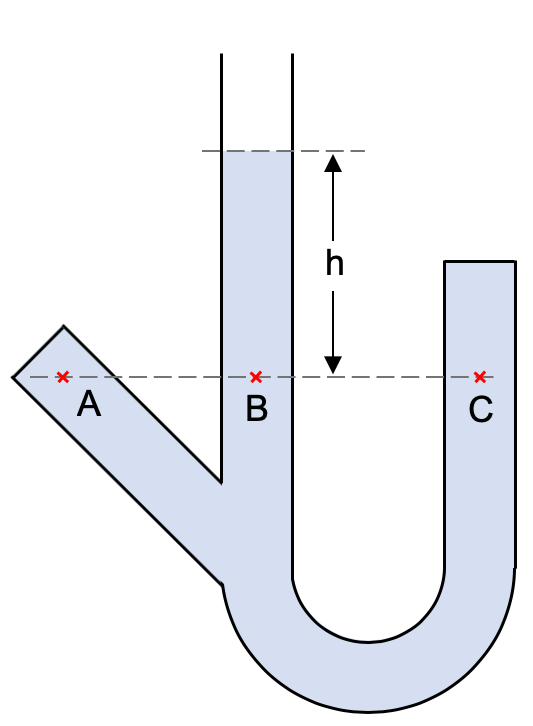
| Q: Which point is at the greatest pressure?
|
| << Back | Pressure | Next >> |
| Links |
|---|
| https://en.wikipedia.org/wiki/Communicating_vessels |
| https://demonstrations.wolfram.com/PascalsPrinciple/ |