Pascal’s Law
| Definition: Pascal’s Law |
|---|
| Pascal’s Law states that pressure exerted anywhere in a confined incompressible fluid is transmitted equally in all directions throughout the fluid. |
| Blaise Pascal (1623 – 1662) |
|---|
| French mathematician, physicist, inventor & philosopher. Aside from his work in pressure and fluid dynamics (the unit of pressure is named after him), he contributed much towards the field of modern economics and developed one of the earliest mechanical calculating machines. |
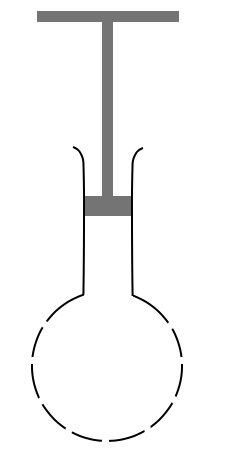
If we consider a sphere with holes around it connected to a syringe like this:
If we fill this with a liquid and press in the piston we will observe liquid squirting out in all directions.
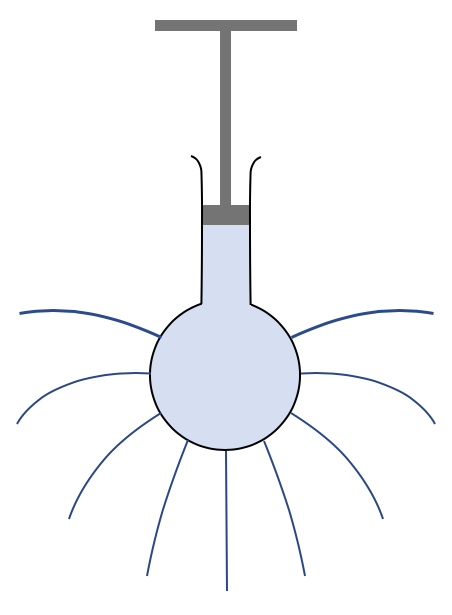 The liquid will be leaving each of the holes at the same speed. This is because in pressing the piston we increased the pressure in the liquid and that pressure increase is transmitted throughout the whole liquid.
Hydraulic Systems
Hydraulic systems are used to transmit pressure from one point to another.
Hydraulic systems work because liquids are almost incompressible and they transmit pressure equally in all directions (Pascal’s Law).
| Example |
|---|
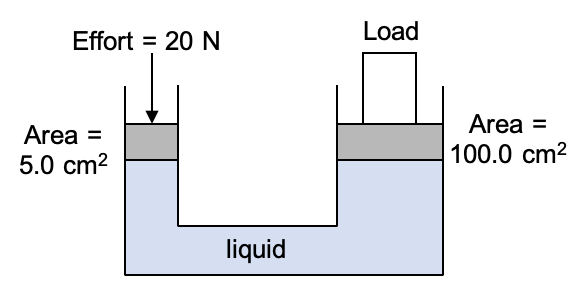
| What is the maximum load that can be lifted by an effort of 20 N applied to the left-hand piston?
|
| Example |
|---|
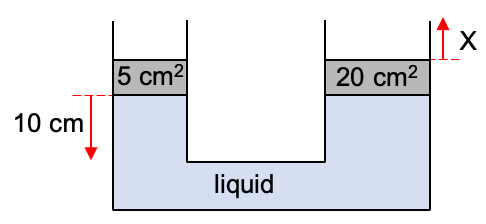
| The following shows a hydraulic system consisting of two pistons having areas 5 cm² and 20 cm².
If the left-hand piston is pushed down 10 cm, what is the distanced the right-hand piston moves up? |
| Conservation of Energy |
|---|
| We are not getting an increased force for nothing. In the above example the force becomes 4 times larger, however the distance the load moves will only be ¼ times the distance.
This means that the Law of Conservation of Energy is not violated. |
| Example |
|---|
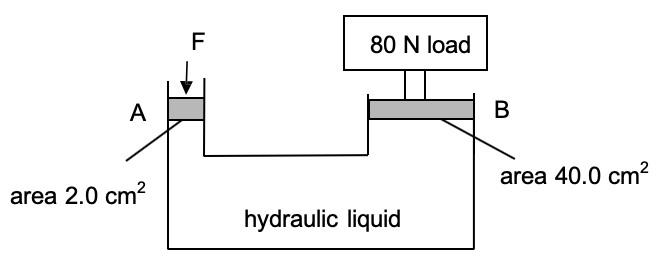
| The diagram below shows the structure of a simple hydraulic lift. When a force F is applied at A, a force is set up at B to lift a load.
Calculate the magnitude of force F required to lift a load of 80 N at B. |
| Example |
|---|
| The diagram below shows a simple hydraulic system. Piston P has a diameter of 1.0 cm and piston Q has a diameter of 2.5 cm. 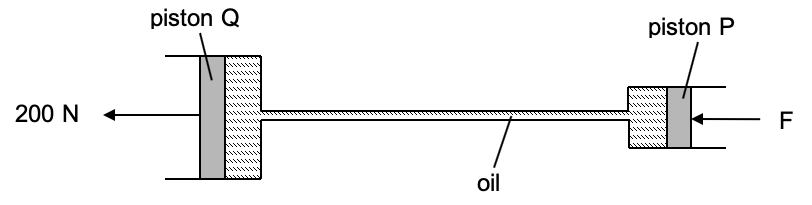 Calculate the magnitude of the force F on piston P to exert a force of 200 N on piston Q. Calculate the magnitude of the force F on piston P to exert a force of 200 N on piston Q.
|
Applications Of Hydraulic Systems
Car Brakes
Hydraulic systems form an important part of vehicle brake systems.
Operating Machinery
Many machines are powered by hydraulic systems.
 hydraulic pistons can clearly be seen on this digger
| << Back | Pressure | Next >> |
| Links |
|---|
| Pascal’s Law & Hydraulic Brake System |
| Properties of brake fluids |
| Advantages & Disadvantages of Hydraulic Systems |