Boyle’s Law states that for a fixed mass of gas at a constant temperature, the volume V of the gas is inversely proportional to its pressure P.
So mathematically,
V∝1/P OR P∝1/V
We could also write this as
PV = constant
As we are normally comparing the pressure and volumes of a gas before and after we have compressed it we can use:
PiVi = PfVf
where the subscriptsi and f indicate the initial and final conditions respectively.
More commonly, we will see:
P1V1 = P2V2
Where subscripts 1 and 2 represent that values at two points in time.
Units In Boyle’s Law Equation
As both pressure , P, and volume, V, appear on both sides of the equation there is no need to convert into standard (SI) units. We can use any unit we like.
P1V1 = P2V2
However, care must be taken to use the same unit on either side of the equation.
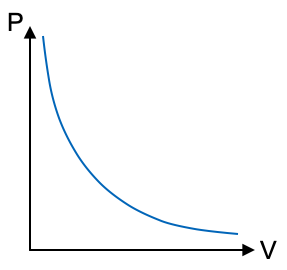
Graphically we should know the graph will look like this:
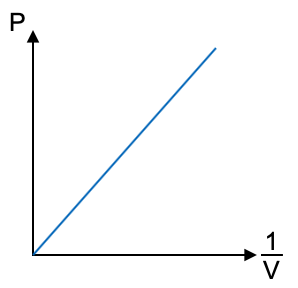
To obtain a straight line graph we could take the reciprocal of one of the values such as this:
Qualitative description of Boyle’s Law
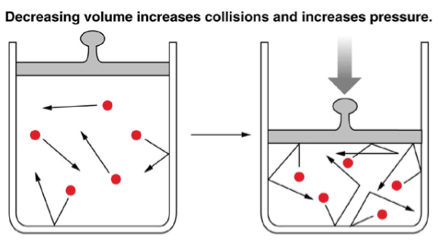
For a fixed mass of gas at constant temperature, the average speed of the molecules remains the same. If the volume is halved, the number of gas molecules per unit volume will be doubled. The number of molecules hitting the wall per unit time will also be doubled. Consequently the gas pressure will be doubled.
Example
The volume of a fixed mass of gas at 76.0 cm Hg pressure is 150 cm³. If the temperature remains constant, find:
(a) the pressure of the gas when its volume is 250 cm³, and
Using PiVi = PfVf,
then 76.0 × 150 = Pf × 250
Pf = 45.6 cm Hg
(b) its volume at a pressure of 75.0 cm Hg.
Using PiVi = PfVf,
then 76.0 × 150 = 75.0 × Vf
Vf = 152 cm³
Example
An air bubble at the bottom of a pond 60 m deep has a volume of 2.0 cm3. What will its volume be when it rises to just below the surface of the water
Assume the atmospheric pressure is equivalent to a height of 10 m of water.
Pressure at surface = Patm = 10 mH₂O
Pressure at bottom = pressure due to water + Patm
of the pond
P = PH₂O + Patm
P = 60 mH₂O + 10 mH₂O
P = 70 mH₂O
Applying Boyle’s Law,
P1V1 = P2V2,
70 × 2.0 = 10 x V2
V2 =14.0 cm³
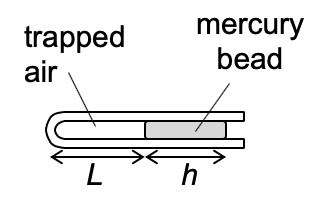
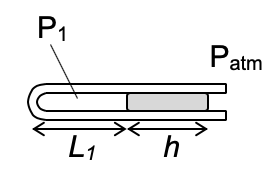
Consider some air trapped in a thin uniform glass tube by a bead of mercury of length h:
Tube horizontal:
Pressure of trapped air is P₁.
The mercury bead here is not moving sideways so must be under the same pressure from either side.
Hence,
P₁ = Patm
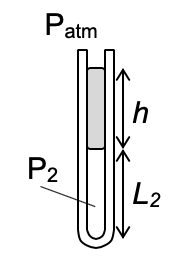
With the tube vertical (trapped air at bottom):
Pressure of trapped air is P₂.
Here the mercury bead of length h is pushing down on the trapped air.
As the top end of the mercury is exposed to atmospheric pressure, that must also be acting on the trapped air.
Hence,
P₂ = Patm + h
(Assumes all pressure measured in cmHg)
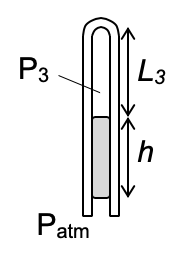
With the tube vertical (trapped air at top):
Pressure of trapped air is P₃.
Here the mercury bead of length h and the the trapped air are pushing down on the air below the mercury (which is at atmospheric presser, Patm).
Hence,
Patm = P₃ + h
P₃ = Patm−h
(Assumes all pressure measured in cmHg)
Example
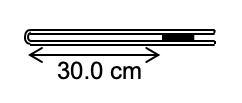
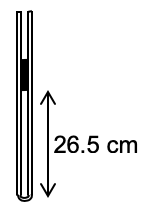
A narrow uniform tube, closed at one end, contains some dry air which is sealed by a thread of mercury 10.0 cm long. When the tube is held horizontally, the air column is 30.0 cm long but when it is held vertically, with the closed end at the bottom, the air column is 26.5 cm long.
Calculate the atmospheric pressure.
Let atmospheric pressure be A,
P1V1 = P2V2,
A x 30.0 = (A + 10.0) x 26.5
Using Length instead of Volume
In many questions (such as the one above) we may not know the volume of the trapped gas but be given the length of the trapped gas. In such questions if we assume the contained has uniform cross-section then the length can be used in place of the volume as
volume = length x cross-sectional area.
i.e.
P1V1 = P2V2
P1L1A = P2L2A
P1L1 = P2L2
General Problem Solving Approach – Pressure Problems
Identify any changes in pressure at a point or between two points in a fluid (gas or liquid). This may cause the fluid to move from a high pressure region to a low pressure region.
Identify any differences in pressure between the inside and outside of an enclosed system (e.g. balloon). The corresponding difference in forces (net force) may cause expansion or contraction of the system, unless the container is very stiff.
Identify any factors or properties related to pressure: e.g. temperature, gas is compressible, liquid is not compressible, change in volume (check conditions for using Boyle’s law), change in depth or altitude.
Apply problem solving approaches in specific cases, e.g. barometer, manometer.
Always check for consistency of units of pressure: e.g. Pa, N cm-2, cmHg, atmospheres.