Electricity is used in many appliances in our homes, schools, work places etc.
The three main uses of electricity are for the production of heat, light and motion.
Electric Heating
Appliances producing heat generally consist of a heating element, such as a nichrome wire. Current passing through the wire will heat the wire up.
Nichrome is a nickel-chromium alloy of very high melting point and high resistivity that is resistant to oxidation at high temperatures. This wire is usually wrapped around an insulating, fire-proof material such as silica or fire-clay.
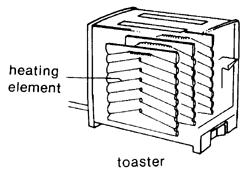
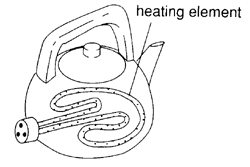 Appliances:
Electric kettle
Iron
Electric cooker
Electric water heater
Electric Lighting
Generally less energy-consuming than producing heat there are two main mechanisms in which light can be produced from electricity.
1. Filament Lamp
Also known as an incandescent lamp, a filament lamp consists of a fairly large, thin, frosted or clear glass envelope. Inside the glass is an inert gas like argon and/or nitrogen. At the center of the lamp is a tungsten filament. Electricity heats this filament up to about 2,500 °C. Just like any hot metal, the tungsten gets “white hot” at that temperature and emits a great deal of visible light in a process called incandescence.
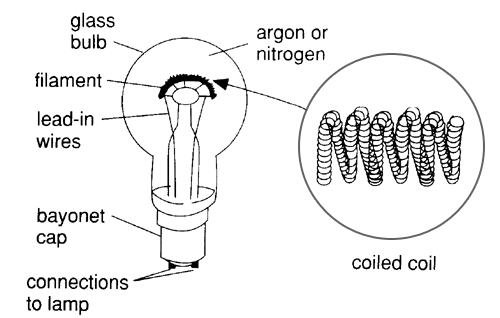
A normal light bulb is not very efficient, and it only lasts about 750 to 1,000 hours in normal use. It’s not very efficient because, in the process of radiating light, it also radiates a huge amount of infrared heat – far more heat than light. Since the purpose of a light bulb is to generate light, the heat is wasted energy. It doesn’t last very long because the tungsten in the filament evaporates and deposits on the glass. Eventually a thin spot in the filament causes the filament to break and the bulb “blows”.
A variation of the filament lamp is the halogen lamp. Using a similar tungsten filament but in a vapour of highly reactive halogen gases – usually iodine or bromine. Instead of glass, the gas is enveloped in quartz, which can withstand the higher temperatures produced. The halogen gas will react with the tungsten vapour when cool – such as near the quartz envelope – but dissosiates at the very high temperatures when near the filament. This actually means that the metal can be re-deposited on to the filament (instead of the quartz) – thus the bulb will last longer and can be operated at a higher temperature, where it will produce more useful light relative to the heat produced.
2. Fluorescent Lamp
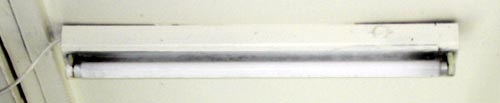
A fluorescent bulb uses a completely different method to produce light. In a fluorescent tube there are electrodes at both ends of the tube and a gas containing argon and mercury vapor within the tube. A stream of electrons flows through the gas from one electrode to the other. These electrons bump into the mercury atoms and excite them. As the mercury atoms move from the excited state back to the unexcited state, they give off ultraviolet light. This UV light hits the phosphor coating the inside of the fluorescent tube, and this phosphor creates visible light.
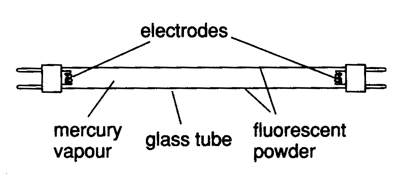
A fluorescent bulb produces less heat, so it is much more efficient. A fluorescent bulb is 4 to 6 times more efficient than an incandescent bulb. A 15 watt fluorescent bulb can typically produce the same amount of light as a 60 watt incandescent bulb.
Electric Motors
Electic motors make use of the magnetic effect of a current.
Appliances:
Hairdryer
Fan
Food mixer
Electric drill
Washing machine
| << Back | Practical Electricity | Next >> |