A fuse is a safety device. It does not normally play a part in the circuit and is only of use when something has gone wrong.
A fuse is a piece of wire which will melt to disconnect the appliance from the high potential when the current through it exceeds its rating. E.g. if a fuse is rated 10 A, it will melt if a current of 11 A flows through the fuse.
Fuses are generally of the form of a replaceable cartridge made of glass or ceramic, with the fuse wire inside.
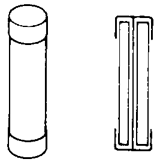
Consists of a glass tube capped by two metal caps with a piece of fuse wire connected between them.
When the fuse blows the whole cartridge is replaced.
This is the type of fuse found in a plug and normally comes in 1 A, 3 A, 5 A, 13 A ratings.
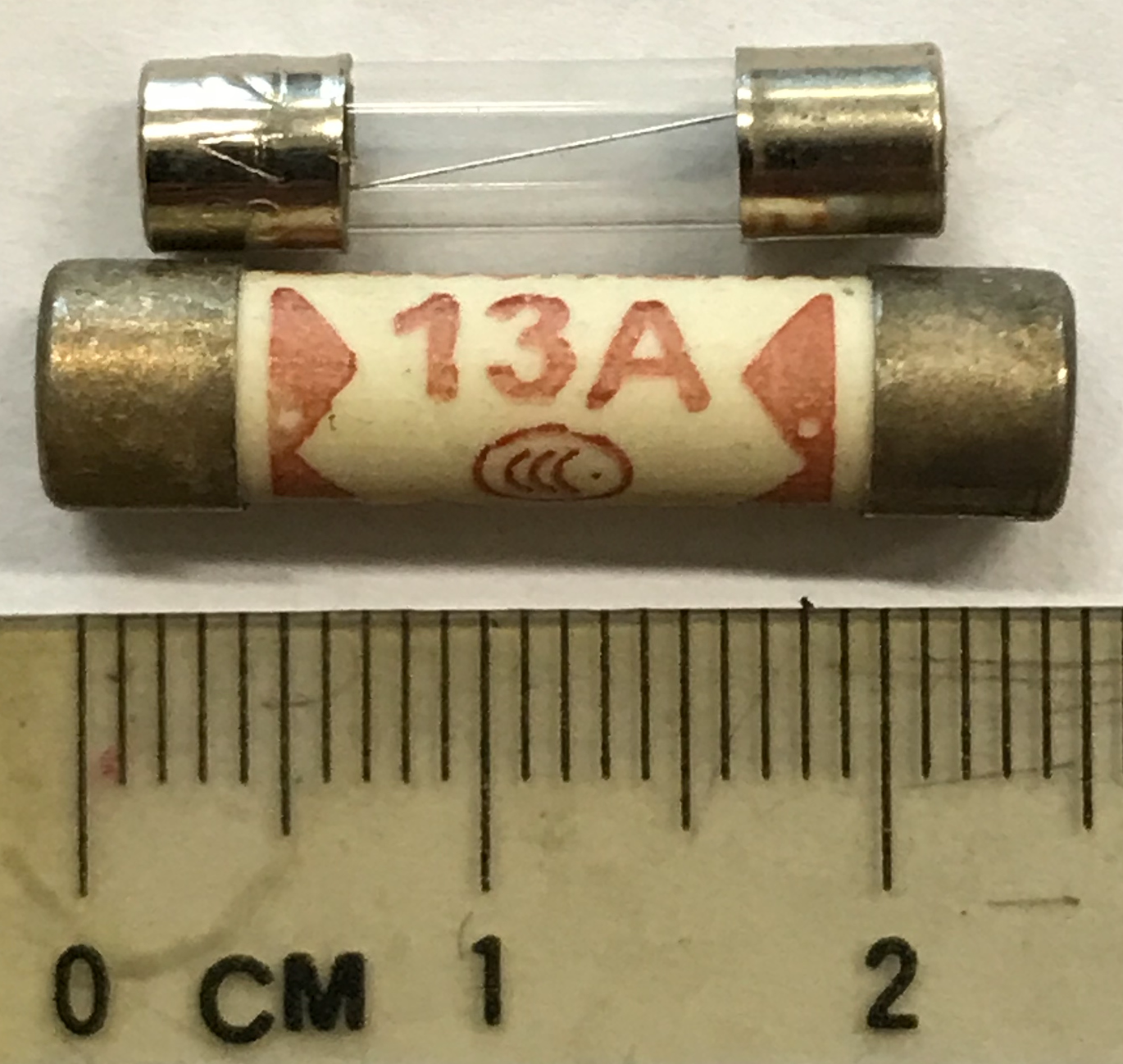 showing the scale of typical cartridge fuses
| Old Type of Fuse |
|---|
In the past, before fuse cartridges were common , ceramic fuses were used.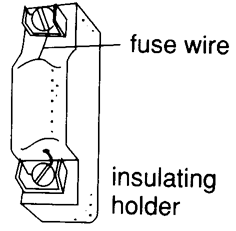
The ceramic can withstand high temperatures and is an insulator. When the fuse blows a new piece of fuse-wire is screwed into place. |
A fuse should always be placed in the live wire so that when the fuse blows, the appliance will be disconnected from the high voltage source.
When the current flowing through a fuse exceeds a certain value – “the fuse rating” – the fuse will “blow” and break the circuit. The fuse can thus be thought of as a current limiter in the circuit.
Note: the fuse does not “stop” or “reduce” the current flowing. It has no effect on the circuit until it “blows”.
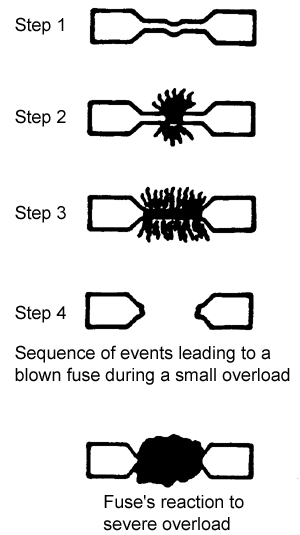
Fuses behave differently depending on the severity of the overloading as shown below:
| << Back | Practical Electricity | Next >> |