Electrical Power
| Definition: Electrical Power |
|---|
| Power is energy supplied per unit time. |
SI unit for power is Watt (W)
In equation form:
 |
Where:
 = power of the electrical appliance: watts (W)
 = electric current flowing through appliance: amperes (A)
 = potential difference across appliance: volts (V)
by substituting in V = I R, we can get the following variations:
 |
 |
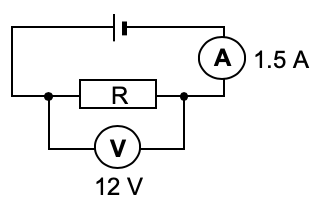
| Example 1 (P = IV) |
|---|
| What is the power dissipated in resistor R?
|
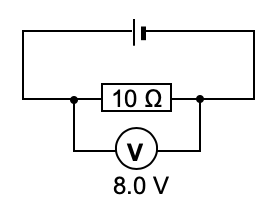
| Example 2 (P = V²/R) |
|---|
| What is the power dissipated in the 10 Ω resistor?
|
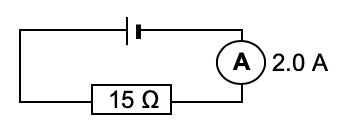
| Example 3 (P = I² R) |
|---|
| What is the power dissipated in the 15 Ω resistor?
|
| Example 4 |
|---|
| What is the power dissipated in the 6 Ω and 12 Ω resistors connected in parallel?
|
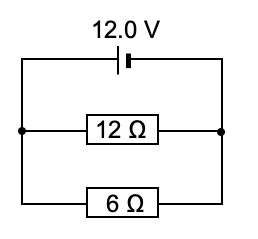
For resistors in parallel it is actually the resistor with lower resistance which will use the most power.
As the electrical energy is converted into heat here the 6 Ω resistor will get hotter than the 12 Ω resistor.
The battery is supplying 36 W to the circuit.
| Example 5 |
|---|
| What is the power dissipated in the 6 Ω and 12 Ω resistors connected in series?
|
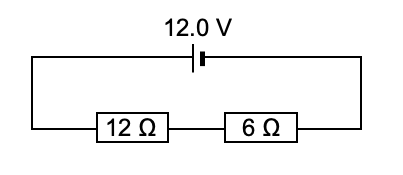
For resistors in series it is the resistor with larger resistance which will use the most power.
As the electrical energy is converted into heat here the 12 Ω resistor will get hotter than the 6 Ω resistor.
The battery is supplying 8.0 W to the circuit.
| Example 6 |
|---|
| A bulb is marked as “60 W, 240 V”.
(a) What is the current drawn from the bulb when used correctly?
(b) What is the resistance of the 60 W bulb?
(c) The bulb is plugged in in another country whose mains electricity is delivered at 120 V. What is the power that the bulb produces in this instance? |

Note:
- The bulb does not use 60 W when not connected to a 240 V supply.
- As the voltage is halved, the current will also be halved, and the power will then one quarter of the original value (60 W ÷ 4 = 15 W)
| << Back | Practical Electricity | Next >> |