Electrical Energy
Electrical energy can be determined by:
 |
Where:
 = the electrical energy: joules (J)
 = electrical power: watts (W)
 = time: seconds (s)
As we know  we can say:
 |
Where:
= total electrical energy: joules (J)
 = potential difference across component: volts (V)
 = current flowing through component: amperes (A)
= time: seconds (s)
| Example: Finding Energy in Joules |
|---|
| What is the energy used by a 2.0 V bulb in one minute, if a current of 0.5 A flows though it? |
The kilowatt-hour
Although the SI unit of electrical energy is Joule (J), another common unit for electrical energy usage is the kilowatt-hour (kWh). We still use the same equation but with a different set of units.
|
Where:
= the electrical energy: kiolwatt-hour (kWh)
= electrical power: kilowatts (kW)
= time: seconds: hour (h)
| Example: Finding Energy in Kilowatt-hours (kWh) |
|---|
| What is the energy used by a 1500 W air-conditioner in running for 8 hours? |
| Example 2 |
|---|
| How long will a 60 W laptop run on 0.36 kWh of electrical energy? |
| Joules vs Kilowatt-Hours |
|---|
| Consider a 1000 W appliance switched on for one hour.
Power used (in joules) is:
Power used (in kWh) is:
Thus, 1 kWh = 3,600,000 J (3.6 MJ) |
Electricity meter is the instrument used by the electricity company to measure the amount of electrical energy consumed.
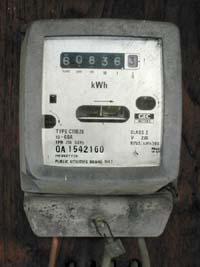
| Reading an Electricity Meter |
|---|
|
Older meters had dials in which each pointer should be read to the lower number.
|
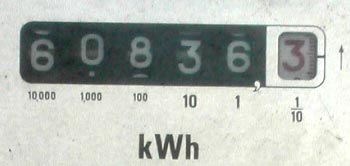
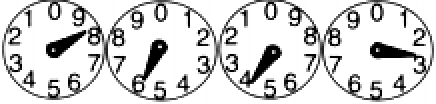
1 kWh of energy is sometimes referred to as a unit of electrical energy.
Cost of electricity consumed = Electrical energy usage measured in kilowatt-hour (kWh) x cost per kWh
OR
| Cost of electricity consumed = No. of Units x cost per Unit |
| Example (Cost of Electricity) |
|---|
| How much does it cost to run a 100 W fridge for 30 days if electricity is sold at $0.25 per kWh? |
| Example 3 |
|---|
| How much will it cost to use a 2500 W air-conditioner for a week if electricity cost 30.0¢ per unit and it is switched on for 6 hours a day? |
| Caution: A Common Mistake |
|---|
| Be careful with pricing – don’t mix up dollars and cents. |
| << Back | Practical Electricity | Next >> |