This is going to be a very rambling page of a non-musical Physics teacher who is a growing interest in electronic music and is trying to find out some of the science and theory behind music.
This page is still a work-in-progress.
Pitch & Frequency
Pitch of a note describes how high or low is the sound. Low pitch notes have low frequencies, high pitch notes have high frequencies. Frequency is of course measured in hertz (Hz), being the number of oscillations (vibrations) per second.
Pitch is a subjective / perceptual property of a heard sound. Thus we are able to identify which note has a higher pitch, but are not able to quantify the frequency of the sound.
Humans can hear approximately from 20 Hz to 20,000 Hz (20 kHz).
Frequency of Notes of a String
The frequency,  , of the fundamental note of a plucked string is given by:
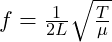
where:
 is the length of the string (m)
 is the tension in the string (N)
 is the mass per unit length of the string (kg/m)
Thus any time we reduce the length of a string (such as placing a finger on a guitar fret) the frequency of the note produced on that string will get higher.
In particular, reducing the length of a string by half will result in a note being produced with double the frequency. Such notes are said to be an octave higher in pitch.
| This string, of length , produces a note of 220 Hz when plucked.
This string, of length of length ½
This string, of length ¼
|


In practice though, a string of length will not only vibrate at the fundamental frequency but will also have multiple harmonic oscillations also occurring.

Here we are shown the first 4 harmonic frequencies on the string:
The first is the fundamental harmonic of frequency .
The second harmonic (first overtone) results in a note of frequency 2.
The third harmonic (second overtone) results in a note of frequency 3.
The fourth harmonic (third overtone) results in a note of frequency 4.
Of course this will continue to many further (whole number) harmonics being on the string.
These harmonics add together to give the overall timbre of the instrument being played.
Note that whilst some of these overtones are the same note at higher octaves that is not always the case. For example a string with a fundamental frequency of 100 Hz will also resonate at the following frequencies:
100 Hz, 200 Hz, 300 Hz, 400 Hz, 500 Hz, 600 Hz, 700 Hz, 800 Hz, 900 Hz, …
Those in bold are 2n multiples of 100 and will thus be higher octaves intervals of the 100 Hz note. But many other overtones will not be whole octaves higher up the scale.
Consonance and Dissonance
Consonant notes are those that sound pleasing and stable when played together.
Dissonant notes that do not sound like they fit together, they grind against each other and do not sound pleasant.
Consonant notes tend to be those that have frequencies that are related by simple numerical ratios such as 1:1 (unison), 2:1 (an octave apart) and 3:2 (a perfect fifth).
Octaves
In music, an octave (from the Latin octavus meaning eighth) is an interval between two notes, one having twice the frequency of vibration of the other.
Thus the A note above middle C on the piano is 440 Hz. The A above that would have a frequency of 880 Hz, whilst the A below that on the piano is 220 Hz.
On a string instrument a note an octave higher would be produced when a string’s length is halved (all other factors being kept constant).
Chromatic Scale – The 12 notes
Firstly, I assume you know there are 12 different notes on a keyboard:

This is called the Chromatic Scale, and contains all the notes that are used in western music. 12 notes, each separated by a semitone. So that between C and C# there is 1 semitone, and between C and D there is 1 tone (or 2 semitones) of distance.
Scales
A scale is a collection of notes. For example the C Major Scale contains the following seven notes:
C D E F G A B
Here C is the first note of the scale (also called root note), D is the second, E is the third, G is the fifth, etc.

The scale degree represents the position of the note in the scale with the root note being 1 as indicated by the numbers below these notes.
Notice that there are actually different intervals between these notes.
C-D is a whole note, D-E is a whole note, E-F is a semitone, F-G is a whole note, G-A is a whole note, A-B is a whole note and B-C is a semitone.
All Major Scales will display this same spacing between its member notes. Thus an E Major Scale would contain the following notes:

Why 12 Notes?
Two notes that have the same frequency are said to be in unison.
A note and a second that is double the frequency of the first are perceived by the human ear as having very similar sounds and are pleasing to listen to. They are said to be an octave apart.
The next most pleasing combination of notes is a pair of notes with the ratio of frequencies as 3:2.
Two notes whose frequencies are this ratio apart are said to be Perfect Fifths as they are 5 degrees apart on a scale or 7 semitones apart on the 12 note scale.
Building a Scale Using Perfect Fifths
If we start with a note and repeatedly multiply by 3/2 (going up a perfect fifth each time), we can generate a series of notes. Let’s start with A at 220.00 Hz and see what happens:
Starting note:
-
- A: 220.00 Hz (our reference, f₀)
1st perfect fifth:
-
- 220.00 × 3/2 = 330.00 Hz (E)
2nd perfect fifth:
-
- 330.00 × 3/2 = 495.00 Hz (B)
- Above octave, so: 495.00 ÷ 2 = 247.50 Hz
3rd perfect fifth:
-
- 247.50 × 3/2 = 371.25 Hz (F♯)
4th perfect fifth:
-
- 371.25 × 3/2 = 556.88 Hz (C♯)
- Above octave, so: 556.88 ÷ 2 = 278.44 Hz
5th perfect fifth:
-
- 278.44 × 3/2 = 417.66 Hz (G♯)
6th perfect fifth:
-
- 417.66 × 3/2 = 626.48 Hz (D♯)
- Above octave, so: 626.48 ÷ 2 = 313.24 Hz
7th perfect fifth:
-
- 313.24 × 3/2 = 469.86 Hz (A♯)
- Above octave, so: 469.86 ÷ 2 = 234.93 Hz
8th perfect fifth:
-
- 234.93 × 3/2 = 352.40 Hz (F)
9th perfect fifth:
-
- 352.40 × 3/2 = 528.59 Hz (C)
- Above octave, so: 528.59 ÷ 2 = 264.30 Hz
10th perfect fifth:
-
- 264.30 × 3/2 = 396.45 Hz (G)
11th perfect fifth:
-
- 396.45 × 3/2 = 594.67 Hz (D)
- Above octave, so: 594.67 ÷ 2 = 297.34 Hz
12th perfect fifth:
-
- 297.34 × 3/2 = 446.00 Hz (A)
- Above octave, so: 446.00 ÷ 2 = 223.00 Hz
Thus by repeatedly making pleasing notes that are always 3/2 of the last (and moved down to always be in the same one octave range), after 12 times we end up (almost) exactly at the starting note.
This should be A again (220.00 Hz), but we got 223.00 Hz – close, but not exact!
The discrepancy is: 223.00 / 220.00 = 1.0136 (about 1.4% higher)
The Sequence of Fifths
Notice the order in which notes appear as we stack fifths:
A → E → B → F♯ → C♯ → G♯ → D♯ → A♯ → F → C → G → D → (A)
This sequence is called the Circle of Fifths and is fundamental to music theory. Each step moves us 7 semitones higher (or 5 semitones lower when brought down within the octave).
| Interval Name | Ratio |
| Unison | 1:1 |
| minor 2nd | |
| Major 2nd | |
| minor 3rd | |
| Major 3rd | |
| perfect 4th | 4:3 |
| augmented 4th | |
| perfect 5th | 3:2 |
| minor 6th | |
| Major 6th | 5:3 |
| minor 7th | |
| Major 7th | |
| Octave | 2:1 |
| Note | Frequency / Hz |
| A | 220.0000 |
| A♯/B♭ | 233.0819 |
| B | 246.9417 |
| C | 261.6256 |
| C♯/D♭ | 277.1826 |
| D | 293.6648 |
| D♯/E♭ | 311.1270 |
| E | 329.6276 |
| F | 349.2282 |
| F♯/G♭ | 369.9944 |
| G | 391.9954 |
| G♯/A♭ | 415.3047 |
| A | 440.0000 |
https://www.tonegym.co/course/introduction
Chords
The musical ♯♭