You will frequently be measuring time in the laboratory using a digital stopwatch.
The useful precision of the stopwatch is 0.1 s
Note, most stopwatches will have a display in the following format:
H:MM:SSss or M:SSss
Where H is hours, MM is minutes, SS is seconds and the final digits (ss) being hundredths of a second.
| Recording a Stopwatch Reading |
|---|
| However, even though the digital stopwatch will usually display 0.01 s, as human reaction time is typically much more than 0.1 s (typically 0.2 s to 0.5 s) we will only be recording the reading to the nearest 0.1 s. |
| Example 1 |
|---|
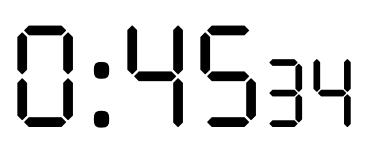
| What is the reading on the following stopwatch display? And how should the value be recorded?
Reading: 45.34 s Recorded as: 45.3 s |
| Example 2 |
|---|
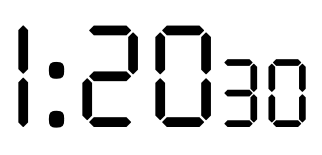
| How would you record the following time displayed on a stopwatch?
Reading: 80.30 s The display is showing 1 minute, 20 seconds and 30 1/100ths of a second. As SI units are seconds, we should use seconds and not minutes. Recorded as: 80.3 s |
| Taking an Average
Due to the uncertainty in making time readings (caused by human reaction time) we will usually try to make several readings and then determine an average value. A minimum of 2 readings should be taken, with more being preferable. |
| Example |
|---|
| In an experiment 2 timings are taken, t1 = 23.4 s and t2 = 23.5 s. How should the average be recorded? |
| Wait a Sec! |
|---|
| SI unit for the second is ‘s’, thus ‘1.2 s’ is correct ‘1.2 sec’ will be marked as wrong as it is non standard. |
| << Back | Measurement | Next >> |
| Links |
|---|
| Test your Reaction Time |