| Physical quantities are physical properties of a body or a substance that can be quantified by measurement. Examples of physical quantities include: area of a tennis court, mass of a girl, height of a building and speed of a car.
When stating any measurement of physical quantity, two things should be recorded: (i) the numerical value of the quantity (magnitude) and Example: height = 1.62 m |
SI Units
The International System of Units, universally abbreviated SI (from the French Le Système International d’Unités) is the world’s most widely used system of measurement for the physical sciences. It is based on seven base units and the convenience of the number ten.
Base Units
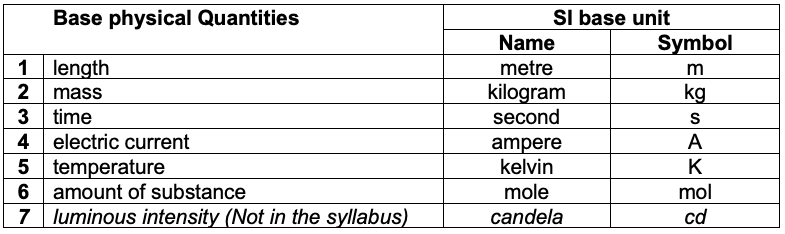
The seven SI base units for seven base quantities assumed to be mutually independent.
| lower case or UPPER CASE? |
|---|
| Whether a symbol is upper or lower case IS IMPORTANT!
If you write the length is 2.0 M you will be marked wrong. It should be either 2.0 m or 2.0 metres. In general unit symbols are lower case, unless they are named after a person. So kelvin (K), watt (W), ohm (Ω – capital greek letter), etc all have capital letters for their symbols. Note that the actual name of the unit does not start with a capital letter. |
| How long is 1 metre? |
|---|
|
Original concept of the metre goes back to France in 1973 in an attempt to standardise and modernise the units that were being used. It was defined to be one ten-millionth of the distance from the north pole to the equator (passing through Paris). This distance is actually 10 001 966 metres. The metre is the length of the path travelled by light in vacuum during a time interval of 1/299 792 458 of a second. Note that the effect of this definition is to fix the speed of light in vacuum at exactly 299 792 458 m·s-1. The original international prototype of the metre, which was sanctioned by the 1st CGPM in 1889, is still kept at the BIPM under the conditions specified in 1889. |
Derived Units
Other quantities, called derived quantities, are defined in terms of the seven base quantities via a system of quantity equations. The SI derived units for these derived quantities can be obtained from these equations and the seven SI base units.
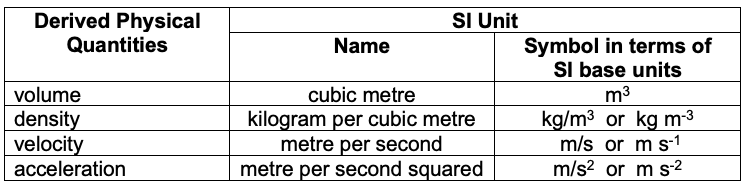
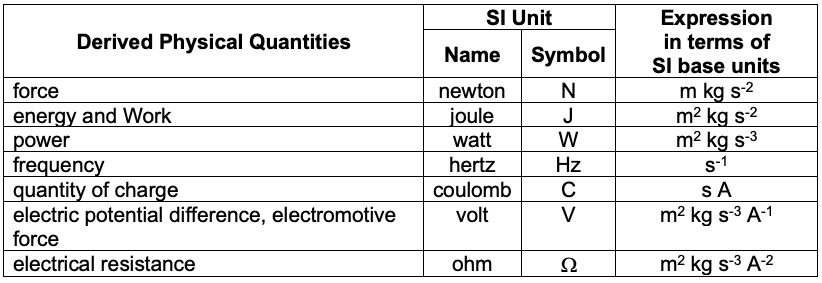
Some units of other derived quantities have been given special names.
| Example |
|---|
| Express newton in terms of SI base units?
Newton is the unit of force. Recalling a basic equation of force: F = ma So, 1 N = 1 kg × 1 m s⁻² Hence, 1 N = 1 kg m s⁻² |
Prefixes
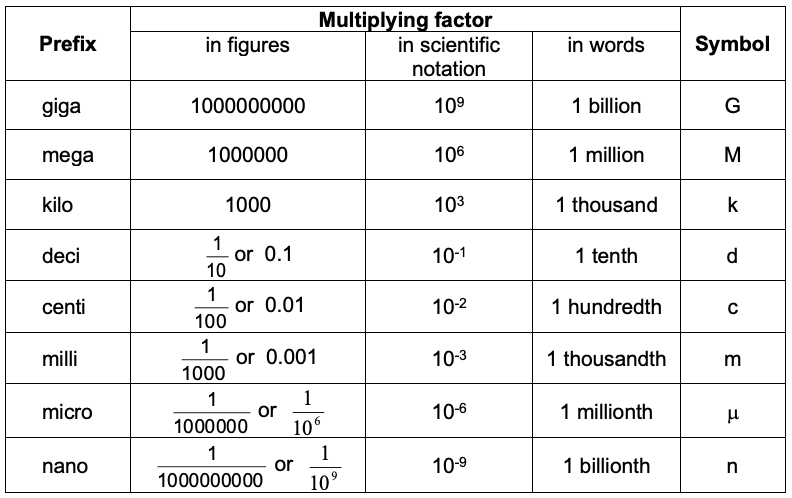
One advantage of the SI system is its use of standard prefixes to represent multiples of 10, so that readings of very large or very small values can be easily expressed.
| Caution |
|---|
| You should try and have a feeling of values and be able to make educated approximate estimates as to the values of objects. eg if thinking about a cup of coffee a mass of 300 g, a temperature of 70 °C would be reasonable, and likely close to the measured values. A mass of 3 kg and temperature of 17 °C would obviously be pretty poor estimates of these values.
In this was you will also likely be able to tell if your answer to a physics question is right or wrong. We will try to make answers as close to real life as possible. |
| << Back | Measurement | Next >> |
| Links |
|---|
| https://en.wikipedia.org/wiki/SI_base_unit |
| https://en.wikipedia.org/wiki/International_System_of_Units |
| The following nicely shows the relationship between Base SI units and derived ones: http://physics.nist.gov/cuu/Units/i/SubwayDiagram.gif |
| The following explains how to use the units correctly: https://physics.nist.gov/cuu/Units/checklist.html |