The pendulum swing was used for many centuries as a way of keeping time.
A pendulum is a mass – known as a ‘bob’ – connected to a light (massless) string or rod. Given a small push away from the equilibrium position the bob will swing back and forth in a regular manner.
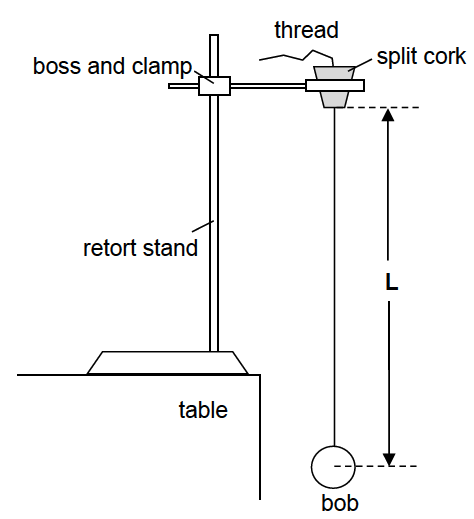
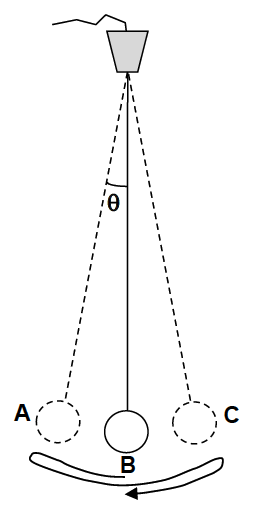
L is the length of pendulum (measured to the centre of the bob)
θ is the angular displacement
One complete oscillation is from B to A to C and back to B.
(Or any from A to C and back to A, etc…)
Period, T is defined as the time taken for the pendulum to complete one oscillation. The S.I. unit for period is seconds, s.
Frequency, f refers to the number of complete oscillations the pendulum makes in one second.
Hence, f = 1/T.
The S.I unit for frequency is hertz, Hz.
The period for a pendulum is given by the equation:
![\[ T=2\pi\sqrt{\frac{L}{g}} \]](https://physics.shone.sg/wp-content/ql-cache/quicklatex.com-4134eff3a6840a92c5a02828490ae9e3_l3.png "Rendered by QuickLaTeX.com")
From this we can see that at a fixed location, the period is only dependant upon the length of the pendulum.
However, errors increase when the pendulum is swinging with a large amplitude or when the pendulum is not swinging in a vertical plane.
Questions:
- What is a plumb line? Where did it get its name from?
- What is Foucault’s pendulum?
Physics Simulations:
Pendulum Lab (iPad friendly)
https://phet.colorado.edu/en/simulation/pendulum-lab
Some interesting clips from the web:
Wikipedia
http://en.wikipedia.org/wiki/Pendulum
Video of swings of pendulums of different lengths
http://youtu.be/yVkdfJ9PkRQ
The making of Kinetic Rain
http://youtu.be/jhP9n6WvVfQ
| << Back | Measurement | Next >> |
| Funny Physics! |
|---|
I was studying frequency in my physics class. Now my brain Hertz. |