Induced Magnetism
Why does a piece of unmagnetised iron get attracted to a magnet?
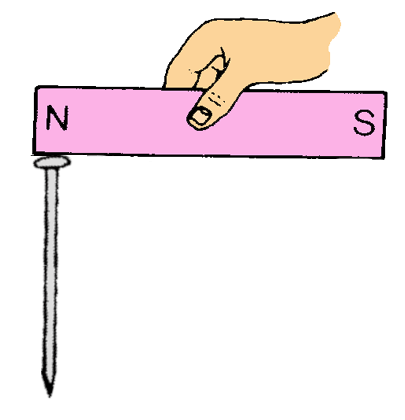
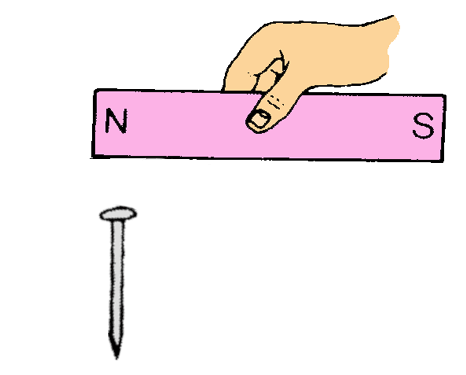 This iron nail, placed near the north pole of a magnet, will be attracted to the magnet. This is because the nail has turned into an induced magnet because of its proximity to the magnet.
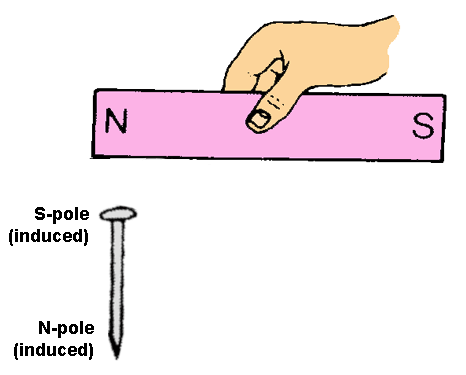
Induced poles in the nail are shown here. The nail is now a magnet – an induced magnet. The nail will be a weaker magnet than the permanent magnet. The induced poles will always form in such a way as to cause attraction.
| Definition: Induced Magnetism |
|---|
| Unmagnetised magnetic objects placed near a magnet will be attracted to the magnet. This is because the object has itself become a magnet – an induced magnet. |
| Induced Magnetism Is Temporary |
|---|
| The object will remain an induced magnet so long as it is close to the magnet. When moved away from the magnet the object will again be unmagnetised.
Induced magnetism is temporary. |
Position of Poles
We can attract multiple object to a magnet, like this:
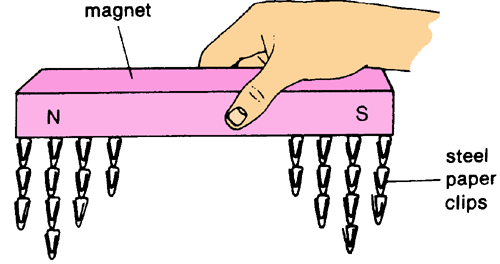
You will note that the greatest number of paper clips supported is not at the very end of the magnet. Hence the strongest part of the pole is near (but not at) the end of the bar. The middle of the bar has very little magnetism and in this example cannot support paper clips.
| Example 1 |
|---|
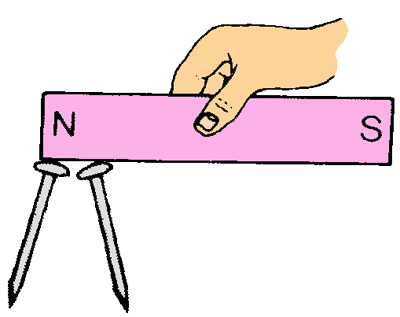
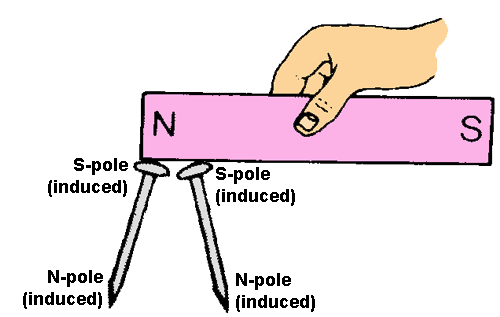
| Two iron nails attracted to a permanent magnet are observed to swing away from each other. Why is this so?
When brought close to the permanent magnet each nail has become an induced magnet.
|
| Example 2 |
|---|
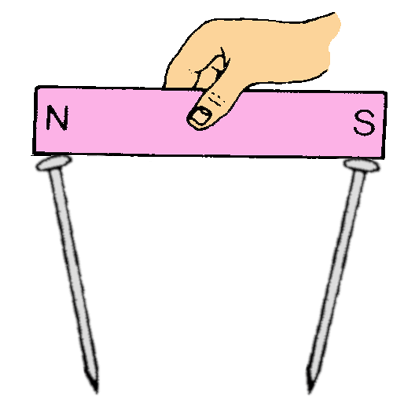
| A single nail hangs vertically down. If another nail were to be hung from the other end of the magnet, would both nails still hang vertically? Explain.
If a second nail were to be placed near the south pole of the magnet it too would become and induced magnet. However, its head would be a N-pole and its tip a S-pole. Thus the two tips (bottom ends) of the long nails now have unlike poles and so they will be attracted to each other.
So the two nails will not hang vertically. |
Theory of Magnetism
Magnetic materials can be thought of as being made up of many tiny little magnets. These ‘tiny magnets’ are called magnetic domains. A magnetic domain is a region in which all the atoms are aligned and behave as a ‘tiny magnet’.
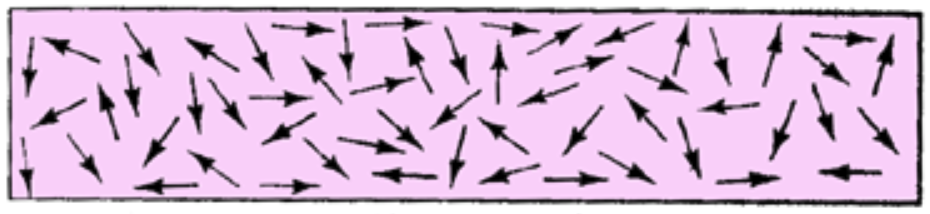 In an unmagnetised object these ‘tiny magnets’ will be disorganised and pointing in random directions as shown above.
If we magnetise an object then we are aligning the ‘tiny magnets’. to point in the same direction.
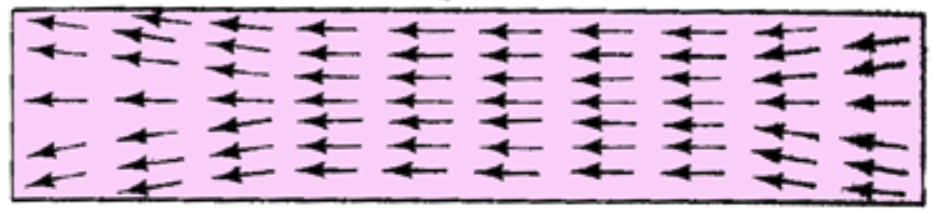 The diagram above shows a magnetised object (e.g. a permanent magnet.)
| Magnetic Saturation |
|---|
| The above diagram shows all of the domains (‘tiny magnets’) pointing in the same direction. This magnet is thus as strong as it can get. This is called magnetic saturation.
In practice, most magnets will have some (but not all) domains pointing in a certain direction and so will be magnetised, but not at their maximum possible strength. |
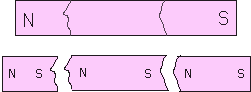
Domain theory can explain many phenomena in magnetism. Such as why, when we break a magnet, we get many magnets, and not one half which is a south pole and one half which is a north pole.
| << Back | Magnetism | Next >> |
| Links |
|---|
| Magnetism Notes 17.2 – (Mr Shone Explains) |