Magnetisation
To magnetise an object is to align the magnetic domains within the object itself.
There are two main ways to create a magnet from a piece of unmagnetised material:
1. Stroking with a permanent magnet
An unmagnetised steel bar can be stroked from end to end several times in the same direction with the same end of a permanent magnet.
In practice we many stroke 50 – 100 times or more.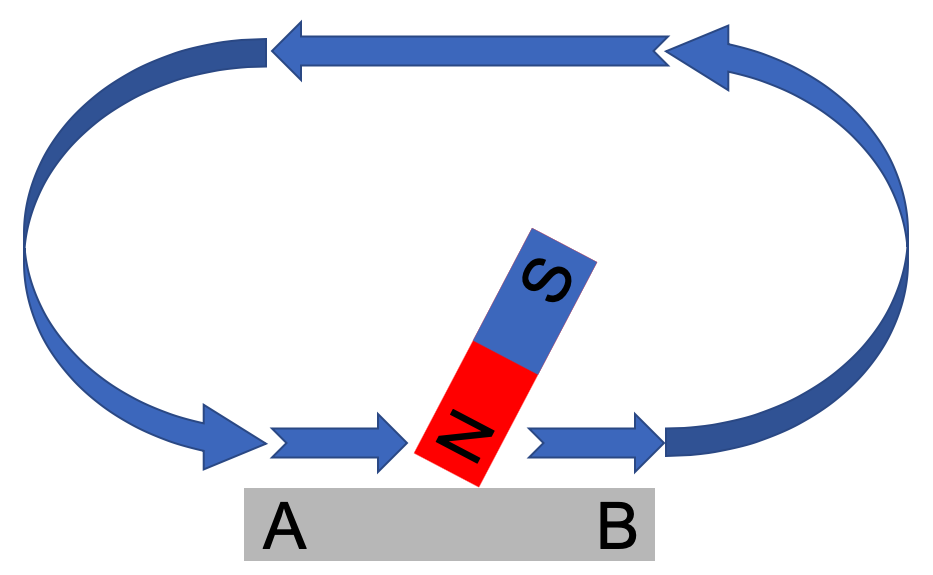 In this example unmagnetised steel bar AB is stroked many times with the north pole of a permanent magnet always from A to B. Care is taken to always move the north pole far away from AB when moving it back around towards A.
We are essentially inducing magnetism in the bar over and over again. Gradually some of the domains will remain orientated in a given direction and the bar becomes permanently magnetised.
The pole produced at the end of the magnetised bar after stroking is always of the opposite polarity to that of the stroking pole.
In this example B will be a south pole and A will be a north pole.
A variant of this is to stroke with two opposite magnetic poles at the same time from the centre to the ends as shown:
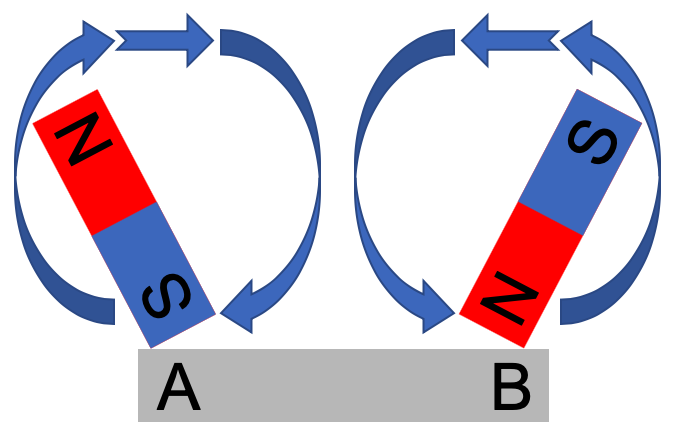 Again, B will be a south pole and A will be a north pole.
This method is slightly more efficient than using a single magnet.
2. Electrical method
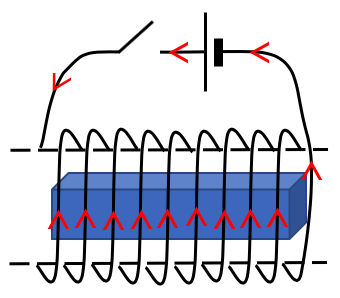
Wind an electrical wire around into a coil – this is known as a solenoid. This could be done by winding the wire around a cardboard tube.
Place the unmagnetised steel bar inside the solenoid and connect the solenoid to a direct current (d.c.) supply.
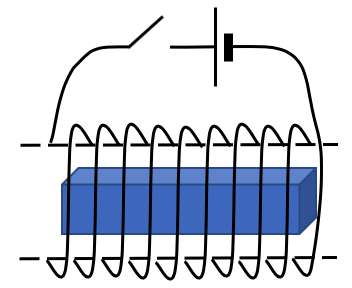
Switch the current on (just a second or two is enough) and the bar will become strongly magnetised.
The electrical method is the most effective method of producing a powerful magnet.
This method works because a solenoid creates its own powerful magnetic field. This field force the ‘tiny magnet’ (magnetic domains) to align themselves within the steel bar.
| Right Hand Grip Rule: Determining the Polarity of the Magnet |
|---|
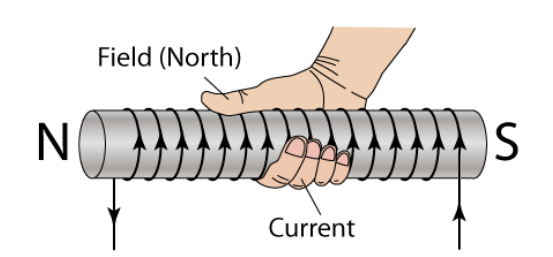
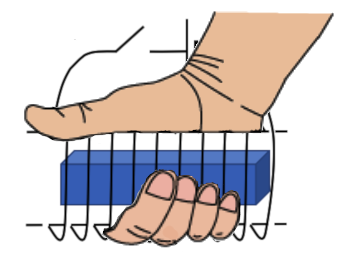
| Which end will be the north pole and which end will be the south pole of the magnet can be determined using the Right Hand Grip Rule.
Grip the coil in your hand with your fingers winding around the coil in the same direction that the current flows around the coil. Your thumb will then always be pointing to the north pole of the magnet. |
| Question: Determining the Polarity of the Magnet |
|---|
| A magnet is made by placing an unmagnetised bar of steel in a solenoid.
The current will be flowing around the solenoid lies this:
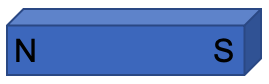
We can see that the left side of the magnet is the north pole and so the right side will be the south pole.
|
Demagnetisation
To demagnetise a magnet is to disturb the alignment of the magnetic domains so that they all point in different directions.
1. Putting the magnet over intense heat
If we heat the magnet to a very high temperature the magnet will quickly lose its magnetism. This is because atoms in the ‘tiny magnets’ (magnetic domains) within the magnet vibrate more vigorously and will loose their alignment.
This can be achieved by placing a magnet in a bunsen flame.
2. Hitting the magnet with a hammer
Hitting a magnet with a hammer causes the ‘tiny magnets’ to lose their alignment.
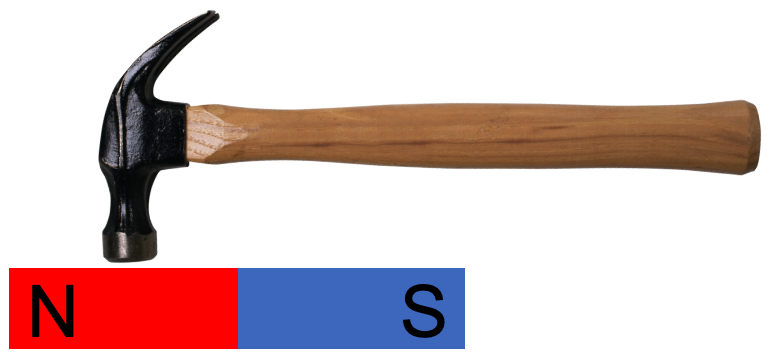
A magnet will need to be struck many, many times.
| Don’t Drop Magnets |
|---|
| This is why we should never drop magnets – it will cause them to become less magnetised (weaker magnets). |
3. Electrical method
Place the magnet in a solenoid and connect the solenoid to an A.C. supply. Remove the magnet slowly from the solenoid till it is far away.
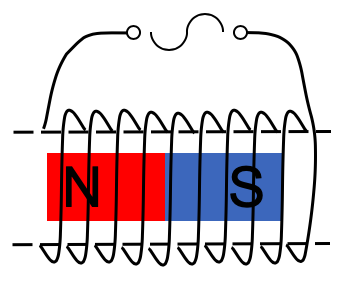
The solenoid will magnetise the bar in one direction and then in the other. As the bar is pulled put from the coil the magnetic effect gets weaker and so not all of the ‘tiny magnet’ (magnetic domains) within the bar will be completely flipped over. This process has the effect of randomising their directions.
Ideally, you would pull the bar out in an East-West direction so as to negate any effect of the Earth’s magnetic field (which runs North-South).
Storing Magnets
Magnets should be stored correctly to ensure that they do not slowly loose their magnetism over time.
Magnets should be stored using soft-iron keepers. Keepers are often used in pairs like this:
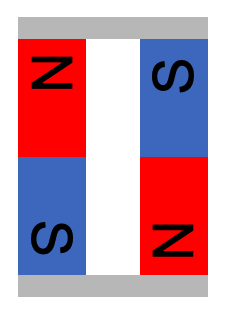 A pair of magnets correctly having soft-iron keepers to
help them from losing magnetism over time.
A common shape of magnet is the horseshoe magnet.

 Horseshoe magnet with keeper correctly fitted
to stop it losing its magnetism over time.
| << Back | Magnetism | Next >> |
| Links |
|---|
| Magnetism Notes 17.3 – (Mr Shone Explains) |