Magnetic Materials
Iron, Nickel and Cobalt can be strongly magnetised and are also be strongly attracted to magnets. Many of their alloys, including steel, behave similarly. These materials we can refer to as magnetic materials or ferromagnetic materials.
Other materials such as all other metals (copper, aluminium, gold, etc.), wood, glass etc, we can refer to as non-magnetic materials. These cannot be made into magnets and also are not attracted to a magnet.
| Magnetically Hard and Magnetically Soft |
|---|
| Hard magnetic materials are hard to magnetise, but once magnetised they hold onto their magnetism. Hard magnetic materials can be use to make permanent magnets. Examples of hard magnetic materials are steel, alnico (Al, Ni, Co alloy) & neodymium magnets (NdFeB alloy). Soft magnetic materials are easy to magnetise and will lose their magnetism easily. They are useful for making electromagnets. |
Poles
A magnet has two poles, at which the attractive force seems greatest. The poles are called north-seeking, or north (N), and south-seeking, or south (S).
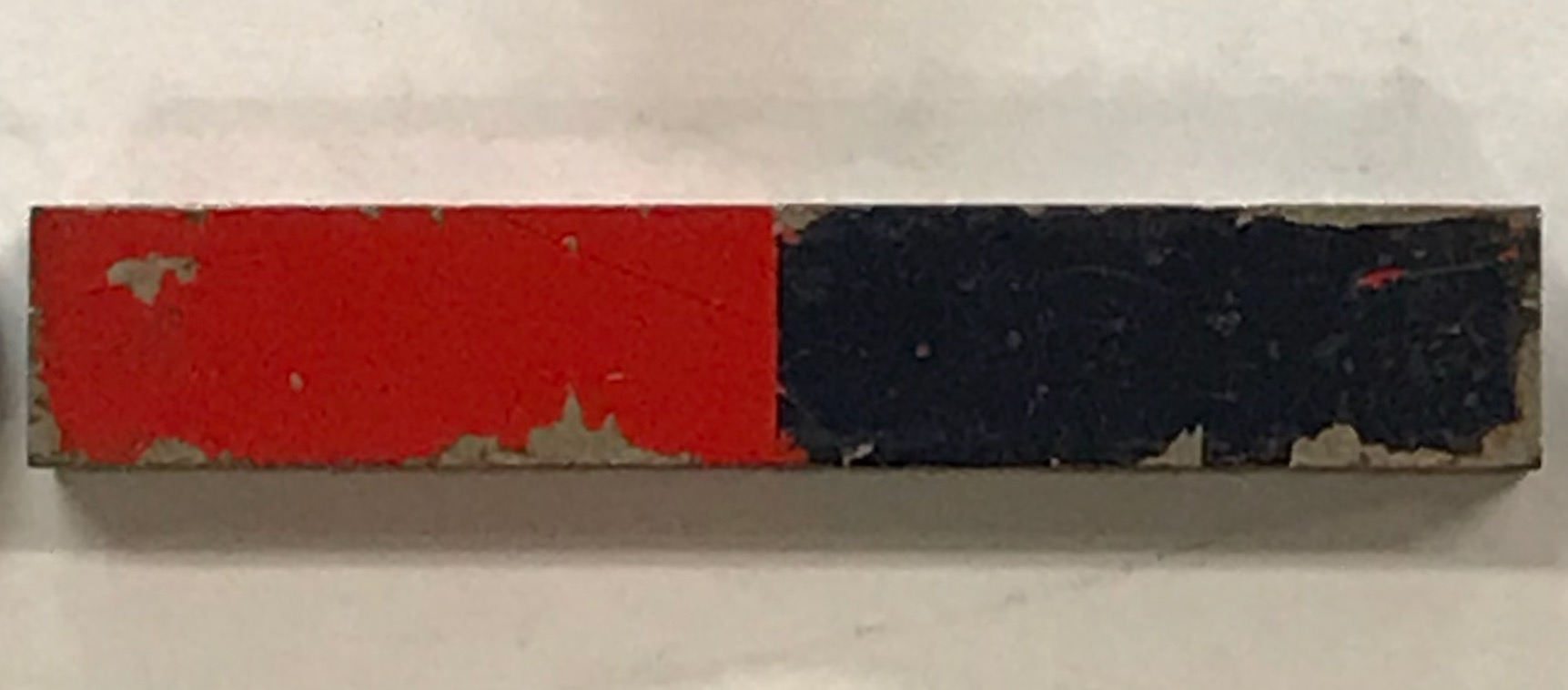 Typical lab magnet. North pole usually
painted red for easy identification.
| North & South Poles |
|---|
| All magnets must have at least one North Pole and one South Pole. You can’t have a magnet with a single pole!
Complex shapes of magnets can lead to a magnet having more than two ends (poles) |
If you hang a magnet freely so that it can swing in a horizontal plane, it always comes to rest in N-S direction. N pole (north seeking pole) points towards the Earth’s Magnetic North Pole, and S pole (south seeking pole) points towards the Earth’s Magnetic South Pole.
A magnet can therefore be used as a compass. A compass needle is freely pivoted magnet.
Law of Magnetism
| Definition: The Law of Magnetism |
|---|
| The Law of Magnetism states that like poles repel each other, and unlike poles attract each other. |
Like Poles Repel:


Unlike Poles Attract:


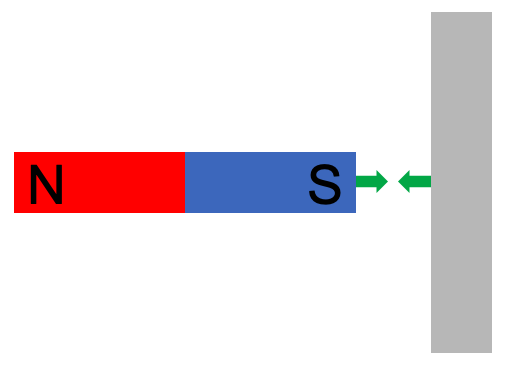
However, It is not just magnets that attract magnets. A magnet will attract any magnetic material (even if it is unmagnetised).


| Magnetic Forces are Examples of Action-Reaction Force Pairs |
|---|
| Recalling Newton’s Third Law, the forces shown above are action-reaction pairs of equal force acting in opposite directions. |
Of course, two unmagnetised pieces of magnetic material (e.g. iron) will not have a magnetic attraction.

| Test if an object is Magnetic |
|---|
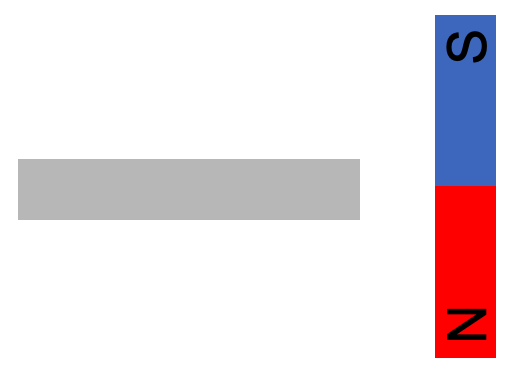
| Only repulsion between a specimen and a magnet allows us to conclude that the specimen is a magnet. |
| Telling A Magnet & An Iron Bar Apart |
|---|
| Given an unmagnetised iron bar (or any other unmagnetised magnetic material) and a magnet, they will obviously attract each other. So how to differentiate them?
|
| North Pole vs Magnetic North Pole vs Geographical North Pole |
|---|
| The Earth behaves like a giant bar magnet.
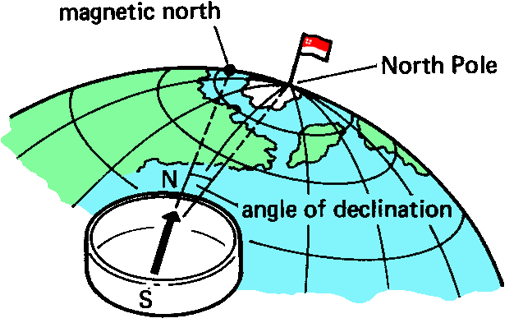
Earth’s Magnetic North Pole refers to the magnetic pole that is near the Geographic North Pole (i.e where the polar bears live – not the penguins!) The poles of the Earth’s bar magnet fall close to the geographical poles. Not actually at them. In fact the magnetic poles are constantly moving.
The North-seeking pole (North pole) of a compass points to a place near the geographic North Pole – known as magnetic north. Because we know unlike poles attract it is actually a South Pole near the Earth’s Geographic North Pole! To make things even more confusing the Earth’s magnetic field actually flips every 10,000 years or so. |
| Magnetism | Next >> |
| Links |
|---|
| Magnetism Notes 17.1 – (Mr Shone Explains) |