So far we have been solving all lens problems by means of ray diagrams. It is, however, possible to find image positions and magnifications by means of calculations.
The lens equation:
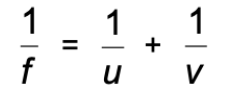
links the focal length, ƒ, with the object distance, u, and the image distance, v.
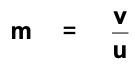
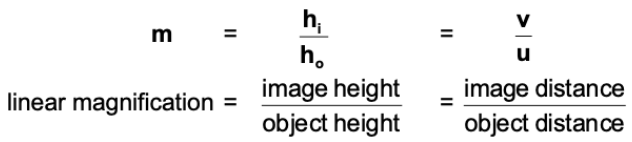
Often used together with the equation for linear magnification:
| Note on Units to be Used |
|---|
| for both of the equations you may use any units for lengths – you do not have to convert all to metres. However, all units must be the same (e.g. use centimetres for all). |
Sign Conventions
For images:
- real image: u and v are positive
- virtual image: u is positive and v is negative (image on same side of lens as object)
For lenses:
- convex lens: ƒ is positive
- concave lens: ƒ is negative
Note: you will not be tested on concave lenses and so should not come across negative values of ƒ in our examples and assignments.
| Example |
|---|
| An object of height 25.0 cm that is placed in front of a converging lens of focal length of 22.0 cm forms a virtual image 50.0 cm away from the lens. Determine
(a) the position of the object,
(b) the height of the image formed. |
| Example |
|---|
| A typical single lens reflex (SLR) camera has a converging lens with a focal length of 50.0 mm. What is the position and size of the image of a 25.0 cm candle located 1.00 m from the lens? |
| << Back | Lenses | Next >> |