Human eyes are organs that reacts with light and allows light perception, colour vision and depth perception.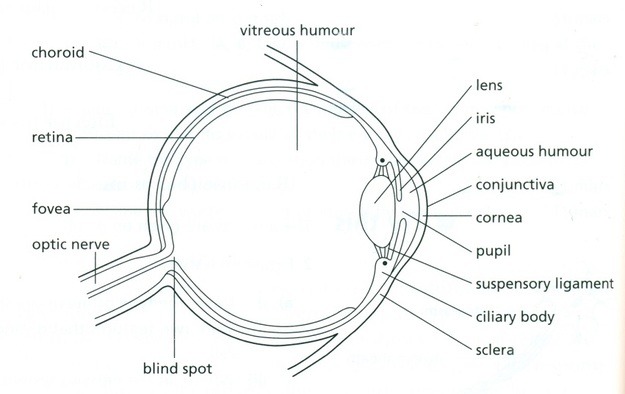
Rods (that work well in low light) and cones (that respond to colour) in the retina are photoreceptive cells which are able to detect visible light and convey this information to the brain. As these are sensitive to changes the eyes constantly move around to stimulate different light cells, even we we are staring constantly at a single point.
Having two eyes allows for binocular vision and depth
Typically the pair of eyes gives humans a 135º vertical and 200º horizontal field of view.
Only about 2º of this is actually high acuity
Iris controls the size of the pupil (hole) and the regulates the amount of light entering the eye.
Dark environments will take a few seconds to adjust to but actually increases over 30 minutes or more. Short bursts of white light will cause the eye to start adaptation to the dark again. If you need to use a torch at night, use a red light this has less impact on night vision.
Each eye has a bind spot due to the optic nerve entering the eye.
Eye colour (colour of the iris) is genetic, however, the relationship is complex with as many as 15 genes playing a part in the colour.
Although the eye contains a lens, most bending of light actually occurs as light enters the eye.
Ciliary muscles around the lens change the shape of the lens. This alters its focal length and thus control what is focussed on the retina.
Myopia
Also known as Near Sightedness or short-sightedness occurs when the image forms in front of the retina.
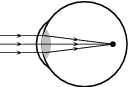
Close objects can be focussed, but far objects will appear blurry.
Corrected by placing a diverging lens in front of the eye.
Hyperopia
Also known as farsightedness or long-sightedness, occurs when the image forms behind the retina.
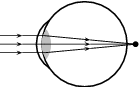
Far objects can be focussed, but close will appear blurry.
Corrected by placing a converging lens in front of the eye.
Our eyes see light, but the brain also processes the image and looks for patterns in the world. Thus we are prone to seeing things that are not there – such optical illusions
| << Back | Lenses |
| Links |
|---|
| https://en.wikipedia.org/wiki/Human_eye |
| https://www.color-blindness.com |
| Optical Illusions |