Velocity is speed in a specified direction. It is a vector quantity.
| Definition: Velocity |
|---|
| Velocity is the rate of change of displacement |
| OR |
| Velocity is the distance travelled per unit time in a specified direction |
In equation form:
v =  |
where:
v – velocity (or speed)
s – displacement (or distance)
t – time taken
Similar to speed, SI units will be the metres per second.
As velocity is a vector we need to include its direction. For most questions we will be assuming that the motion is one-dimensional (i.e. in a straight line) and we will use the sign of the vector (positive or negative) to indicate the direction. So positive numbers will mean an object is moving in one direction, whilst a negative number will mean that the object is moving in the opposite direction.
Referring to an object’s velocity usually means we are referring to its velocity at a particular point in time, the instantaneous velocity.
So a girl walks along a straight road on her way to school with a velocity of 4 km/h. on her way home walking along the same road her velocity would be −4 km/h.
If the velocity is changing we may instead be interested in the average velocity.
| Average Velocity |
|---|
| can be calculated by (total displacement ÷ total time) |
in equation form:
 |
| <v> = |
Velocity and Sign Convention
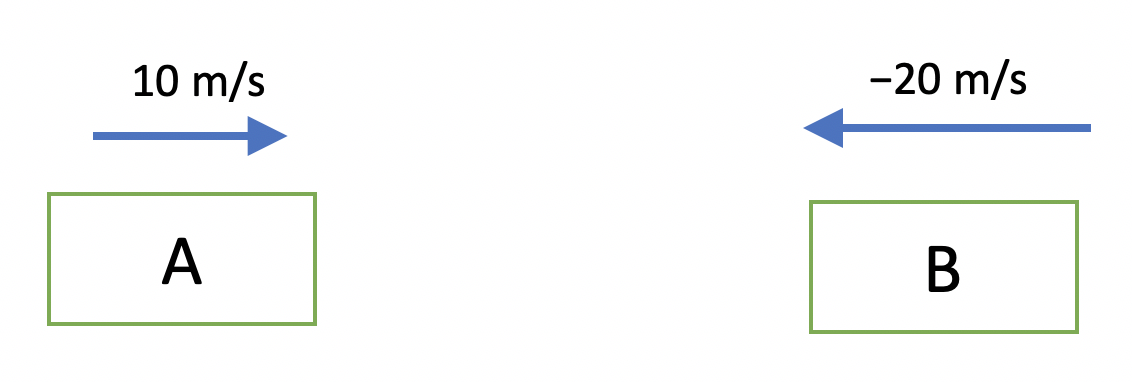
Consider two cars moving in opposite directions as shown here:
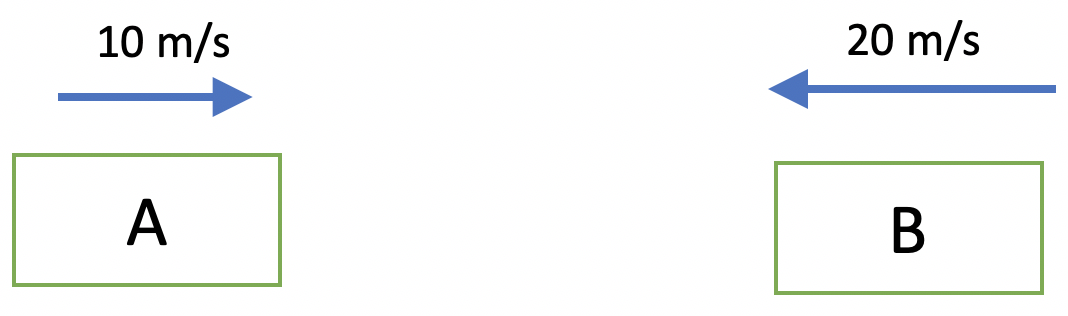
Some of the ways we could correctly identify their directions are:
1. We could say:
The velocity of A is 10 m/s to the right
The velocity of B is 20 m/s to the left
2. If we were told that “car A was heading North along a road”,
then we could say:
The velocity of A is 10 m/s to the North
The velocity of B is 20 m/s to the South
3. If compass directionshad been included in the diagram with the question such as this: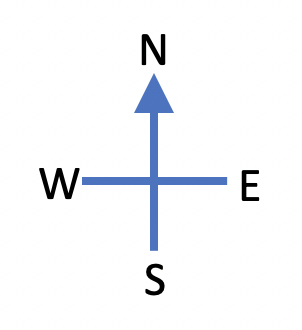
then we could say:
The velocity of A is 10 m/s to the East
The velocity of B is 20 m/s to the West
4. Or we could say:
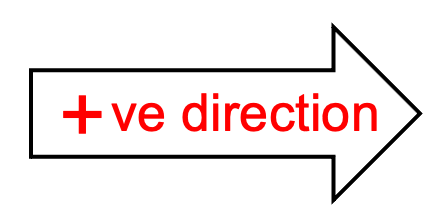
“Let the direction in which A is moving be the positive direction” then:
The velocity of A is +10 m/s
The velocity of B is –20 m/s
5. Or we could say:
“Let the direction in which B is moving be the positive direction” then:
The velocity of A is –10 m/s
The velocity of B is +20 m/s
On a diagram, instead of arrows, we could indicate the direction via sign convention
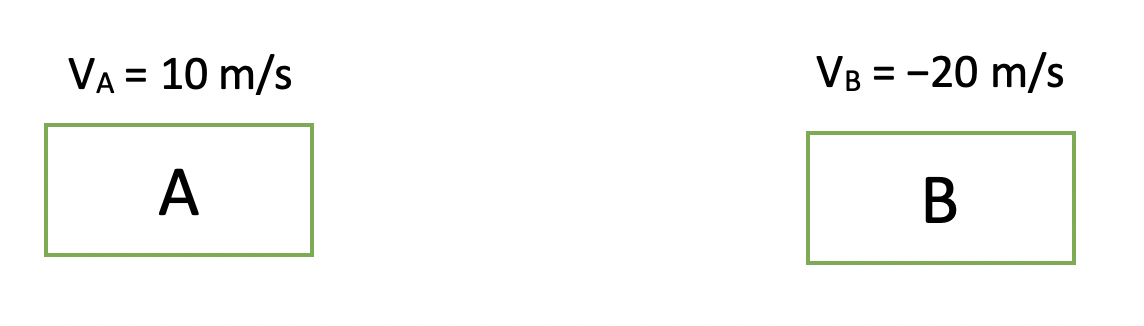
Although we would also need to have indicated the sign convention somewhere in words on on the diagram, like so:
| Caution |
|---|
| However, the following is not acceptable
Either use arrows together with speeds OR sign convention and no arrows. In this example it is unclear if B is actually moving to the left or to the right! |
| << Back | Kinematics | Next >> |