Scalars
| Definition: Scalar Quantities |
|---|
| A scalar quantity is a physical quantity that has only magnitude. |
Examples of scalars: distance, mass, time, temperature.
Adding scalars follows simple algebraic addition.
| Example: Adding Scalars |
|---|
| A person has 2 kg of sugar. You give them 3 kg of sugar. How much sugar do they have now?
2 kg + 3 kg = 5 kg i.e the answer is found from simple arithmetic addition. |
Vectors
| Definition: Vector Quantities |
|---|
| A vector quantity is a physical quantity that has both magnitude and direction. |
Examples of vectors: displacement, velocity, acceleration, force (e.g weight, friction, air resistance, etc).
| Representing Vectors
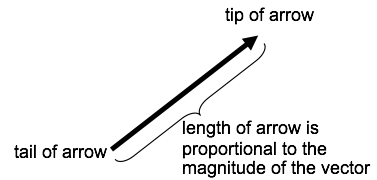
A vector can be represented by an arrow drawn with a specific direction, as shown in the following diagram.
|
Adding vectors follows vector addition and must take direction into account.
| Example: Adding Vectors |
|---|
| A person walks 3 km away from their home. They then walk another 2 km. How far could they be from their home?
If they had continued to walk in the same direction: 3 km + 2 km = 5 km They will be 5 km away from their home. If they turned around and walked back towards their home: 3 km − 2 km = 1 km They will be 1 km away from their home. So, depending on the directions, 3 km added to 2 km could be anywhere from 1 km to 5 km. We will look at this in more detail in the next chapter. |
Vector Addition: Triangle (Polygon) Method
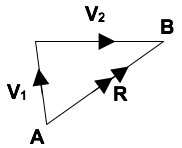
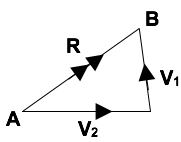
The order in which the vectors are added does not matter as can be seen in the diagram below – which gives the same resultant vector, R.
For a more detailed look at vector addition see: |
| Kinematics | Next >> |