Projectile Motion (Non-Linear Motion)
(Advanced Physics Topic)
- A projectile is an object that moves in two dimensions under the influence of gravity and nothing else.
- If air resistance is negligible, any projectile will follow the same type of path: a trajectory with the mathematical form of a parabola, of the form y = ax2 + bx + c, where a is negative.
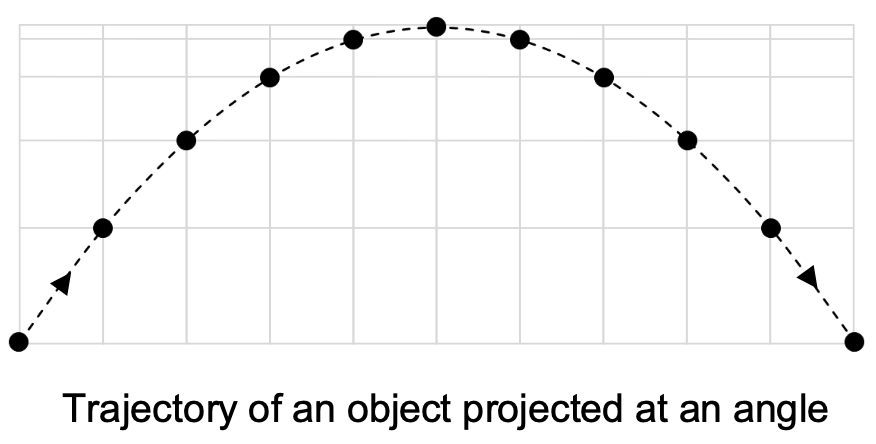
Examples of projectile motion: balls flying through the air, long jumpers, and cars doing stunt jumps.
To analyse the projectile motion near the Earth’s surface, we often apply the following three assumptions:
-
- the acceleration due to gravity, g, is constant (10 m s-2 pointing downwards) over the entire motion
- there is no horizontal acceleration
- the effect of air resistance is negligible
Two perpendicular components of projectile motion
Consider an object that is projected with an initial velocity u directed at an angle θ as shown below.
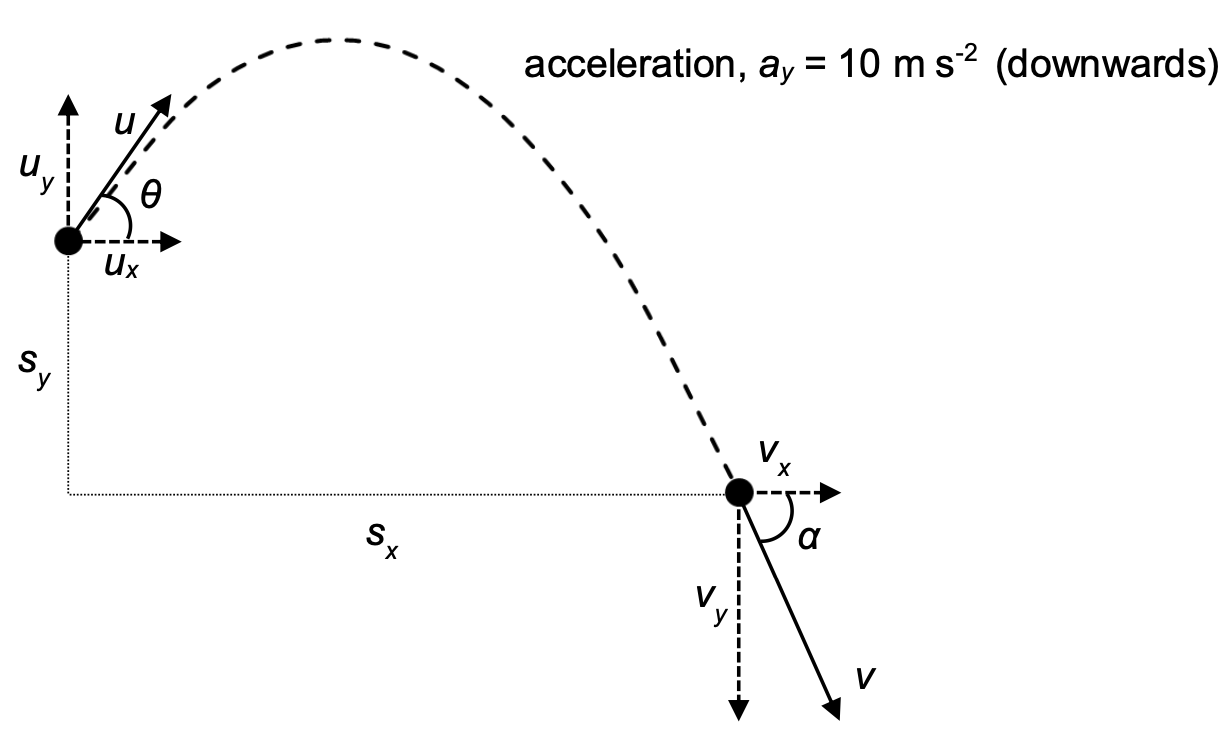
A projectile’s motion can be analysed as two perpendicular components.
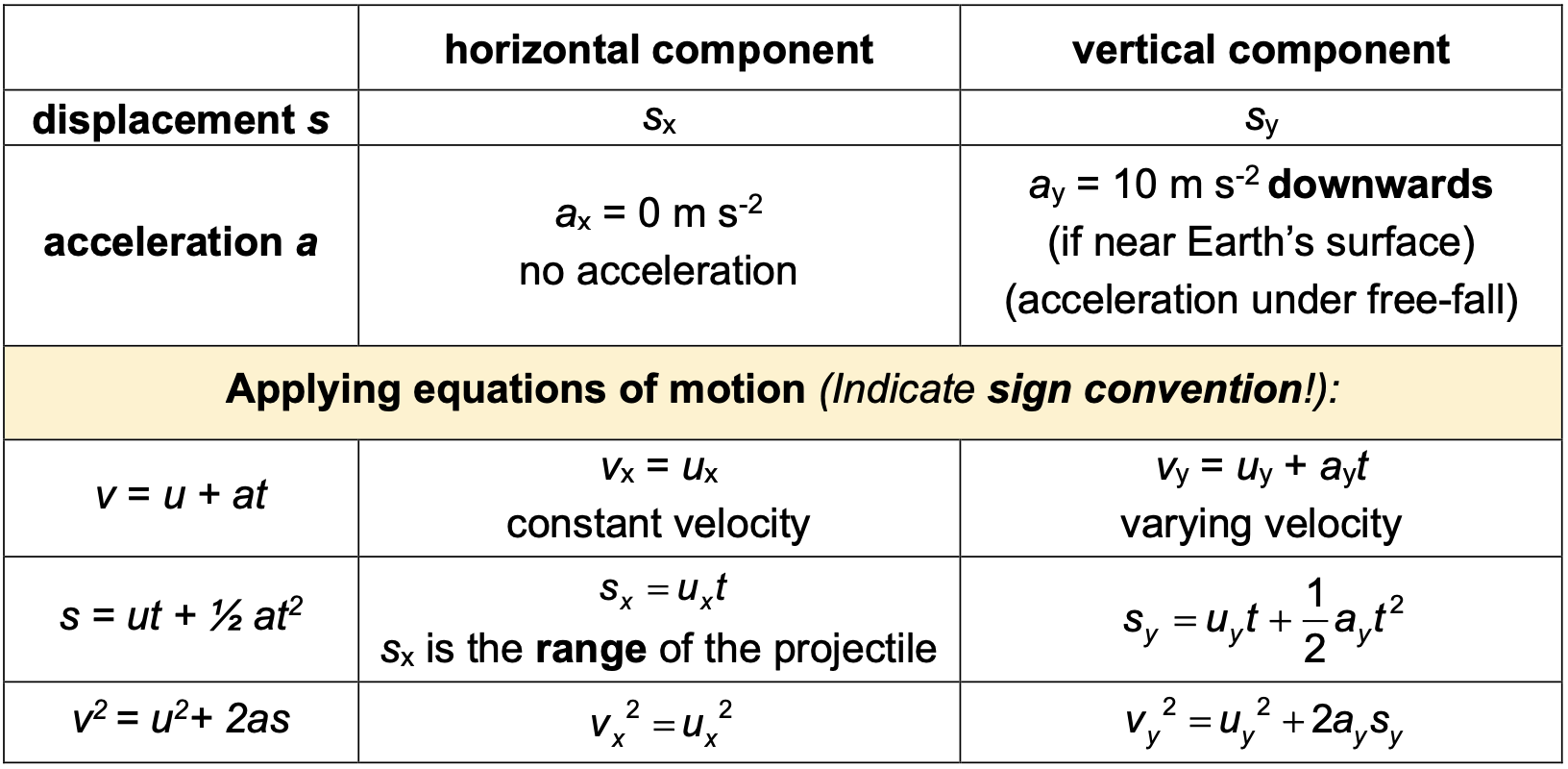
Problem solving approach
- Sketch a diagram to show the complete path of a projectile and indicate given and unknown variables.
- Analyse the motion in two perpendicular directions independently using suitable symbols with suitable subscripts, e.g. x and y.
- If the initial velocity is given, resolve it into its x and y components.
- Neglecting air resistance, any projectile experiences
- no horizontal acceleration (constant horizontal velocity).
- a vertical acceleration: choose sign convention, apply equations of motion to vertical motion
- If the instantaneous velocity (or direction) of the projectile is needed, add the two components of the velocity (vx and vy) using vector addition.
Additional tips:
- When an object is at its highest point of motion, the vertical component of its velocity, vy is always zero.
- If an object is projected horizontally with a speed u,
- the horizontal component of initial velocity ux is u,
- the vertical component of its initial velocity, uy is zero.
Launch angle
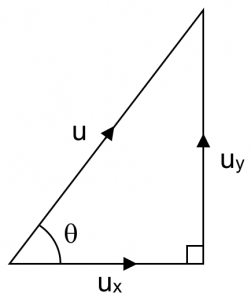
- A projectile is launched with an initial speed u at an angle θ to the horizontal, as shown below.
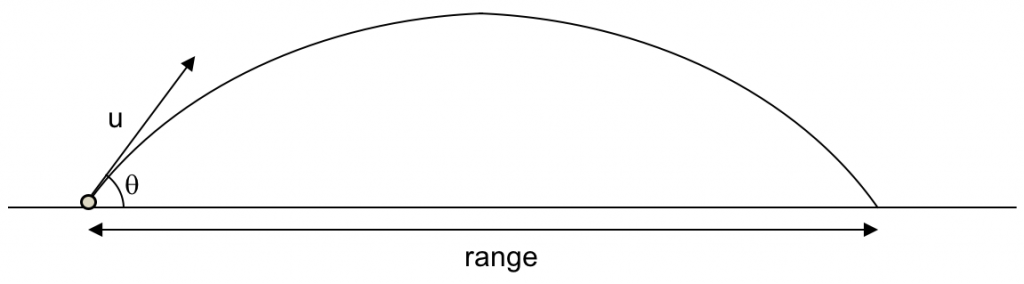
Consider the Initial Velocity, u
-
- the x-component of the initial velocity is ux = u cosθ
- the y-component of the initial velocity is uy = u sinθ
- u2 = ux2 + uy2
- tanθ = uy/uX (Ensure calculator in degree mode)
| Example |
|---|
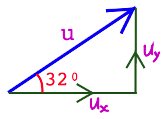
| A ball is thrown at an angle of 32° from the ground with a speed of 25 m s-1. Calculate the magnitude of the horizontal and vertical components of its initial velocity.
horizontal component: vertical component: |
Range
- Range is the horizontal distance travelled by a projectile.
range x = horizontal velocity × time
x = ux t
- It can be shown that the maximum range is obtained with a launch angle of 45°.
| Example 2 |
|---|
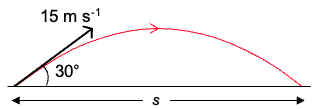
| A football is kicked on level ground at a velocity of 15 m s-1 at an angle of 30° to the horizontal.
(a) Determine the time taken by the football till its first bounce on the ground. sign convention: upward is positive, a = g = −10 m s-2 Vertical motion: sy = byt + ½ayt2 Since the ball returns to the same vertical level, sy = 0 m 0 = (15sin30°) t + ½ (−10)t2 t = 0 s (initial) or t = 2(15 sin30°)/10 = 1.5 s (b) Hence, calculate the range of the football. Horizontal motion: sx = ux t = (15 cos30°)(1.5) = 19 m (2 s.f.) |
Effect of air resistance on projectile motion
- reduce the maximum height
- reduce the maximum range
- make the angle of descent steeper
- distort the shape of the path away from a parabola.
Other Types of Non-Linear Motion
Although we have been considering projectiles here (2D motion in the presence of gravity), the same concepts can be applied to other situations such as electrons moving through an electrostatic field.
Charged particles in uniform electric field
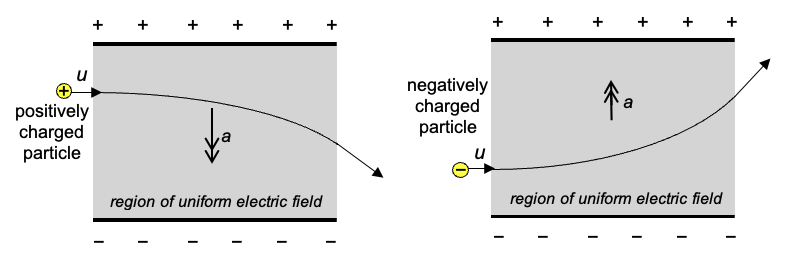
- Two parallel plates can be setup using an e.m.f. source to become charged with opposite charges. This creates a region of uniform electric field.
- A charged particle will experience a constant acceleration in this region of uniform electric field.
- Hence, if the charged particle enters the electric field with a velocity u at right angles to the direction of the acceleration, the particle will follow a parabolic path.
| << Back | Kinematics |