| Definition: The Four Equations of Motion |
|---|
|
v = u + at s = ut + ½ at2 v2 = u2 + 2as s = ½(u + v)t where: s : displacement (m) |
As the average velocity, <v>=½(u + v), we could write this last equation as s=<v>t
Notice that these equations all contain only four of the five SUVAT quantities. To determine Which equation we need, simply note down which values we have been given and which we need to find.
Note: These equations are only applicable for motion with uniform acceleration.
| Mathematical derivation of the equations (You do not need to know or memorise this) |
| Worked Example 1 |
|---|
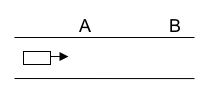
| A car speeds up from rest on a straight road. When the car passes by point A, its velocity is 10 m s-1. When the car passes point B, its velocity increases to 30 m s-1. The car takes 5.0 seconds to travel from point A to point B. Calculate the distance travelled by the car in the 5.0 seconds. 1. Sketch a diagram:
2. List all variables: Note: We are looking at the motion from A to B, thus the initial velocity was not taken to be at rest. Putting down the unknown helps to identify which of the equations of motion we should use. 3. Write down equation: 4. Substitute in values and solve: s = 100 m |
| Worked Example 2 |
|---|
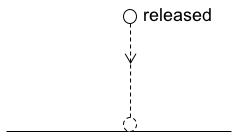
| A ball is released from a height above the ground. The ball hits the ground 4.0 s after being released. Calculate the height it was released from.
1. Sketch a diagram:
2. List all variables: 3. Write down equation: 4. Substitute in values and solve: s = 80 m |
| Worked Example 3 |
|---|
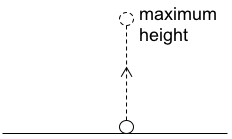
| A ball is thrown upwards with a velocity of 40 m s-1. Calculate the maximum height attainable by the ball, assuming that g is 10 m s-2.
|
| Worked Example 4 |
|---|
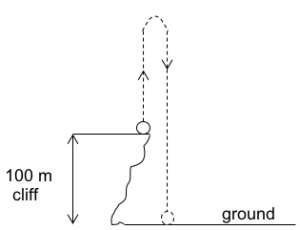
| A ball is thrown upwards with a velocity of 40 m s-1 at the top of a 100 m high cliff. Determine (a) the time the ball takes to reach the ground, and
(b) the velocity at which it hits the ground. |
| << Back | Kinematics | Next >> |