This page covers both distance-time graphs and displacement-time graphs. Either of which can be referred to as an s-t graph.
Assume all s-t graphs are displacement-time graphs unless told otherwise.
| Information Obtainable from a Displacement−Time (s−t) Graph |
|---|
| The gradient of the displacement-time graph is equal to the velocity of the object. |
| Differences between distance-time graphs and displacement-time graphs |
|---|
| The gradient of a distance-time graph gives speed (not velocity).
Distance can never be negative. Distance can only get larger, never decrease. Thus there will never be a negative gradient on a distance-time graph. |
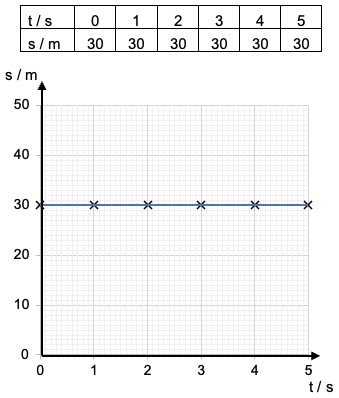
| Situation 1 – Object At Rest
The s-t graph has zero gradient. The body is at rest (zero velocity). The body remains at rest at some distance (30 m) away from the origin. Displacement is constant throughout this example. The object is not moving. Velocity is zero throughout this example. |
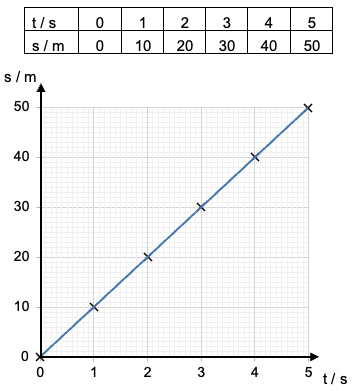
| Situation 2 – Object Moving With Constant Velocity
The s-t graph has a constant gradient. The body moves with a constant (uniform) velocity. The body starts from rest at the origin and moves in a positive direction with a constant velocity. Displacement is positive throughout this example. Velocity is positive throughout this example. |
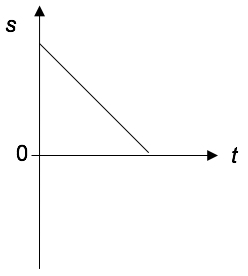
| Situation 3 – Object Moving With Constant (Negative) Velocity
The body starts at a positive displacement from the origin and moves in the negative direction with constant velocity ending at the origin. Displacement is positive throughout this example. Velocity is negative throughout this example. |
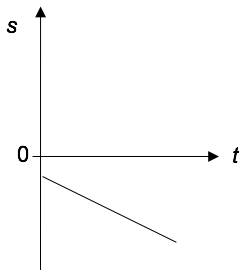
| Situation 4
The body starts at a negative displacement from the origin and moves in the negative direction with a constant velocity ending further away from the origin. Displacement is negative throughout this example. Velocity is negative throughout this example. |
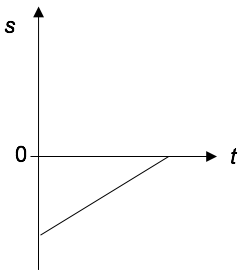
| Situation 5
The body starts at a negative displacement from the origin and moves in the positive direction with constant velocity ending at the origin. Displacement is negative throughout this example. Velocity is positive throughout this example. |
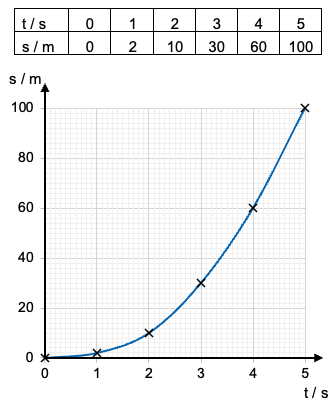
| Situation 6 – Increasing Velocity (Non-uniform Velocity)
The s-t graph has an increasing gradient. The body moves with an increasing velocity. The body starts from rest at the origin and moves in a positive direction with an increasing velocity. Displacement is positive throughout this example. Velocity is positive throughout this example. Acceleration is positive throughout this example. |
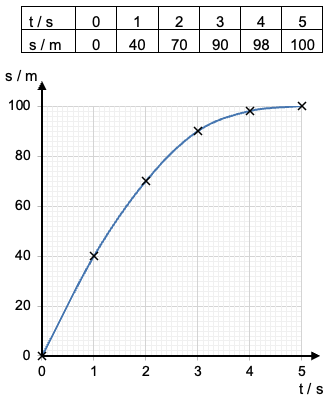
| Situation 7 – Decreasing Velocity (Non-uniform Velocity)
The s-t graph has an decreasing gradient. The body moves with an decreasing velocity. The body starts from rest at the origin and moves in a positive direction with a decreasing velocity. Displacement is positive throughout this example. Velocity is positive throughout this example. Acceleration is negative throughout this example. |
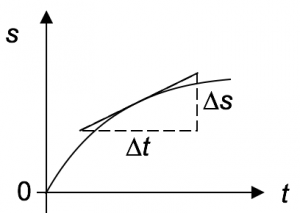
For an object moving in such a manner, we can find the instantaneous velocity from the gradient of the graph.
| Example 1 |
|---|
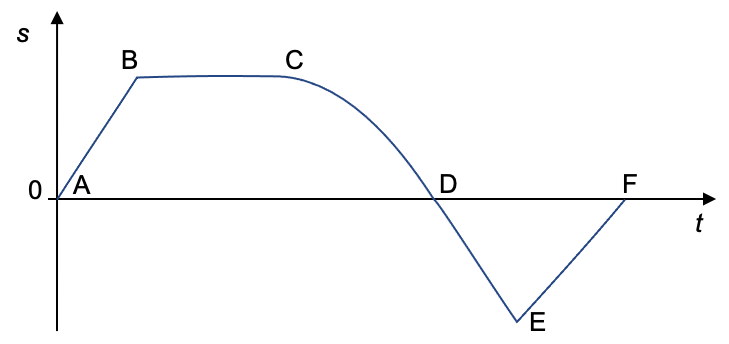
| Describe the motion of the object over its journey.
AB: Constant velocity (in the +ve direction) BC: At rest CD: Acceleration DE: Constant velocity (in the −ve direction) EF: Constant velocity (in the +ve direction) |
| Example 2 |
|---|
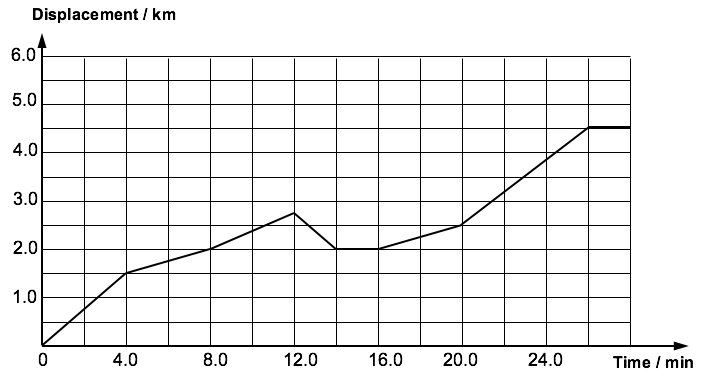
| The displacement-time graph of a cross-country runner in a race is shown below. Assume the path of the race track is a straight line.
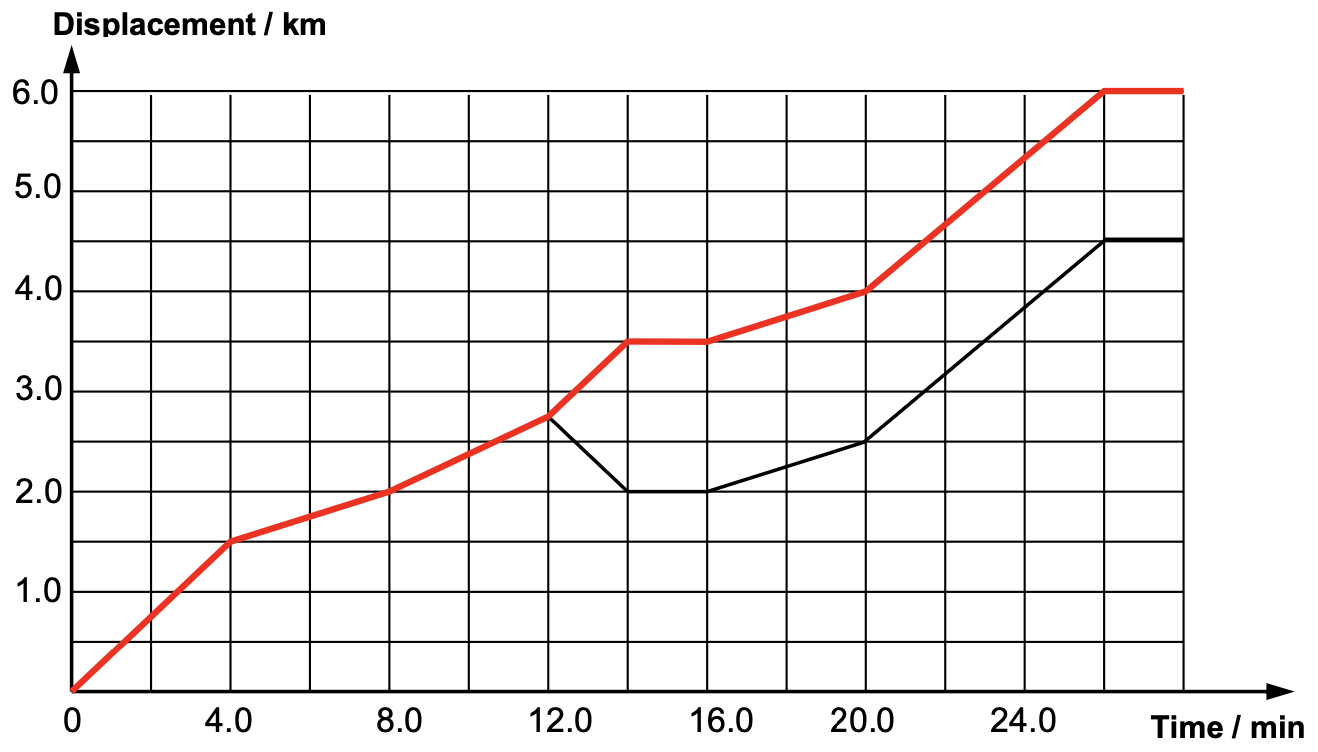
(a) What was the distance of this cross-country race? 4.5 km (b) How long did the runner take to complete the race? 26 minutes (c) What was her average velocity for the whole race in km/h? average velocity = 4.5 km / (26.0 ÷ 60) hr = 10 km/h (d) Mark the section LM where the runner had to backtrack because she dropped her watch. between 12 and 14 minutes (e) How long did the runner stop during the race? 2 minutes (from t=14 min to t=16 min) (f) Mark on the diagram XY, the section where she was running the fastest. Between t=0.0 min and t=4.0 min (the steepest part of the graph. (g) Draw on the same grid above a distance-time graph of the runner for the same race.
|
| << Back | Kinematics | Next >> |